About Urolophus gigas Scott, 1954
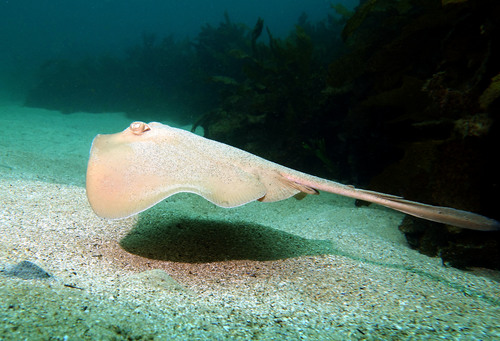
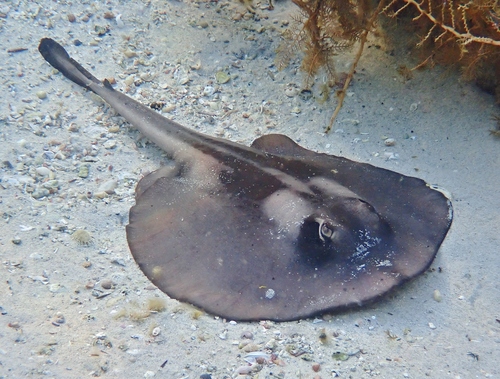
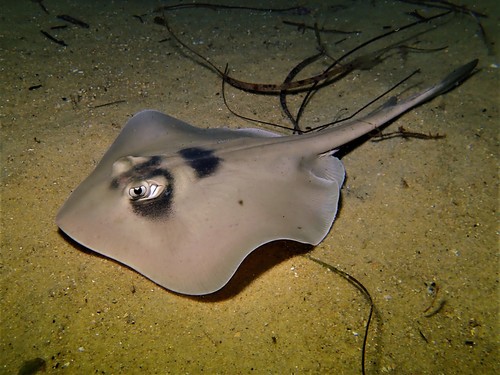
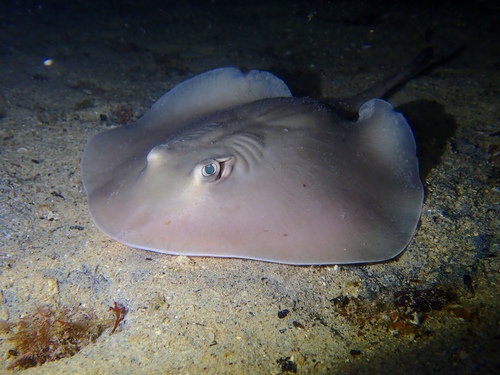
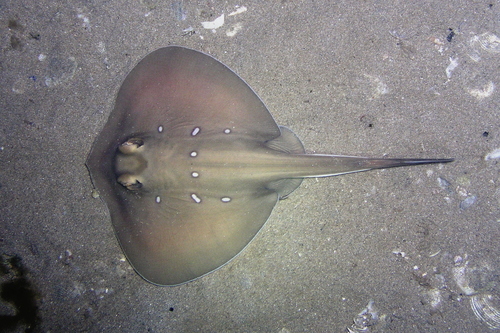
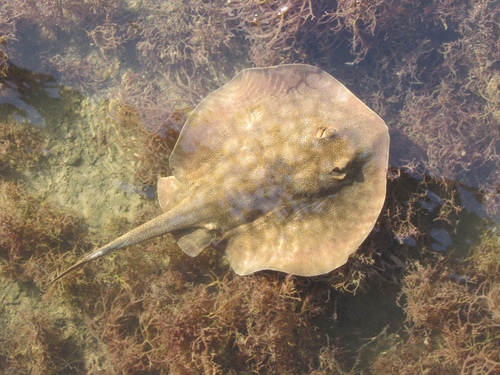
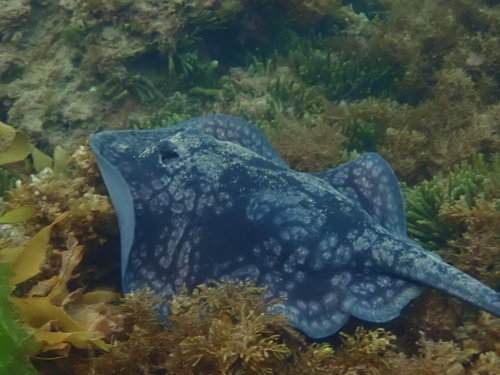
This is a description of the spotted stingaree, whose scientific name is Urolophus gigas Scott, 1954. The pectoral fin disc of the spotted stingaree is oval-shaped and slightly longer than it is wide; juvenile individuals have a more circular disc. Its snout is fleshy and usually smoothly rounded, with no protruding tip. The eyes are tiny, and are followed by much larger comma-shaped spiracles that have rounded posterior rims. Between the nostrils, there is a skirt-shaped curtain of skin with a finely fringed posterior margin. The floor of the small mouth holds 9 to 12 nipple-like structures called papillae, and an additional narrow patch of papillae is located on the lower jaw. The teeth are small, with roughly oval bases. The five pairs of gill slits are short, and the pelvic fins are small and rounded. The tail measures 76 to 80% as long as the disc, is fairly thick, has an oval cross-section, and has no lateral skin folds. A serrated stinging spine is positioned on top of the tail, and a prominent dorsal fin sits ahead of the spine; the caudal fin is lance-like, short, and deep. The skin is completely smooth. The upper surface of the disc is dark brown to black, lightening toward the margins, and sometimes has irregularly scattered dark dots. There are 2 to 3 rows of small whitish spots that border the disc margin and may extend onto the tail, plus much larger pale spots arranged in groups across the middle of the back. The areas before and behind the eyes, and a pair of patches at the back of the disc, are usually free of spots. Juveniles have a light stripe along the midline of the tail, and some adults have light spots on the tail; the dorsal and caudal fins are dark brown to black with whitish edges. The underside is white or nearly white; most individuals have dusky blotches and wide bands that border the lateral disc margins. In some spotted stingaree individuals, the color pattern is faint. This species can reach a maximum length of 80 cm (31 in). The spotted stingaree has a wide but patchy distribution along the southern coast of Australia, occurring from Albany, Western Australia to Lakes Entrance, Victoria. This range includes Bass Strait and the northern Tasmanian coast. The species does not appear to be common, and does not aggregate in any particular location. As a bottom-dwelling species, it inhabits the continental shelf from the intertidal zone down to a depth of 50 m (160 ft). It is most often found in and around seagrass beds and rocky reefs, and has also been recorded from estuaries. During the day, the spotted stingaree is often found buried in sand or hidden among seagrass or rocks. It feeds mainly on crustaceans. Like other stingrays, it is presumed to be aplacental viviparous, meaning developing embryos are nourished by maternal histotroph, also called "uterine milk". Females can produce litters of up to 13 pups. Males reach sexual maturity at approximately 42 cm (17 in) long, while females reach sexual maturity at approximately 46 cm (18 in) long.