About Urolophus cruciatus (Lacepède, 1804)
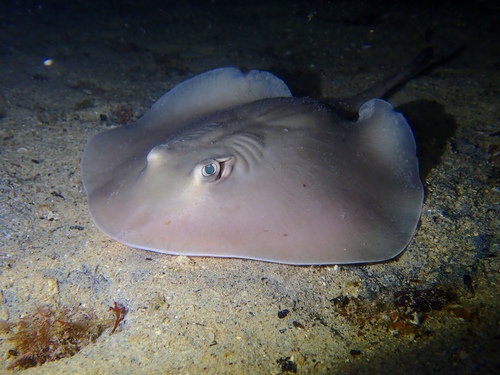
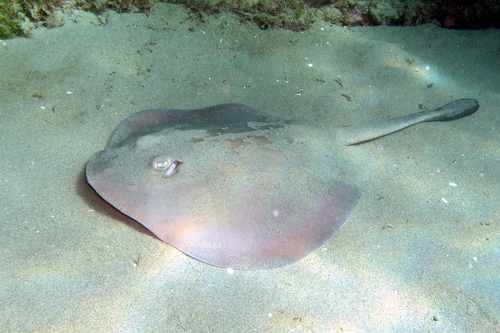
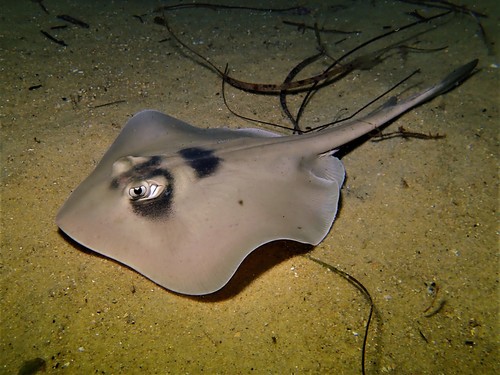
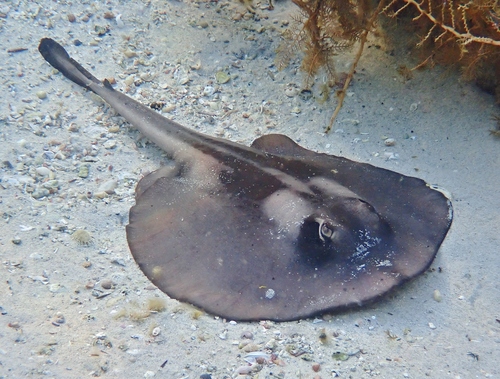
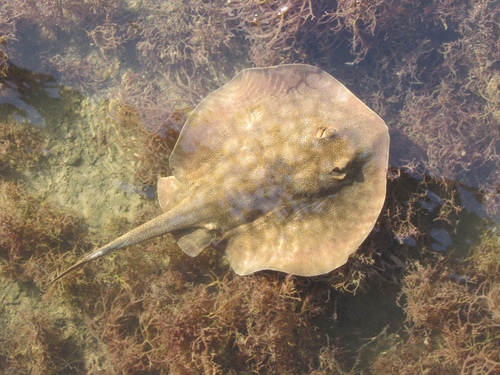
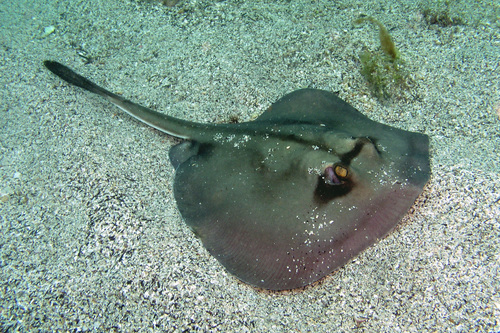
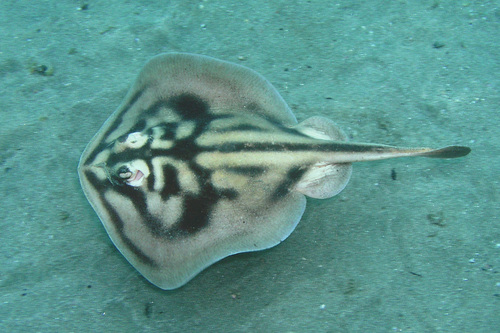
Urolophus cruciatus, commonly called the crossback stingaree, has an oval pectoral fin disc that is slightly wider than it is long. The anterior margins of the disc are nearly straight and meet at a very obtuse angle. Its snout is fleshy and blunt, and does not generally protrude from the disc. The eyes are small, and are immediately followed by teardrop-shaped spiracles with rounded to angular posterior rims. The outer rim of each nostril may form a small knob at the back. A skirt-shaped curtain of skin with a deeply fringed posterior margin sits between the nostrils. The small mouth is strongly arched; it holds 3–6 nipple-like papillae on its floor, and an additional patch of papillae is found on the outside of the lower jaw. Both upper and lower teeth are small with roughly oval bases, arranged in a quincunx pattern. The five pairs of gill slits are short, and the small pelvic fins have rounded margins. The rather short tail is 63–84% of the disc length, flattened oval in cross-section, and lacks lateral skin folds. A single serrated stinging spine is positioned on the upper surface of the tail about halfway along its length. Newborns have a small dorsal fin just in front of the sting, but this fin is lost with age, though a small ridge or scar may remain. A very short, deep, leaf-shaped caudal fin sits at the tip of the tail. The entire skin lacks dermal denticles. The upper body of the crossback stingaree is grayish to yellowish brown, with a pattern of dark markings: a dark stripe along the midline crossed by three transverse bars, one near the eyes, one over the gill region, and one over the center of the disc. This pattern is most distinct in individuals from the southern portion of the species' range. A small number of dark brown or fully black individuals have been recorded. The underside is off-white, and sometimes darkens slightly at the disc margin. The caudal fin is grayer than the body, and the tail may bear dusky blotches. This species reaches a maximum known total length of 50 cm (20 in), and females generally grow larger than males. The crossback stingaree is distributed mainly across the coastal waters of Victoria and Tasmania, Australia, where it is quite abundant. Its range extends east as far as Jervis Bay in New South Wales, and west as far as Beachport in South Australia. This bottom-dwelling species occurs from the intertidal zone down to a depth of 210 m (690 ft) on the upper continental slope. The Victorian subpopulation prefers sandy flats and rocky reefs, and is seldom found in water less than 25 m (82 ft) deep, occurring most commonly at depths greater than 100 m (330 ft). By contrast, the Tasmanian subpopulation is usually found over muddy bottoms in very shallow bays and large estuaries, and occasionally enters brackish water. Generally nocturnal, the crossback stingaree spends most of the day lying motionless on the sea floor, partially or fully buried in sediment. It is known to form groups of varying sizes, and sometimes mixes with other stingaree species. This ray is a generalist predator that forages for small organisms on or buried in the sea floor. Off Victoria, over three-quarters of its prey are crustaceans: isopods, particularly Natalolana woodjonesi and N. wowine, make up the majority of these crustaceans, with amphipods and decapods making up the rest. Polychaete worms are also eaten in significant quantities, while priapulids and the burrowing squid Euprymna tasmanica are consumed infrequently. Young rays under 30 cm across feed mainly on smaller isopods, amphipods, and shrimps; as they age, they progressively add a greater diversity of larger prey, such as penaeid prawns, priapulids, and polychaetes, to their diet. The broadnose sevengill shark Notorynchus cepedianus is known to prey on the crossback stingaree. When threatened, this ray raises its tail in a scorpion-like warning position above its body. Documented parasites of this species include a tapeworm from the genus Acanthobothrium, and the monogenean Calicotyle urolophi. Like other stingrays, the crossback stingaree is aplacental viviparous. Once developing embryos use up their yolk supply, the mother provides them with nutrient-rich histotroph, also called uterine milk, through specialized extensions of the uterine epithelium called trophonemata. Females produce litters of 1 to 4 pups every other year. Embryonic development completes rapidly over a six-month period, though the total gestation period may be much longer if eggs enter a dormant period after fertilization, as has been recorded in other stingaree species. Off Tasmania, large estuaries including the mouth of the River Derwent act as nursery areas for the species. Different authors have recorded birth length ranging between 10 and 15 cm (3.9 and 5.9 in), and maturation length ranging between 20 and 32 cm (7.9 and 12.6 in); females usually mature at a slightly larger size than males. This variation in reported sizes may reflect differences in life history across different parts of the species' range. Both sexes mature around six years of age, and can live to at least 11 years. The crossback stingaree may naturally hybridize with the closely related yellowback stingaree off southern New South Wales, where the two species' distributions overlap. Apparent hybrid offspring with intermediate colour patterns have been found in this area. If confirmed, this would be one of the few known cases of hybridization among cartilaginous fishes.