About Urogymnus granulatus (Macleay, 1883)
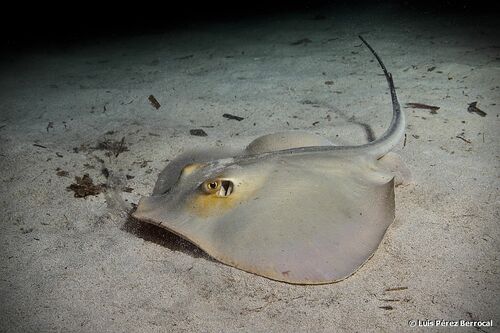
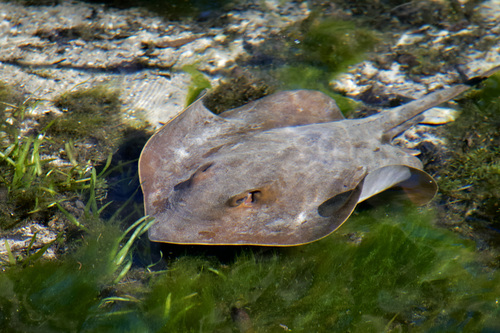
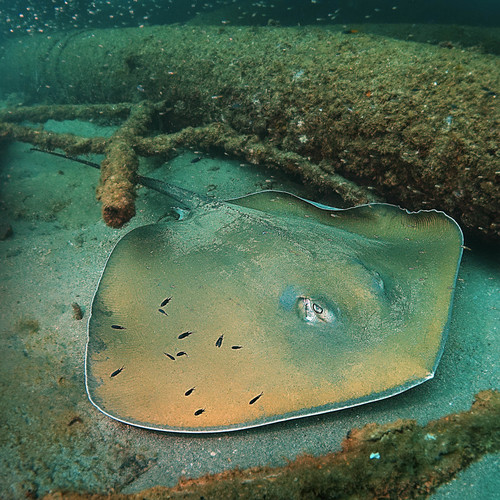
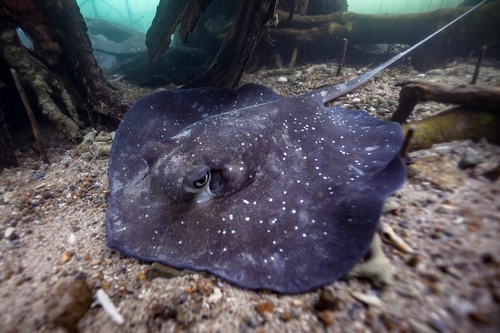
Urogymnus granulatus, commonly called the mangrove whipray, has a very thick, oval-shaped pectoral fin disc that is 0.9–1.0 times as wide as it is long. The anterior margins of the disc are nearly straight and converge at a broad angle at the snout tip. Medium-sized, widely spaced eyes sit immediately before the spiracles. Between the long, thin nostrils is a short, broad curtain of skin with a finely fringed posterior margin. The lower jaw is bow-shaped, and 0–5 papillae extend across the floor of the mouth. Teeth are arranged in a quincunx pattern, with 40–50 rows in the upper jaw and 38–50 rows in the lower jaw. There are five pairs of gill slits beneath the disc, and the pelvic fins are small and narrow. The tail is thick at its base and measures 1.5–2 times longer than the disc width. One or two dorsally located serrated stinging spines are found in the first third of the tail; beyond the sting, the tail thins into a whip-like shape with no fin folds. The upper surface of the body and tail are roughened by tiny dermal denticles, which grow larger toward the midline of the back and tail. One or two irregular rows of thorns run along the dorsal midline from the head to the sting. The mangrove whipray is dark brown to gray on its upper surface, marked with many white dots and flecks that grow denser as the ray increases in size. This dark coloration comes from a layer of mucus; without the mucus, the body is light orange-gray. The underside is white, with small dark spots toward the margin of the disc. Past the sting, the tail abruptly turns white. This species grows to 1.4 m (4.6 ft) across the disc and over 3.5 m (11 ft) in total length. Though uncommon, the mangrove whipray is widely distributed across the Indo-Pacific. It has been recorded from the Red Sea, South Asia including the Maldives and the Andaman Islands, the Gulf of Thailand, the Malay Archipelago (except Sumatra), New Guinea, northern Australia, and multiple islands including Guam, Fiji, the Solomon Islands, and Micronesia. This bottom-dwelling species typically lives in shallow water near shore, though adults have also been recorded offshore at depths of at least 85 m (279 ft). Juvenile rays frequent brackish habitats such as mangroves and estuaries, while adults prefer areas of sand, sand and rock rubble, or hard bottom, and are often found in lagoons or on coral reefs. Unlike many of its relatives, the mangrove whipray is reportedly solitary. It is relatively inactive during the day, often resting half-buried in sand or on top of coral heads, and actively forages for food at night. Its electroreceptive ampullae of Lorenzini have a sensitivity of 4 nV/cm and an effective range of 25 cm (10 in), allowing it to locate buried prey. Juveniles feed mainly on small crustaceans such as prawns and crabs. Adults prey on small benthic bony fishes including rabbitfishes, gobies, blennies, wrasses, and damselfishes, as well as invertebrates including peanut worms, crabs, octopuses, and bivalves. Like all stingrays, the mangrove whipray is aplacental viviparous; developing embryos are sustained by nutrient-rich histotroph, also called "uterine milk", produced by the mother. Newborn mangrove whiprays measure 14–28 cm (5.5–11.0 in) across the disc, and males reach sexual maturity when the disc is 55–65 cm (22–26 in) across. Known parasites of this species include the tapeworm Rhinebothrium himanturi, and another undescribed species within the same genus.