About Urogymnus asperrimus (Bloch & Schneider, 1801)
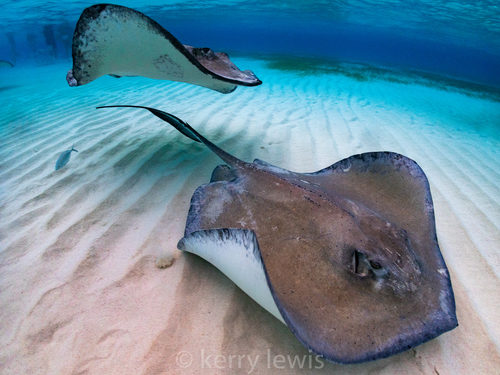
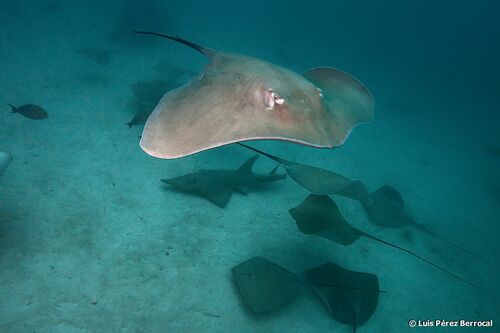
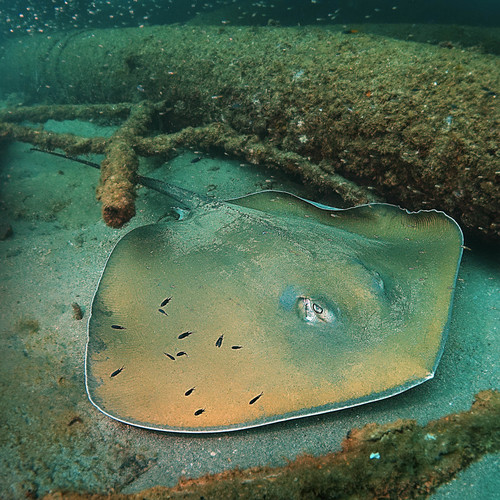
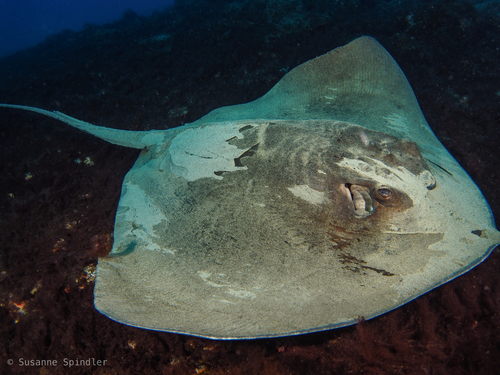
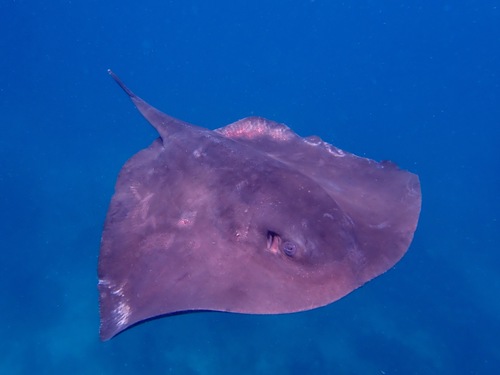
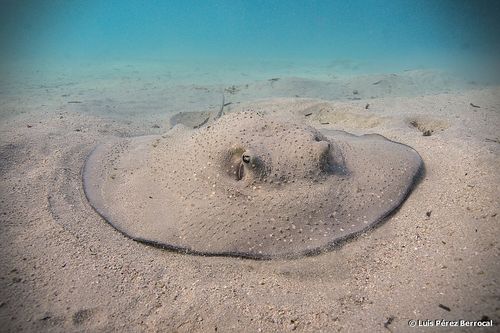
Urogymnus asperrimus, commonly known as the porcupine ray, has an evenly oval pectoral fin disc that is almost as wide as it is long. The disc is very thick at its center, creating a domed appearance. The snout tip is rounded and barely protruding. Its small eyes are positioned immediately before much larger spiracles. Between the narrow nostrils sits a skirt-shaped curtain of skin; the posterior edge of this curtain is heavily fringed and overhangs the ray's mouth. The floor of the mouth holds three to five papillae, with prominent furrows at the mouth corners. The area around the mouth, including the skin curtain, is heavily covered in additional papillae. Each jaw contains around 48 tooth rows, and the teeth themselves are small and flattened. Five pairs of gill slits are located on the underside of the disc. The pelvic fins are small and narrow. The thin, rapidly tapering tail is roughly the same length as the disc, has an almost cylindrical cross-section, and lacks fin folds. Unlike other members of its family, the porcupine ray also has no venomous stinging spine on its tail. A dense patch of flattened, heart-shaped dermal denticles covers the center of the disc and extends onto the tail. Larger individuals also have numerous tall, sharp thorns across the entire upper surface of the disc. The upper side of the porcupine ray is solid light to dark gray or brown, darkening to blackish toward the tail tip, while its underside is white. This is a large species that grows to at least 1.2 m (3.9 ft) across the disc and 2.2 m (7.2 ft) in total length, and may reach 1.5 m (4.9 ft) across. The porcupine ray has a wide distribution, but it is uncommon compared to other stingrays that share its range. It occurs along the entire continental edge of the Indian Ocean, ranging from South Africa to the Arabian Peninsula, Southeast Asia, and Ningaloo Reef off western Australia, including the locations of Madagascar, the Seychelles, and Sri Lanka. It has also entered the eastern Mediterranean Sea through the Suez Canal. In the Pacific Ocean, its range extends through Indonesia and New Guinea, north to the Philippines, east to the Gilbert Islands and Fiji, and south to Heron Island off eastern Australia. This species is also found in the eastern Atlantic Ocean off the coasts of Senegal, Guinea, and Côte d'Ivoire. The porcupine ray is a bottom-dwelling species that lives close to shore at depths between 1 and 30 m (3 to 100 ft). It inhabits sandy flats, coral rubble, and seagrass beds, often in areas near reefs, and can also enter brackish water. Porcupine rays can sometimes be found resting motionless on the seabed, either in open areas or inside caves. They are known to gather in groups at Ningaloo Reef. Their diet consists mainly of sipunculids, polychaete worms, crustaceans, and bony fishes. When feeding, the ray plows deep into the seabed, expelling excess sediment from its spiracles in a plume that is visible from far away. Documented parasites of the porcupine ray include the tapeworm Rhinebothrium devaneyi, the nematode Echinocephalus overstreeti, and the capsalid monogeneans Dendromonocotyle urogymni and Neoentobdella baggioi. The porcupine ray reproduces via aplacental viviparity; developing embryos are sustained until birth by histotroph, also known as "uterine milk", secreted by the mother. Mangrove forests are an important habitat for juvenile porcupine rays. Males reach sexual maturity at around 90 cm (35 in) across the disc, while females reach sexual maturity at around 100 cm (39 in) across.