About Urodynamis taitensis (Sparrman, 1787)
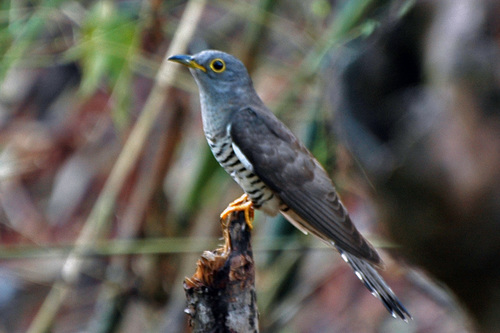
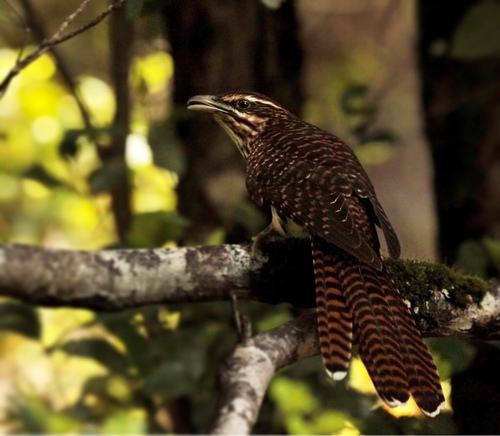
Urodynamis taitensis, commonly known as the long-tailed koel, is approximately 40–42 cm in length, with a wingspan of approximately 47–52 cm, and weighs about 120 grams. It has broad pointed wings, a long tail that is softly rounded at the tip, and a short stout beak with a slightly hooked tip. It has brown upperparts marked with brown barring, and white underparts marked with dark streaking. Both males and females share similar physical features. Juvenile long-tailed koels differ markedly from adults: they are spotted, with buff coloration on their underside, and the sides of their head and neck. For adult long-tailed koels, the top of the head and hindneck are dark brown, with bold buff streaking. The supercilium is white, bordered below by a bold dark-brown eye stripe that continues down the sides of the neck. The cheeks, chin, throat, and foreneck are white, with thin brown stripes, and fine black streaking near the neck and throat. The remainder of the upperparts are brown, with white spotting on the wings. The tail is tipped white. The underbody is white with coarse black-brown streaking. The legs and feet are gray to green. The long-tailed koel produces a loud, intense sound described as a "shrill whistle", and it is sometimes called the "screamer". This species is endemic to New Zealand, where it can be found on Little Barrier Island, the West Coast of the South Island, Nelson, and throughout the central North Island. The long-tailed koel prefers forest habitat on the mainland and near shore or offshore islands, from sea level up into mountainous areas; it occurs more often on vegetated ridges than in valleys. It is usually found in the dense, closed canopy of native forests dominated by beech (Nothofagus), broadleaf species, podocarps, or mixtures of these, with or without a shrub layer. Its habitat is usually surrounded by Pinus pine plantations. It can also be found around other vegetation such as mānuka (Lepotospermum scoparium) near rivers, within forests, or in mountainous areas. Occasionally, it can be found in recreational parks, residential areas, and gardens. In New Zealand, long-tailed koels live mainly in native forest, particularly in the canopy. They also inhabit exotic pine plantations, scrub, cultivated land, and suburban gardens. In Pacific islands, they live in lowland forest, gardens, and coconut plantations. Individuals are usually solitary. The long-tailed koel only breeds in New Zealand, where it is resident during the warmer months, from early October until February or March, sometimes April, and occasionally later. The average one-way journey from New Zealand to Polynesia is around 2500–3500 kilometres, so the total round trip distance traveled is over 6000 kilometers. For winter, the bird migrates to islands across the southern Pacific. It can be found year-round on the Kermadec Islands, the Norfolk Island group, and the Lord Howe Island group, which are subtropical islands located partway between the New Zealand mainland and the tropical Pacific Islands. The species' winter distribution is extraordinarily wide, stretching almost 11,000 km from Palau in the west to Pitcairn Island in the east. Over most of its winter range, it is known by the indigenous name kārewarewa, or local variations of this name. In spring, the bird's migration routes would almost certainly have served to guide the Polynesian ancestors of Māori to find New Zealand.