About Urocyon cinereoargenteus (Schreber, 1775)
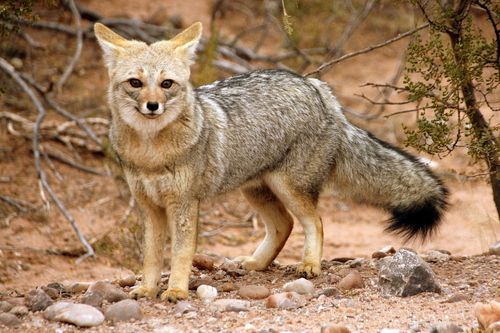
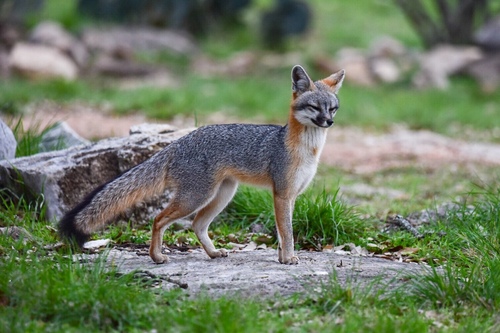
Description: The gray fox (Urocyon cinereoargenteus) is mainly distinguished from most other canids by its grizzled upper parts, strong neck, black stripe running down the middle of its tail, and a black-tipped tail. Its skull can be easily told apart from all other North American canids by its widely separated temporal ridges that form a U-shape. Like other canids, the gray fox has angular, pointed ears and muzzle. Its claws are typically longer and more curved than related canids. There is very little sexual dimorphism in this species, with only females being slightly smaller than males. Total body length ranges from 76 to 112.5 cm (29.9 to 44.3 in), with the tail making up 27.5 to 44.3 cm (10.8 to 17.4 in) of this total length. Hind feet measure 100 to 150 mm (3.9 to 5.9 in). The gray fox typically weighs 3.6 to 7 kg (7.9 to 15.4 lb), though exceptionally large individuals can reach up to 9 kg (20 lb). It is easily distinguished from the red fox by its complete lack of the prominent "black stockings" seen on red foxes. Individual guard hairs of the gray fox are banded with white, gray, and black. It has white fur on its ears, throat, chest, belly, and hind legs, and black markings around its eyes, on its lips, and on its nose. Unlike Vulpes genus species such as the red fox, the gray fox has oval pupils rather than slit-like pupils. It also has reddish coloration on parts of its body, including the legs, sides, feet, chest, and the back and sides of the head and neck. While gray foxes often have a similar weight to red foxes, they appear smaller because their fur is shorter and they have shorter limbs. The dental formula of Urocyon cinereoargenteus is 3.1.4.2 / 3.1.4.3 = 42 total teeth.
Distribution and habitat: This species occurs throughout most rocky, wooded, brushy regions across the southern half of North America, ranging from southern Canada (Manitoba through southeastern Quebec) to the northern part of South America (Venezuela and Colombia), and does not live in the mountains of the northwestern United States. It is the only canid whose natural range spans both North and South America. Habitat preferences vary by region: in the North American Midwest it prefers a mix of wooded and agricultural land; in the western United States it favors juniper forests and ponderosa pine stands; in eastern North America it prefers deciduous forests. In the southern portion of its range in Belize, it also prefers a mix of forest and agricultural land. In southeastern Mexico, it prefers areas near human activity such as roadsides. High population densities can occur in areas near brush-covered bluffs.
Reproduction: Like other foxes, the gray fox is assumed to be monogamous. Breeding season varies by geographic location: gray foxes mate in early March in Michigan, while breeding peaks in February in Alabama. Gestation lasts approximately 53 days. Litter size ranges from 1 to 7 kits, with an average of 3.8 young per female. Females reach sexual maturity at around 10 months of age. Kits begin hunting with their parents at 3 months old. By 4 months old, kits have developed their permanent dentition and can easily forage on their own. The family group stays together until autumn, when young males reach sexual maturity and disperse. In one study of 9 juvenile gray foxes, only males dispersed, moving up to 84 km (52 mi); juvenile females stayed within 3 km (1.9 mi) of the den and always returned. Adult gray foxes of both sexes do not disperse. The annual reproductive cycle of males has been studied via epididymal smears, which found males become fertile earlier and remain fertile longer than females. Suitable den sites include logs, trees, rocks, burrows, or abandoned human dwellings. Dens may be used any time of year, but are used most often during whelping season. Dens are built in brushy or wooded areas and are more thoroughly concealed than red fox dens. Gray foxes typically live between six and ten years.