About Urocolius macrourus (Linnaeus, 1766)
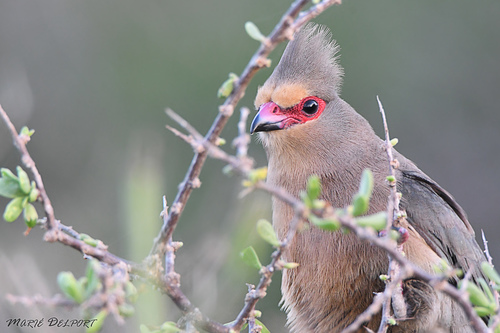
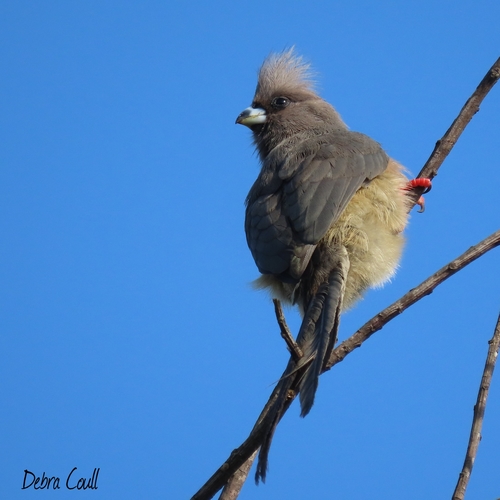
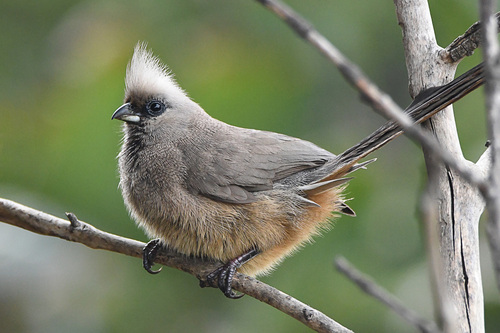
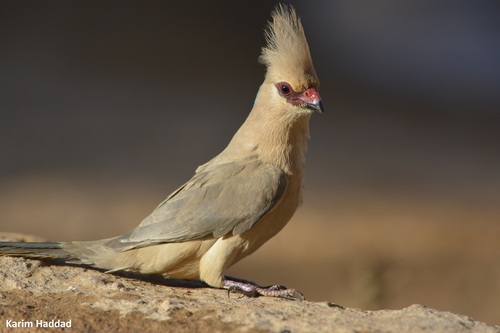
The blue-naped mousebird (Urocolius macrourus) is a fairly small to medium-sized bird. It measures 33–38 cm (13–15 in) in total length, which includes its elongated 20–28 cm (7.9–11.0 in) tail, and weighs 34–65 g (1.2–2.3 oz). Adult blue-naped mousebirds have ash grey plumage that is darker on the upper body and lighter on the underparts. They have a bright turquoise-blue patch covering the nape and hindneck, a long crest, and a slender, steeply graduated tail; females have shorter tails than males. Both sexes have brown-tinged ash-grey upperparts and greyish-buff underparts. They have crimson-red bare skin on the lores and around the eyes, most of the upper mandible is crimson-red with the rest of the bill black, and their feet are purplish red. Juveniles lack the blue nape patch, have pink facial skin, greenish bills, and shorter crests than adults. Like other mousebirds, blue-naped mousebirds have large, widely spaced pamprodactylous feet for their body size. They can rotate all four toes to face forward at will. Their strong, dextrous toes let them climb and scurry along branches, hang by a single toenail, and hold food with one foot. In the wild, blue-naped mousebirds inhabit semi-desert and dry regions of Africa. In East Africa, they occur in a band between 10°N and 20°N that stretches from the western coast east to Sudan, Djibouti, Eritrea, Ethiopia, and Somalia, and extends south of 10°N through East Africa to the borders of eastern Zaire. This species has an extremely large range, so it does not approach the thresholds for classification as Vulnerable under the range size criterion: a Vulnerable classification requires an Extent of Occurrence smaller than 20,000 km² (7,700 sq mi) combined with a declining or fluctuating range size, declining habitat extent or quality, declining population size, a small number of locations, or severe range fragmentation, which does not apply to this species.