About Urocolius indicus (Latham, 1790)
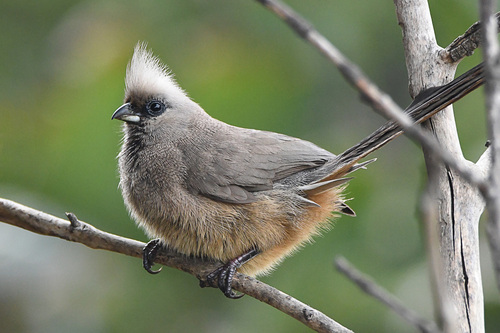
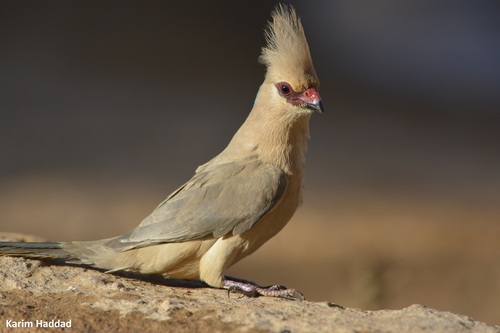
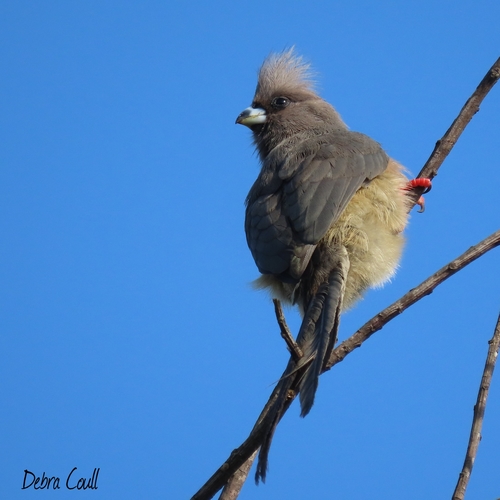
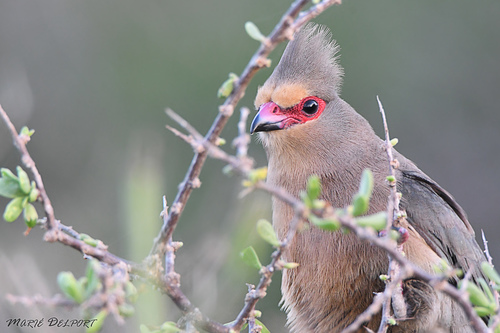
The red-faced mousebird, scientifically named Urocolius indicus (Latham, 1790), is a species of mousebird, also called coly. It is common across southern Africa, ranging from the Democratic Republic of the Congo (formerly Zaire), Zambia, and Tanzania southward to the Cape. Its preferred habitats include savanna with thickets, fynbos scrub, other open woodland, gardens, and orchards. There are five currently recognized subspecies, each with a distinct distribution: Urocolius indicus mossambicus is found from east Angola to southwest Tanzania and Malawi; Urocolius indicus lacteifrons occurs in western Angola, northern and central Namibia, and western Botswana; Urocolius indicus pallidus lives in southeast Tanzania and northeast Mozambique; Urocolius indicus transvaalensis ranges from central and eastern Botswana and southwest Zambia to Mozambique and South Africa; and Urocolius indicus indicus is native to south and central South Africa. This species measures around 34 cm (13 in) in total length, with its tail making up approximately half of this length. Adults have a crested head and pale cinnamon-colored breast, paired with a red bill and a red eye mask. The rest of the upperparts and the tail are blue-grey, with the exception of a paler grey rump, and the belly is whitish. Males and females have similar plumage. Juveniles lack the adult crest and have a green mask instead of the red eye mask. The call of the red-faced mousebird is a tree-ree-ree whistle, regularly produced in multiple repetitions, and this call is identical when the bird is in flight or perched. The red-faced mousebird is a frugivore that feeds on fruits, berries, leaves, seeds, and nectar. Its flight is typically fast, strong, and direct when traveling from one feeding area to another. Outside of the breeding season, this is a social bird that feeds together in small groups, usually around half a dozen individuals, though groups can sometimes reach 15 or more members. They fly and interact in tight gatherings, engage in mutual preening, and roost in groups at night. It is more wary than other mousebird species. These are sedentary birds that breed between June and February. They build large, untidy cup-shaped nests from plant material, lined with materials such as sheep wool. Clutches contain 2 to 6 creamy white eggs marked with reddish brown spots, and the eggs hatch after approximately two weeks of incubation.