About Urocitellus columbianus (Ord, 1815)
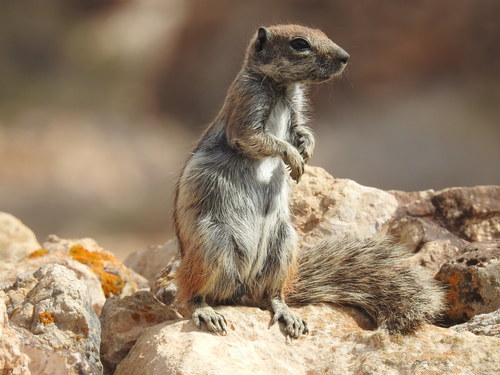
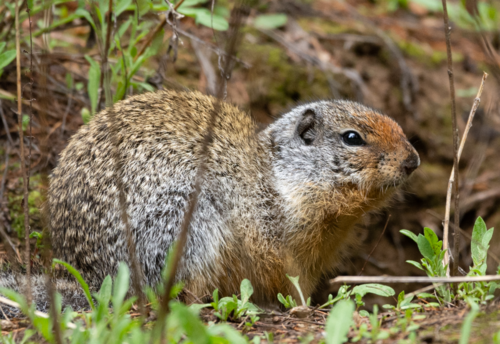
The Columbian ground squirrel (Urocitellus columbianus) is one of the largest species in its genus, with the Arctic ground squirrel being the only larger member. It has a relatively sturdy, robust build: overall body length ranges 325–410 mm (12.8–16.1 in), the tail measures 80–116 mm (3.1–4.6 in), hind feet measure 47–57 mm (1.9–2.2 in), and ears measure 16–22.5 mm (0.63–0.89 in). Its fur is dense and relatively short. Facial fur is bronze across the bridge of the nose; fur on the back, legs, and feet is a more cinnamon buff, with darker fur closer to the body. It has a pale beige to buff ring of fur around the eye, gray neck fur along the sides of the cheeks, and flanks that may be light beige or gray. Its tail is darker, with darker underfur, some lighter beige markings on the upper surface, and coloring from dark to grayish white on the lower surface. Molting occurs diffusely, with no clear line of delineation.
Two subspecies have been described, which differ in appearance. Compared to the nominate subspecies U. c. columbianus, U. c. ruficaudus has a more rufous, less gray upper tail, deeper rust shading on the sides of the face and throat, darker legs and feet, and a broader skull with more robust zygomatic arches. Several albino variants of the species have been recorded. In 1932, a student captured a living albino squirrel in an alfalfa field near Pullman, Washington; the animal had white fur and pink eyes, and a zoologist planned to keep it alive to study the genetic inheritance of the trait. The following year, the zoologist reported finding three more young albinos in the same area. Around 30 years before the 1932 capture, two albino skins had also been collected near Pullman. Researchers proposed that the recessive albino trait persists in this locality, appearing at sporadic intervals.
Columbian ground squirrels are found in western North America. Their range extends through the Rocky Mountains, from as far north as western Alberta and southeastern British Columbia, south through western Montana, central Idaho, and into the northern and eastern portions of Washington, including along eastern Washington's plains. In Oregon, they occur in mountainous areas of the state's east-central region, and occupy elevations between 700–8,000 feet (210–2,440 m). An assessment of the species' distribution in Oregon based on specimens from 71 localities found that over 98% of specimens came from the Blue Mountains ecoregion, which includes the Wallowa and Blue Mountain ranges, with the remaining specimens coming from the Owyhee Uplands.
The known fossil record of the Columbian ground squirrel consists of specimens recovered from the Wasden fossil site (Owl Cave) in Bonneville County, Idaho. Fossils from this site date to the late Pleistocene (Rancholabrean); the site sits at 1,584 metres (5,197 ft) elevation, and small mammal fossils there are primarily from owl predation.
Columbian ground squirrels live in colonies distributed discontinuously across their range. They inhabit alpine and subalpine areas, along meadow edges, or on mounds in areas that experience meadow flooding. They occur less frequently in rocky, fellfield, heather, or herbfield environments than in meadows and grasslands, and will readily occupy disturbed habitats such as clear-cuts. In areas where they overlap in range with Belding's ground squirrel, Columbian ground squirrels occupy higher elevation areas with wetter climates, while Belding's ground squirrel tends to occupy drier, sagebrush regions. In Oregon's Blue Mountains, where the species is primarily found, co-occurring characteristic mammal species include the montane shrew (Sorex monticolus), Belding's ground squirrel (Urocitellus beldingi), American red squirrel (Tamiasciurus hudsonicus), northern pocket gopher (Thomomys talpoides), southern red-backed vole (Myodes gapperi), and western jumping mouse (Zapus princeps).
Predation on other vertebrates by Columbian ground squirrels has not been formally described, but cannibalism has been observed, and adult females sometimes kill juveniles. It has been suggested that sympatric species including northern pocket gophers, deer mice (Peromyscus maniculatus), and meadow voles (Microtus pennsylvanicus) might use or raid the provisioned burrows of Columbian ground squirrels. Observations of possible killings of meadow voles by Columbian ground squirrels were published in 1985; these killings did not appear to be for predation, and may instead have been motivated by defense of home territory and resources.
Population densities of Columbian ground squirrels are reportedly higher in agricultural bottomlands than in wheatfields. In subalpine Idaho, density was recorded at 35 animals per hectare. In Alberta, juvenile density was estimated between 5–20 per hectare, while adult density was estimated at 12–16 per hectare.
Columbian ground squirrels are described as one of the most vegetarian of all ground squirrels. Early in the active season, they primarily eat succulent fresh vegetation; as vegetation becomes tougher, they shift to eating more grains and seeds. By the end of the season, individuals become very fat. Examination of stomach contents from 43 squirrels found vegetable matter in all specimens; 86% of stomachs contained only vegetation, 2% contained traces of other mammals, and 14% contained insect remains.
Columbian ground squirrels can be parasitized by the Rocky Mountain wood tick (Dermacentor andersoni), a vector for the bacteria that causes Rocky Mountain spotted fever. Other recorded external parasites include the lice Enderleinellus suturalis and Neohaemotopinus laeviusculus; the fleas Neopsylla inopina, Opisocrostis tuberculatus, and Oropsylla idahoensis; and the mites Dermacarus heptneri, Androlaelaps fahrenholz, Macrocheles sp., and Pygmephorus erlangensis. Recorded internal parasites include the trypanosome Trypanosoma otospermophili, and three Eimeria species: Eimeria bilamellata, Eimeria callospermophili, and Eimeria lateralis. Instances of Yersinia pestis, the bacterium that causes bubonic plague, have been reported in the species. Antibody screening analyses indicate they may act as a reservoir for Powassan virus or St Louis encephalitis virus. They can also develop dermatitis from infection by Dermatophilus congolensis. Treatment of females with flea powder was found to improve the condition of treated animals: treated females produced larger litters, and gained mass between the birth of young through weaning, while untreated females lost mass over this same period.
Known predators of the Columbian ground squirrel include grizzly bears (Ursus arctos horribilis), coyotes (Canis latrans), Pacific martens (Martes caurina), gray wolves (Canis lupus), American badgers (Taxidea taxus), weasels of the genera Mustela and Neogale, and mountain lions (Puma concolor). Predatory bird predators include golden eagles (Aquila chrysaetos), red-tailed hawks (Buteo jamaicensis), and northern goshawks (Accipiter gentilis).