About Urocitellus beldingi (Merriam, 1888)
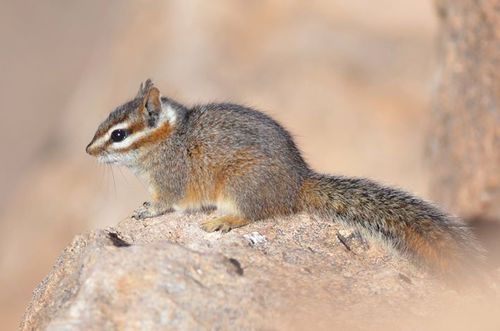
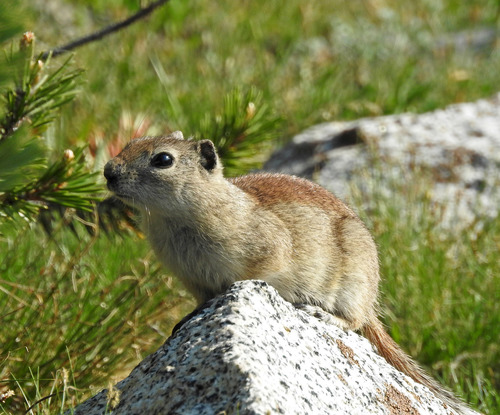
Belding's ground squirrel (scientific name Urocitellus beldingi (Meriam, 1888)) is a medium-sized ground squirrel. It has a relatively short tail, short limbs, and small ears. Its gray fur becomes more cinnamon-colored on the underside and reddish-brown on the back. Body length ranges from 230 to 300 millimetres (9.1–11.8 in), while the tail measures 44 to 76 millimetres (1.7–3.0 in). The tail is bushy and flattened, and the distal hairs of the tail have three distinct color bands: black, white, and red. On average, this species weighs 290 grams (0.64 lb). Its feet have little to no covering of hair, and its cheek pouches are moderate in size compared to other ground squirrel species.
This species is native to the northwestern United States, and its range covers northeastern Oregon, part of Washington, northern California, southwestern Idaho, northern and central Nevada, and northwestern Utah. Belding's ground squirrels are most abundant at higher altitudes, where they occur in alpine and subalpine meadows. They also inhabit sagebrush flats, brush/grass habitats and cultivated areas at lower elevations. They are largely restricted to open areas with enough fresh vegetation and water. They do not live in dense forests, tall grasses, rocky slopes or thick shrubbery, as these environments prevent them from watching for predators. They also do not prefer grass that is too short, as this prevents them from hiding from predators.
For Belding's ground squirrels, mating occurs 2-3 weeks after emergence from hibernation, usually in late May to early June at higher elevations. Both males and females mate with multiple partners in a promiscuous mating system. Females are sexually receptive for less than five hours each year. When a female is receptive, males immediately gather around her and fight viciously to gain access, engaging in grappling, kicking, scratching, and biting. Larger, older, and stronger males are more likely to mate. A single female can mate with as many as five different males during her brief receptive period. A female's first mate generally sires the majority of her litter. Multiple mating increases the likelihood of pregnancy and also increases genetic diversity within litters.
Females give birth to one litter a year. Pregnant females dig nesting burrows and gather grass and grass roots to build nests, and establish nesting-only territories around these burrows. Females protect the burrows from intruding unrelated members of their species by attacking and chasing intruders. This territorial defense lasts until the young are weaned. Gestation lasts 23–31 days. Young are born in late June to early July at higher elevations; at lower elevations such as Central Oregon, young are born in March. Litter sizes range from 3 to 8 young. Litter size and reproductive output change with female age: it is lowest for 1-year-old young females and 5–9-year-old old females, and highest for 2 to 4-year-old females. Females rear young with no assistance from males. In their first few weeks of life, pups stay in their mother's underground nest burrow. Pups first emerge from their natal burrows at weaning, when they are about 27 days old: at Tioga Pass this occurs in July and early August, while in central Oregon it occurs in mid- to late-April. The young remain near the entrance of their natal burrow for several days, then start to explore more widely. Young males travel farther than females, and males begin dispersing before the end of their first summer.
Infanticide occurs frequently in Belding's ground squirrels. An intruding squirrel will drag a squealing, squirming juvenile out of the nest burrow, and kill it promptly by biting its head. The killer will also sometimes eat the carcass. Adult females and yearling males are most often the perpetrators of infanticide, and killers do not live in the same area as their victim. Females never kill their relatives, and will help their kin protect their young from infanticide.
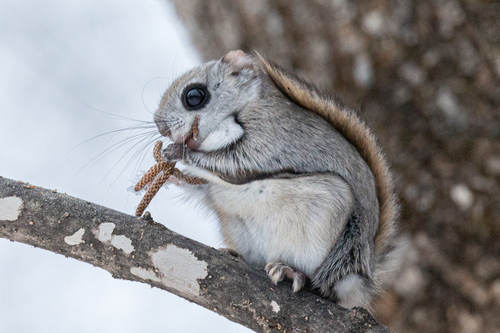
Belding's ground squirrels have a largely herbivorous diet, though they will also eat insects, carrion, other vertebrates, and even other members of their own species. They mostly eat flowers and seeds, and also eat nuts, grains, roots, bulbs, mushrooms and green vegetation. Belding's ground squirrels do not store food in caches, and instead store fat reserves. To build up these reserves, they eat large quantities of food before hibernation, doubling their body weight. They spend as much as 40% of the summer eating. When eating, the ground squirrel feeds itself using its front paws while standing on its back paws.