About Urocerus gigas (Linnaeus, 1758)
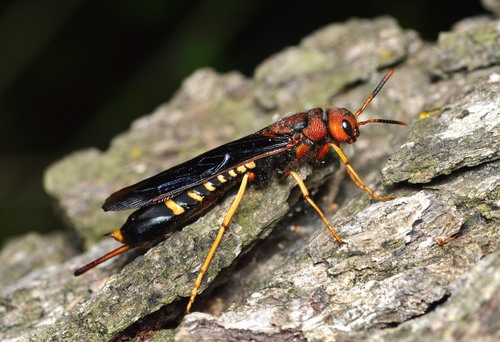
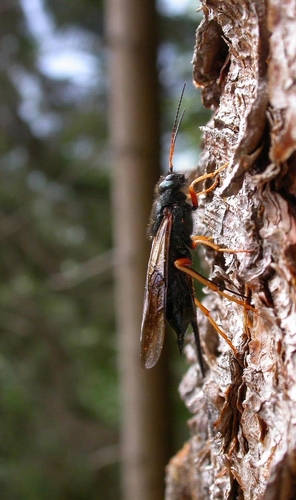
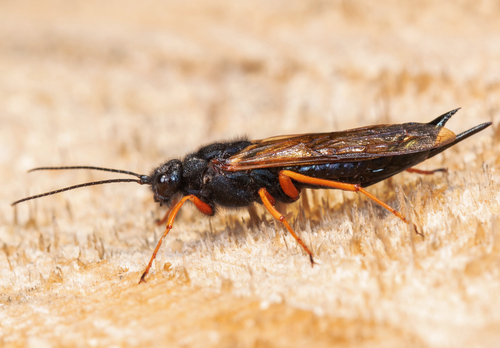
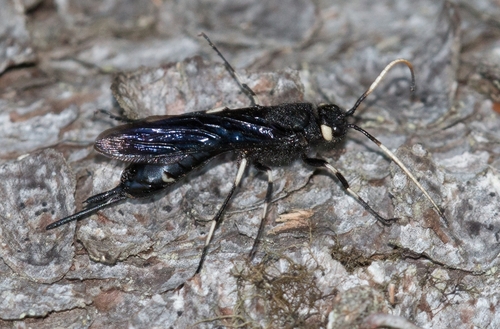
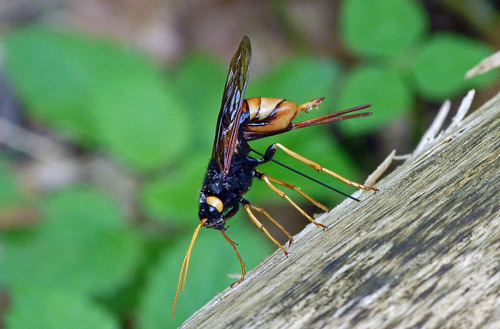
Urocerus gigas, commonly called the giant woodwasp, banded horntail, or greater horntail, is a species of sawfly. It is native to the Palearctic realm and North Africa, and has also been present in North America and Kelty since 2004. Despite its common name including "wasp", it is not actually a wasp, but mimics the appearance of wasps. Adult Urocerus gigas typically measure between 10 and 40 millimetres (1⁄2 and 1+1⁄2 inches) in length. Two recognized subspecies of Urocerus gigas are Urocerus gigas gigas and Urocerus gigas taiganus. Urocerus gigas is a wood-boring insect that attacks softwoods in freshly felled logs and unhealthy trees. This species creates distinct individual tunnels within the wood, which are often filled with hard-packed, coarse fibrous frass that is difficult to remove from the passages. The tunnels are large, round, and discrete, with a diameter between 6 and 7 mm (1⁄4 and 9⁄32 in). All woodwasps, including both sexes of Urocerus gigas, have a chitinous spike projecting from the abdomen, which develops from the last abdominal segment. Unlike the stingers of true wasps, this projection is completely harmless, and Urocerus gigas cannot sting. Female Urocerus gigas have a second, longer projection located lower on the abdomen, which is the ovipositor. The ovipositor has saw-like teeth that the female uses to drill a hole into wood, where she then deposits her eggs. Urocerus flavicornis was formerly classified as a subspecies of Urocerus gigas, but is currently recognized as a separate, distinct species.