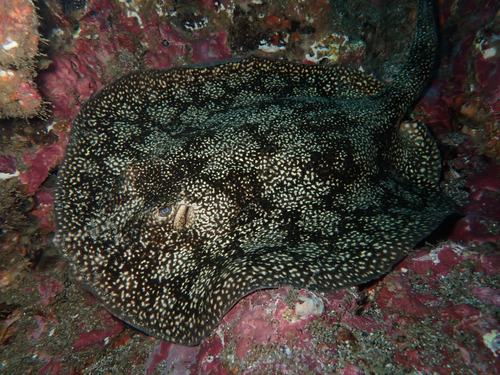
About Urobatis tumbesensis (Chirichigno F. & McEachran, 1979)
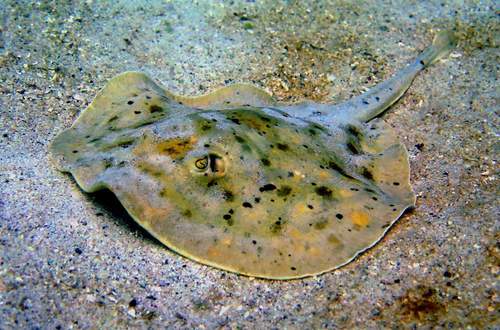
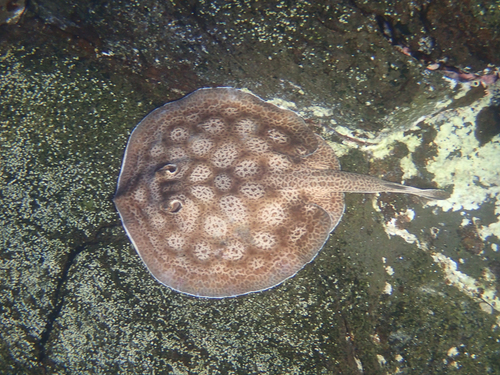
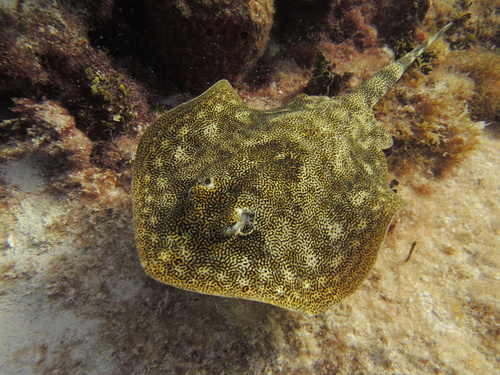
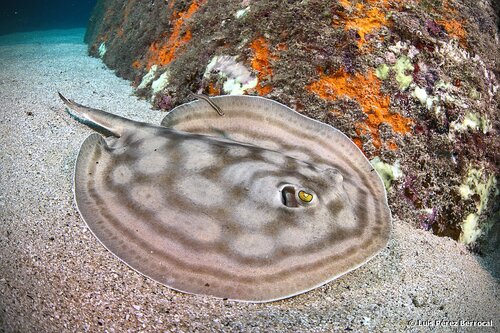
Urobatis tumbesensis, commonly called the Tumbes round stingray, is a little-known species of round ray in the family Urolophidae. This species is known from only three specimens: two immature males collected from 1–2 m deep estuarine waters, and a third collected in 2006 near mangroves. Its range appears to be limited to coastal waters off Tumbes in northern Peru, where individuals are found partially buried in sand or mud. Of the original two specimens, the larger measured 40.4 cm long, and the smaller measured 15.7 cm long. Like other round rays, the Tumbes round stingray has a rounded pectoral fin disc that is slightly wider than it is long. Its tail is stout, bears a serrated stinging spine, and ends in a rounded caudal fin. The pelvic fins have abruptly rounded tips. Its teeth have narrowly oval bases and no elevated cusps. The dorsal surface is uniformly covered by dermal denticles on stellate bases, which grow larger towards the midline of the disc; the underside is smooth. Thorns are also present on the dorsal surface of the disc and tail. The dorsal coloration is made up of ochre vermiculations that separate brownish-white oval or circular spots around the size of an eye, with the pattern becoming more distinct towards the margin of the disc and on the pelvic fins. The denticles and tail spine are ochre-colored, and the underside is light tan with a dark border along the edge of the disc. Unique coloration, denticle pattern, and several proportional measurements separate the Tumbes round stingray from other species in the genus Urobatis. Due to this species' highly restricted distribution and shallow inshore habitat, it warrants conservation concern. More information is needed to confirm whether fisheries activities within this species' range have negative impacts on it.