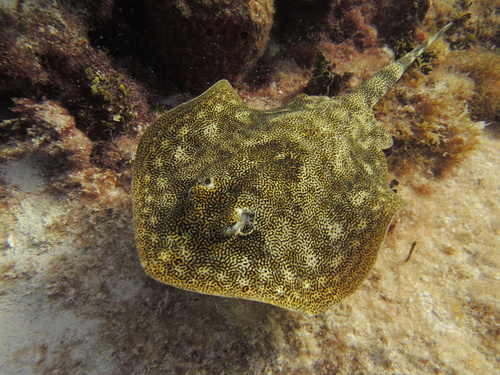
About Urobatis jamaicensis (Cuvier, 1816)
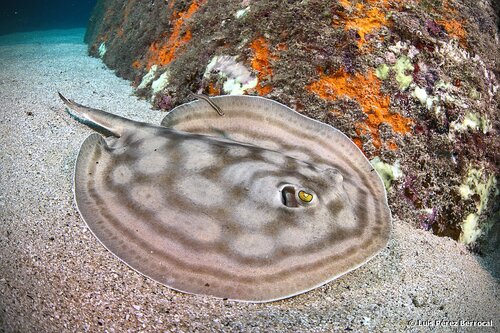
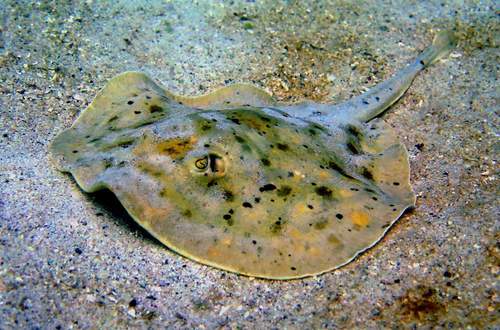
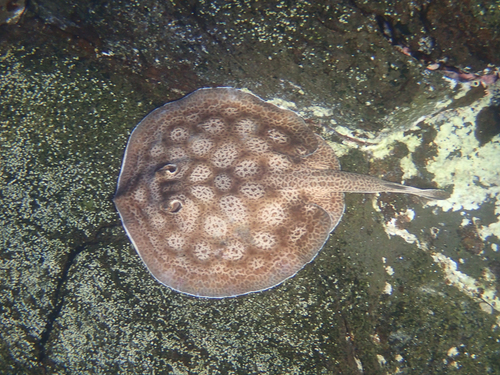
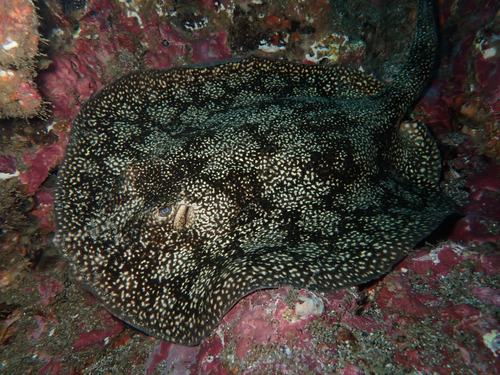
Scientific name: Urobatis jamaicensis (Cuvier, 1816). Common name: yellow stingray. This small stingray grows no larger than 36 cm (14 in) across its pectoral fin disc and 70 cm (28 in) in total length. It has a nearly circular pectoral fin disc that is slightly longer than wide, with a short, blunt snout. Its spiracles sit directly behind the eyes, and a narrow curtain of fringed skin extends between its nostrils. Its mouth is almost straight, with a transverse row of 3–5 small fleshy papillae on the mouth floor. It has 30–34 tooth rows arranged in bands in both the upper and lower jaw. Tooth shape varies by age and sex: females and juveniles have broad-based teeth with low, blunt crowns, while adult males have broad-based teeth with tall, pointed cusps. Male teeth are also more widely spaced than female teeth. Its pelvic fins have nearly straight leading edges and rounded trailing edges. The yellow stingray’s tail is stout and flattened, makes up less than half of its total length, and ends in a small leaf-shaped caudal fin that is one quarter as tall as it is long, and continuous around the final tail vertebra. A serrated venomous spine sits roughly halfway along the tail. Newborn yellow stingrays have smooth skin. Shortly after birth, small blunt tubercles develop on the middle of the back, and these tubercles extend to the area between the eyes, the shoulders, and the tail base in larger adults. Adults also grow recurved thorns along the upper edge of the caudal fin. Individual yellow stingrays vary widely in color and pattern, but most fall into one of two common schemes: fine dark green or brown reticulations over a light background, or dense white, yellow, or golden spots over a dark green or brown background. The underside is yellowish, greenish, or brownish white, with small darker spots near the margin of the disc and the tail. This species can rapidly change the tone and contrast of its coloration to blend into its surroundings. The yellow stingray occurs throughout inshore waters of the Gulf of Mexico, where it is the only member of its family, and the Caribbean Sea, ranging from Florida, the Bahamas, and the Greater and Lesser Antilles south to Trinidad. On rare occasions, individuals can be found as far north as Cape Lookout, North Carolina. It is very abundant in the Florida Keys and parts of the Antilles, and uncommon in most other parts of its range. Off the coast of Mexico, this species lives in waters with a salinity between 26 and 40 ppt. A bottom-dwelling (benthic) species, the yellow stingray inhabits coastal habitats including bays, lagoons, estuaries, and low-energy surf zones, and has been recorded from the shoreline down to a depth of 25 m (82 ft). It especially prefers insular hard-bottom habitats densely covered by sessile invertebrates, called live-bottom habitats, but can also be found over sand, mud, or Thalassia seagrass, sometimes near coral reefs. Off Jamaica, large groups of up to one yellow stingray per square meter gather beneath the aerial roots of mangrove trees that are used as roosts by cattle egrets (Bubulcus ibis); researchers theorize that egret droppings feed the invertebrates that attract these rays. There is no evidence that the yellow stingray migrates seasonally, though in spring females are usually found closer to shore than males. During the day, the yellow stingray is relatively inactive, and spends most of its time buried under a thin layer of sediment or resting motionless in aquatic vegetation. Tracking studies show that individuals generally stay within a small home range of around 20,000 m2 (220,000 ft2), and only use part of this full area on any given day. It prefers areas at the boundary between two different types of terrain, such as sand and reef. Its periscopic eyes give it a full 360° panoramic view of its surroundings, and each eye has a specialized covering called an operculum that allows fine control over how much light enters the pupil. This allows resting rays to easily detect approaching predators, which can include large predatory fish such as the tiger shark (Galeocerdo cuvier). The yellow stingray is most sensitive to sounds between 300 and 600 Hertz, which matches the typical sensitivity of other studied sharks and rays. Along with other stingrays, it has a larger brain relative to its body weight than other rays, with the brain making up 1–2% of its total body weight. The diet of the yellow stingray is not well documented, but it is known to eat shrimp, and is thought to also consume worms, clams, and small bony fishes. To hunt, the ray typically settles over a prey item to trap it against the seabed, then moves its disc to maneuver the prey into its mouth. Like the closely related round stingray (U. halleri), this species sometimes uses undulations of its disc margins to dig pits and expose prey buried under sediment. It has also been observed lifting the front of its disc to create a shaded “cave” that attracts small organisms seeking shelter. Documented parasites of the yellow stingray include the tapeworms Acanthobothrium cartagenensis, Phyllobothrium kingae, Discobothrium caribbensis, Rhinebothrium magniphallum, and R. biorchidum, as well as the monogenean flatworm Dendromonocotyle octodiscus. The yellow stingray is biofluorescent: when exposed to blue or ultraviolet light, it re-emits the light as green, giving it a different appearance than under white light. This biofluorescence may help with intraspecific communication and camouflage.