About Uria lomvia (Linnaeus, 1758)
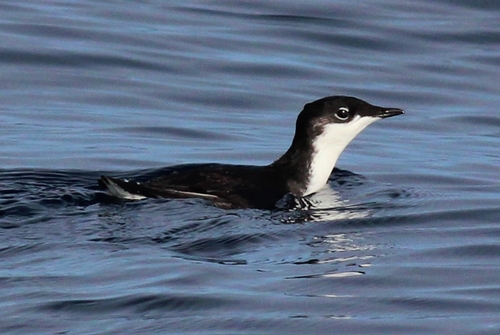
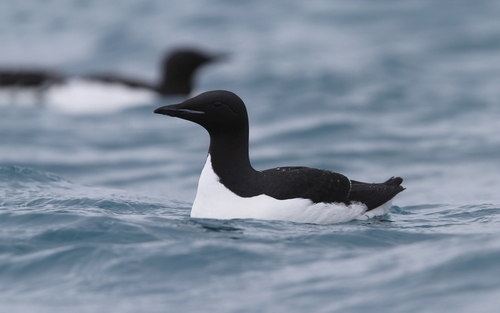
Since the great auk went extinct in the mid-19th century, murres have been the largest living members of the Alcidae bird family. The thick-billed murre (Uria lomvia) is closely related to the common murre (U. aalge, also called common guillemot); while the two species are similar in size, the thick-billed murre has larger average and maximum body size than the common murre. The total body length of the thick-billed murre ranges from 40 to 48 cm (16 to 19 in), its wingspan spans 64 to 81 cm (25 to 32 in), and its weight is between 736 and 1,481 g (26.0 to 52.2 oz). The Pacific subspecies U. l. arra is larger than the Atlantic subspecies, particularly in the size of the bill. Adult thick-billed murres have black plumage on their head, neck, back and wings, with white underparts. Their bill is long and pointed, they have a small, rounded black tail, and the lower area of their face turns white during the winter. At breeding colonies, this species makes a range of harsh cackling calls, but it does not call while at sea. Thick-billed murres can be distinguished from common murres by their thicker, shorter bill that has a white gape stripe, as well as their darker head and back. The 'bridled' morph seen in common murres does not occur in U. lomvia: a murre may have a white eye-stripe, a white bill-stripe, or neither, but never both. This is thought to be character displacement, which lets individual birds recognize members of their own species from a distance in densely packed breeding colonies. Bridled morphs are very common in North Atlantic colonies where both guillemot species breed, matching this hypothesis. In winter, thick-billed murres have less white on their face than common murres, and they appear shorter than common murres when in flight. First-year thick-billed murres have smaller bills than adults, and the white line on the bill is often unclear, so bill shape and markings are not reliable for identifying birds of this age. Head pattern is the most reliable feature to distinguish first-year thick-billed murres from common murres. The thick-billed murre is found across polar and sub-polar regions of the Northern Hemisphere, where four subspecies are recognized. U. l. lomvia lives in the Atlantic and Arctic Oceans of North America, U. l. arra lives on the Pacific coast of North America, and U. l. eleonorae and U. heckeri both inhabit the Russian Arctic. Thick-billed murres spend almost their entire lives at sea in waters that stay below 5°C; the only exception is the breeding season, when they form dense colonies on cliffs. In winter, they move south into the northernmost areas of the North Atlantic and North Pacific, only traveling far enough south to stay in ice-free waters. The flight of the thick-billed murre is strong and direct, with fast wing beats due to their short wings. Like other auks, thick-billed murres forage for food by using their wings to swim underwater. They are skilled divers, capable of reaching depths of up to 150 m and staying submerged for up to four minutes at a time. Most dives are either shallow and short, or longer dives that reach depths of 21 to 40 m. When hunting, the trajectory of their dive forms a shape similar to a flattened 'U'. Thick-billed murres travel long distances to reach preferred feeding grounds. While they usually forage within several dozen kilometers of their nest sites, they often travel more than 100 km to reach fishing areas. For their body size, the sustained flight of thick-billed murres requires more energy than any other animal's sustained locomotion, a consequence of their short wingspan. The regular diving depths and durations thick-billed murres achieve suggest that they, and similar auks, have an as-yet-unknown mechanism to prevent diving sickness and lung collapse when surfacing from dives. It has been proposed that auks temporarily store excess gases by absorbing them into the vascular structure of their bones, then gradually release the stored gases from the bones in a controlled decompression process. The nominate subspecies of thick-billed murre feeds primarily on fish including Gadus species and Arctic cod (Boreogadus saida), along with the pelagic amphipod Parathemisto libellula. Other prey including capelin (Mallotus villosus), Myoxocephalus fish species, other crustaceans, polychaetes, and a small number of molluscs are present in their diet but make up relatively small portions of it. When wintering near Newfoundland, capelin can make up over 90 percent of the thick-billed murre's diet.