About Uria aalge (Pontoppidan, 1763)
The common murre, scientifically named Uria aalge (Pontoppidan, 1763), measures 38–46 cm (15–18 in) in length, with a wingspan of 61–73 cm (24–29 in). Males and females cannot be told apart in the field. Body weight varies by location: individuals in the southern part of the species' range average 945 g (2 lb 1+1⁄2 oz), while those in the north average 1,044 g (2 lb 5 oz), and an overall reported weight range is 775–1,250 g (1 lb 11+1⁄2 oz – 2 lb 12 oz).
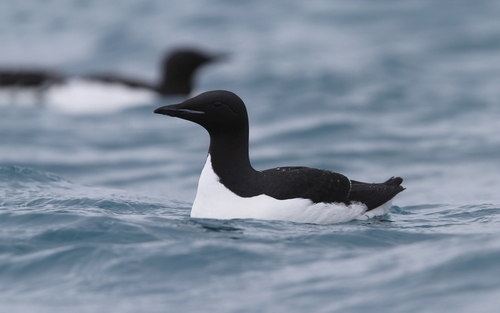
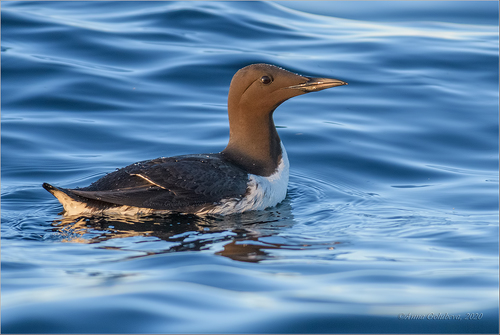
In breeding plumage, the nominate subspecies U. a. aalge has black head, back and wings, with white underparts. It has a thin dark pointed bill and a small rounded black tail. After post-breeding moult, the face becomes white with a dark spur behind the eye, and dark streaks are often present on the flanks. Subspecies U. a. albionis individuals are dark brown rather than black, a difference that is most obvious in colonies in southern Britain. The legs and bill of common murres are dark grey, though adult individuals with yellow-grey legs are occasionally seen, and an aberrant adult with a bright yellow bill was photographed in May 2008.
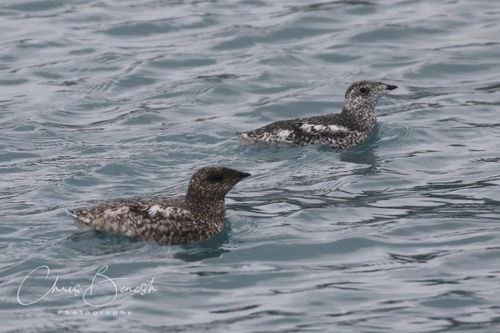
Adults moult into breeding plumage between December and February; U. a. albionis may start this moult as early as November. They moult back into winter plumage in July to August, shortly after leaving breeding colonies. First winter birds have identical plumage to adult winter birds, but their moult into first summer plumage happens later than it does for adults. First year birds often keep winter plumage as late as May, and their first summer plumage usually retains some white feathers around the throat.
Some North Atlantic individuals, called "bridled guillemots", have a white ring around the eye that extends backward as a white line. This marking is not a trait of a distinct subspecies, but a genetic polymorphism that becomes more common in breeding colonies located farther north.
Chicks are covered in down, with blackish feathers on their upper side and white feathers below. By 12 days old, their contour feathers are well developed across most of the body, except the head. At 15 days old, facial feathers show a dark eyestripe against a white throat and cheek. Chicks jump from breeding cliffs when they are 20–21 days old, long before they are fully fledged, after which they are cared for by their male parent at sea.
Common murres produce a range of calls, including a soft purring noise. The main adult call is a growling "murrrr", which can be deafening in large colonies. Chicks produce a high-pitched whistling food-begging call "willee" that carries over long distances.
The breeding habitat of the common murre consists of islands, rocky shores, cliffs and sea stacks. The total global population is large, estimated at around 7.3 million breeding pairs or 18 million total individuals. The population was previously stable, but a massive die-off of common murres in the northeast Pacific was reported in 2016, where affected birds appeared emaciated and starving, and no cause for the die-off has been identified. A marine heat wave killed half of Alaska's common murre population between 2014 and 2016, and as of 2024 the species has not recovered in the region. General potential threats to the species include excessive hunting (which is legal in Newfoundland), pollution, and oil spills. Cape Meares, Oregon hosts one of the most populous nesting colonies of common murres in North America.
Some common murres are permanent residents. Northern populations migrate south to open waters near New England, southern California, Japan, Korea and the western Mediterranean. Populations in the United Kingdom generally stay near their breeding colonies year-round, but some individuals have been recorded making long-distance migrations as far north as the Barents Sea. Common murres rest on the water during winter, a habit that may affect their metabolism; for the black-legged kittiwake, which shares this winter resting habit, resting metabolism on water is 40% higher than it is in air.
Common murres can travel far from breeding grounds to forage, with trips of 100 km (60 mi) or more observed regularly, though they will travel much shorter distances if enough food is available closer to breeding sites. They mainly eat small schooling forage fish that are 200 mm (8 in) long or less, including polar cod, capelin, sand lances, sprats, sandeels, Atlantic cod and Atlantic herring. Capelin and sand lances are preferred foods, but the main prey at any time depends on what is locally abundant. They also eat some molluscs, marine worms, squid, and crustaceans such as amphipods. On average, common murres consume 20–32 g (11⁄16–1+1⁄8 oz) of food per day. They are often seen carrying fish in their bill with the fish's tail hanging out. Snake pipefish are occasionally eaten, but have poor nutritional value. The amount of snake pipefish in the common murre's diet has increased since 2003, as numbers of this fish have grown in the northeast Atlantic and North Sea while sandeel numbers have declined.
In areas including Newfoundland and Labrador, common murres and the related thick-billed murre are called 'turrs' or 'tuirs', and are consumed by people. The meat is dark and quite oily, due to the birds' fish-based diet. Common murre eggs have also been harvested for human consumption; in the mid-19th century, egg collectors from San Francisco collected almost half a million common murre eggs per year from the Farallon Islands to feed the growing city.