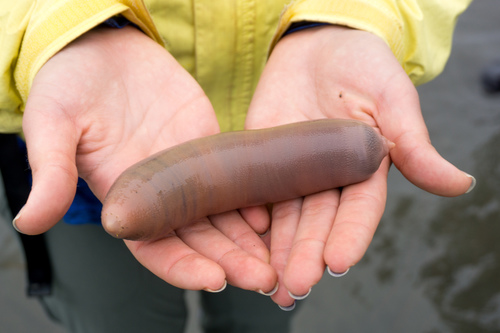
About Urechis caupo Fisher & MacGinitie, 1928
Urechis caupo is a plump, unsegmented, cylindrical pink worm that grows up to 7 inches long, with 5.5 inches being a more common adult length. It has a pair of bristle-like setae on the ventral surface at its anterior end, and a distinctive ring of roughly ten setae around the anus at its posterior end. Its proboscis is short. This species lives in shallow water in the northeastern Pacific Ocean, with a range stretching from southern Oregon to northern Baja California. It inhabits U-shaped burrows it digs in muddy sand in the lower intertidal and shallow subtidal zones. Occasionally, thousands of these worms wash up onto beaches in northern California; one such stranding occurred on December 6, 2019, at Drake's Beach near Pt. Reyes, which was likely caused by recent storm activity that disturbed the worms' burrows. This spoon worm is a detritivore that creates a U-shaped burrow in soft seabed sediment. When feeding, it presses a ring of glands at the front of its proboscis against the burrow wall and secretes mucus that adheres to the wall. As the worm moves backwards through the burrow, it continues to exude mucus, forming a complete mucus net. The worm pumps water through its burrow via peristaltic contractions of its body; as water passes through the net, food particles get stuck to the mucus. Once enough food has accumulated, the worm moves forward through the burrow and swallows both the mucus net and the trapped food. This feeding process repeats, and can be completed in just a few minutes in areas with abundant detritus. Faecal pellets build up around the worm's anus, and periodically the worm contracts its body sharply to force a stream of water out of its anus. This blasts the pellets and loose sediment out of the burrow, leaving a casting on the surface of the sand. Larger food particles that cannot be used are rejected and left in the burrow, where they act as a food source for the many different commensal organisms that live alongside the worm in its burrow. Because it provides food and shelter for these other species, this spoon worm is commonly called the "innkeeper worm". Commensal species that share its burrow include the California softshell clam (Cryptomya californica), pea crabs, shrimps, and scaleworms. The arrow goby (Clevelandia ios) uses the burrow entrance as a refuge, darting inside if it is threatened. The gut of this spoon worm often hosts many trophozoites of the protozoan Zygosoma globosum. Urechis caupo has separate male and female individuals, and fertilization is external. Pinkish or yellowish eggs and white sperm are released into the open water through a pair of modified nephridia. Larvae remain planktonic for around sixty days before settling onto the seabed; they are strongly drawn to settle near other Urechis caupo by a chemical released from the worms' surface castings.

