About Urbanus proteus (Linnaeus, 1758)
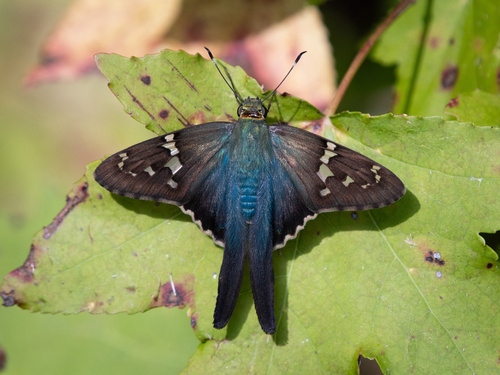
The long-tailed skipper, scientifically Urbanus proteus, is a spread-winged skipper butterfly. It is distributed throughout tropical and subtropical South America, ranging south to Argentina and north into the eastern United States and southern Ontario. It cannot survive in regions that experience prolonged frost. It is a showy butterfly with light brown wings tinted with iridescent blue, and two long tails that extend from its hindwings. Its robust body is light blue on the dorsal side, it has a large head and prominent eyes, and its wingspan measures between 4.5 and 6 centimeters.
This butterfly lays white or yellow eggs, either singly or in small clusters. Eggs hatch into caterpillars that have a yellowish body and a large, dark head. After two to three weeks, the caterpillar forms a pupa. The pupa is held inside a rolled leaf and covered in fine bluish hairs. The pupal stage lasts between one and three weeks, after which an adult butterfly emerges.
The caterpillar of this skipper is a common crop pest, especially for beans, in the southern United States. Because of this, it is sometimes called the bean leafroller in this region. Caterpillars feed on the leaves of plants in the legume family, including wisteria and butterfly peas. When they are ready to pupate, they roll leaves around themselves and line the inner cavity with silk. Adult long-tailed skippers feed on nectar from flowers.
Natural enemies of this species include parasitoid wasps and flies, and the Florida predatory stink bug, Euthyrhynchus floridanus. In the fall, a nuclear polyhedrosis virus can kill up to 50% of this species' larvae.