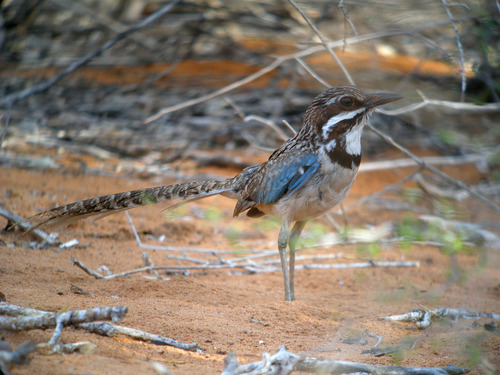
About Uratelornis chimaera Rothschild, 1895
Uratelornis chimaera, commonly called the long-tailed ground roller, has a highly distinctive silhouette marked by a long tail and plump body shape. It measures 34 to 47 centimeters (13 to 19 inches) in total length, with the tail contributing up to 30 centimeters (12 inches) – giving this species the longest tail of any ground roller. It has short wings and long, pinkish-brown legs. Males have a sandy buff crown, dark brown upperparts with black streaks, a pale buff supercilium, and brown ear-coverts. Their eyes are brown, and their short, stout beak is black. They have a long tongue with a brush-like tip adapted to help collect insects. A white stripe sits at the base of the bill, surrounded by brown and black malar stripes that, along with a black breastband, frame a white throat. The tail has 15 to 20 dark brown bars, and the outer rectrices are sky blue; this sky blue color is also present on the wing-coverts. In flight, two conspicuous black and white bands are visible on the primaries and secondaries. The underparts are light gray, and the breast is white. Its toes are zygodactylous: the first and fourth toes point outwards, and the two middle toes point inwards. Females resemble males, but are smaller, have a narrower breastband, a shorter tail, and shed their tail while nesting. These consistent differences between sexes mean the long-tailed ground roller is the only ground roller that definitely displays sexual dimorphism. Juveniles of both sexes look similar to adult females, but have duller plumage, particularly on the black bands of the chest, neck, and eyes. Though generally silent, during the breeding season long-tailed ground rollers produce several vocalizations, including a "hooting" sound, a "popping" tu-tuc, and a soft boo sound. Males give the low-pitched hooting call from a perch 2 to 6 meters (6.6 to 19.7 ft) above the ground at dusk or night; the sound carries at least 200 meters (660 ft) and may function to attract mates or defend territory, and the bird pumps its tail while calling. One territorial call is a series of soft boo notes, typically given in sets of six to ten that decrease in volume toward the end. Both sexes give another call: a series of chuckling tu-tuc sounds that lasts 10 to 40 seconds, and occasionally ends in a loud snapping sound produced by the wings. This call is given when birds are near each other on the ground or low perches, and does not carry over long distances. Using wing-snapping to produce sound is a rare trait in birds, and within the order Coraciiformes only one other family (todies) is known to have this ability. Mated individuals give low gu notes when they make contact with each other. The long-tailed ground roller is endemic to Madagascar, where it lives in a narrow strip of suitable coastal habitat in the southwestern part of the island. This habitat strip is bordered by the Mangoky River to the north, the Fiherenana River to the south, and lowland hills to the east, with a total area of approximately 10,500 square kilometers (4,100 square miles). The species is extremely uncommon across its range, occurring at densities of 0.8 to 10 individuals per square kilometer (2.1 to 25 per square mile). The elevation of its range spans from sea level up to 100 meters (330 ft). It does not migrate, but may disperse across a larger area outside of the breeding season. Its preferred primary habitat is spiny forest, a type of sub-arid habitat made up of thorn-scrub and deciduous woodland that receives an average of just 500 millimeters (20 in) of rainfall per year, and sits on sandy soil. The dominant plants in these spiny forests belong to the cactus-like family Didiereaceae, especially Didierea madagascariensis, and the tree-like family Euphorbiaceae, especially Euphorbia stenoclada. Baobab trees are also common in this habitat. It was once thought that the long-tailed ground roller preferred undisturbed forest, while tolerating low levels of disturbance; later studies have found that it actually prefers degraded habitat. Even so, it requires shade, and does not occur in deforested areas or on the shadeless dunes found within its range. The long-tailed ground roller is a shy, elusive bird: when encountered by human observers, it either freezes or runs away. As suggested by its short wings, it rarely flies, but is a powerful runner. While it is largely terrestrial, it roosts in low trees and bushes, and sings from low perches. It is solitary outside of the breeding season. Though primarily diurnal, it occasionally forages at night, which differs from most other ground rollers. When calling, it bobs its head and raises its tail; it also raises its tail when excited. Its breeding season lines up with the rainy season, which runs from October to January. During this period, the species leaves its solitary habits to find a mate, and pairs remain monogamous. Males establish territories in the breeding season and defend them with territorial calls, which they give from a perch up to 6 meters (20 ft) above ground for an hour after sunrise, and occasionally throughout the day and night. Male courtship behavior includes observed feeding of females. Both males and females use their bills and feet to excavate a downward-sloping burrow in consolidated, flat sand, and build their nest at the end of the burrow. Burrows are always dug away from grassy vegetation, and measure 0.8 to 1.2 meters (2.6 to 3.9 ft) long with an 8 centimeter (3.1 in) diameter. The end of the burrow widens into a 20 centimeter (7.9 in) wide chamber with a shallow depression lined with dry leaves and earthy pellets. While digging the nest, the long-tailed ground roller will sometimes walk under a low branch, tilt its head upward, remain motionless, and emit a rising crescendo of tu-tuc calls. At the peak of the crescendo, the bird stops calling, flies up onto the branch while making a "ripping and crackling sound" with its wingbeats, and then releases a stream of boo notes from the perch. This display is thought to be part of courtship. Each pair digs one to six nesting burrows over the breeding season; the extra unused burrows are called speculative burrows. Egg laying occurs between October and January, peaking in November. Clutches normally contain two smooth, white eggs, though occasionally they hold three or four. The incubation period and fledging time for this species are not known. After the young fledge, they stay in a family group of four to five birds until around February, when the family disperses.