About Uranoscopus scaber Linnaeus, 1758
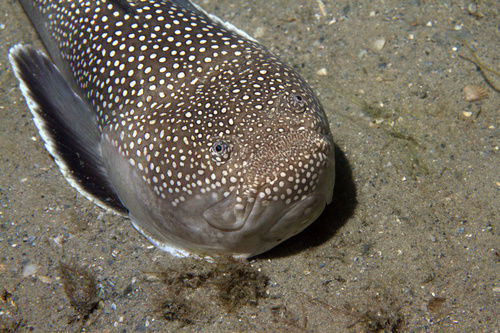
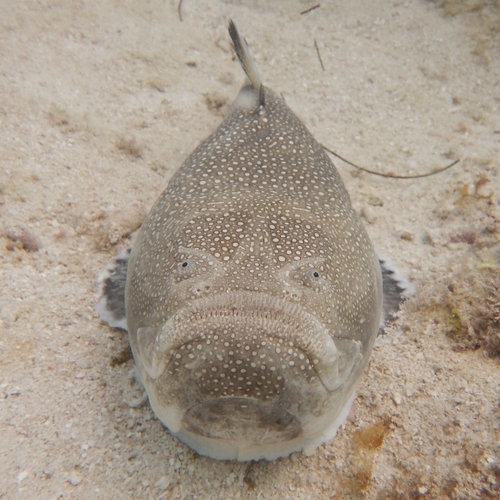
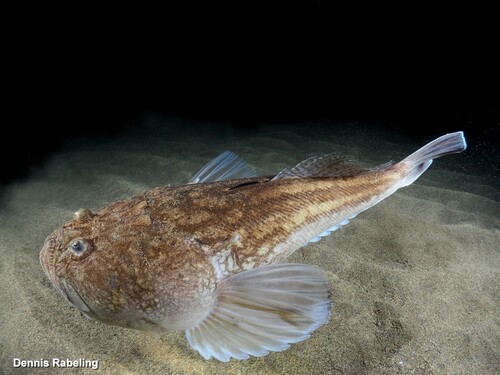
This species, Uranoscopus scaber Linnaeus, 1758, is commonly called the Atlantic stargazer. Like other members of its family, it has a dorsoventrally flattened body, upward-facing head and jaws, and a large mouth. Its body is brown with many small light spots, and it has a lighter colored belly. This species has no swimbladder. Adult Atlantic stargazers are usually 20 to 30 cm (7.9 to 11.8 in) long, but can grow up to 35 cm (14 in) long. Females are generally larger than males, and the species has a typical lifespan of 5 to 6 years. The Atlantic stargazer is widespread along the Atlantic coasts of Europe and Africa, and it is somewhat rare in the Bay of Biscay. It is also common in the Mediterranean Sea and the Black Sea. It is a demersal fish that lives on sandy or muddy sand sediments along the upper slope of the continental shelf, at depths between 14 and 400 m (46 to 1,312 ft). The species is not highly economically important, and is primarily caught as bycatch, but it is considered ecologically important. Spawning occurs between April and September, with timing varying by region. This species produces pelagic eggs that are around 2 mm in diameter. After hatching, larvae, post-larvae, and juveniles stay pelagic. Across the species, males are slightly more common than females, though this ratio varies between local populations.