About Uranomitra franciae (Bourcier & Mulsant, 1846)
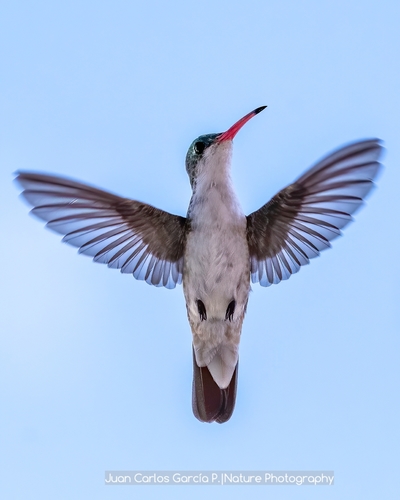
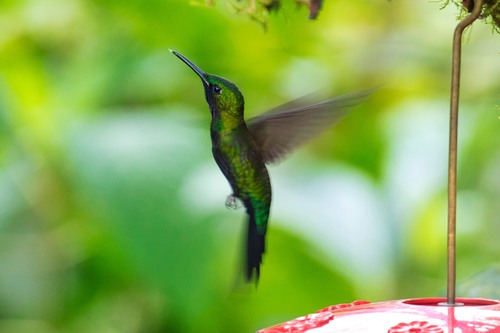
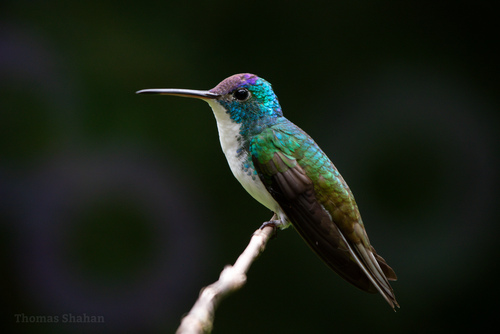
The Andean emerald (scientific name Uranomitra franciae (Bourcier & Mulsant, 1846)) measures 9 to 11 cm (3.5 to 4.3 in) in total length. Males weigh approximately 5.6 g (0.20 oz), while females weigh around 5.3 g (0.19 oz). For all subspecies, both sexes have a medium-length bill that ranges from straight to slightly decurved; the maxilla is blackish, and the mandible is coral red with a dark tip. Adult males of the nominate subspecies U. f. franciae have a glittering violet-blue crown, and glittering golden- to emerald green cheeks and neck. Their upperparts and flanks are light green to golden-green, with a coppery tinge on the uppertail coverts. The center of their underparts is white, and their tail is bronze-green to copperish. Adult females are similar to males, but their crown is turquoise-blue to greenish and less glittering. Juveniles resemble adult females, and additionally have brownish edges on the feathers of their upperparts, and grayish brown flanks. Subspecies U. f. viridiceps differs from the nominate subspecies in having a shorter tail and a green crown. Subspecies U. f. cyanocollis also differs slightly from the nominate: the blue of its crown extends down to the nape. The three subspecies of Andean emerald have separate distributions: U. f. franciae occurs in the Andes of northwestern and central Colombia; U. f. viridiceps occurs in the Andes from southwestern Colombia's Nariño Department, through western Ecuador, to Loja Province; U. f. cyanocollis occurs in the Andes of southeastern Ecuador's Zamora-Chinchipe Province and northern Peru's Marañón River valley, extending south and east to La Libertad Province. The Andean emerald lives in secondary forest, and the edges and clearings of wet primary forest. In Peru, it also occurs in drier shrublands. It can be found at elevations between 600 and 2,100 m (2,000 and 6,900 ft), and is most common above 1,000 m (3,300 ft).