About Urania leilus Linnaeus, 1758
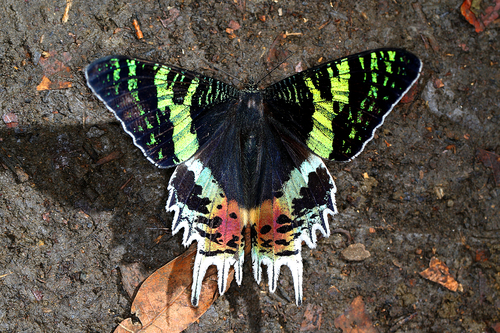
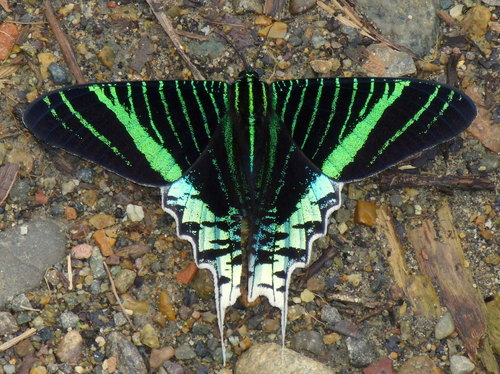
Urania leilus, commonly known as the green-banded urania, is a day-flying moth that belongs to the Uraniidae family. Carl Linnaeus first described this species in the 10th edition of Systema Naturae, published in 1758. This moth is found in tropical South America east of the Andes Mountains, and it occurs most often in the Amazon rainforest. Its confirmed range covers Suriname, Guyana, French Guiana, eastern Colombia, Venezuela, eastern Ecuador, Brazil, northern Bolivia, eastern Peru, and the island of Trinidad. It has also been documented as a vagrant in the central and northern Lesser Antilles, including St. Kitts, Barbados, and Dominica. Its preferred habitat is riverbanks within primary and secondary rainforest, at elevations ranging from sea level to around 800 meters, or 2,600 feet. U. leilus is sometimes mistaken for the closely similar species U. fulgens, which has a distinct distribution west of the Andes in South America, Central America, and Mexico. U. fulgens is also slightly smaller and has less white coloring on its "tail" than U. leilus. Historically, these two moths were classified as a single conspecific species. It has been hypothesized that the two were originally one species, but they diverged into two separate allopatric species when the Andean mountains formed between 5 million and 2.7 million years ago, separating their populations. U. leilus relies heavily on habitats with high rainfall, while U. fulgens can tolerate habitats with moderately lower rainfall levels. The wingspan of U. leilus measures approximately 70 mm, or 2.8 inches. Like all other members of the Urania genus, U. leilus larvae feed exclusively on the leaves of Omphalea, a toxic spurge plant.