About Uracentron flaviceps (Guichenot, 1855)
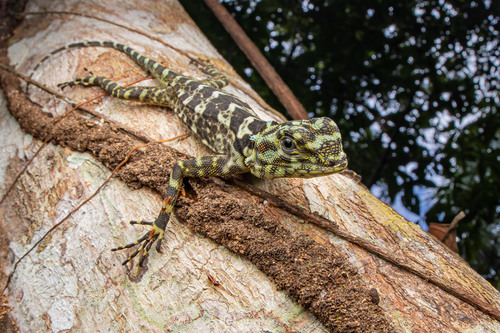
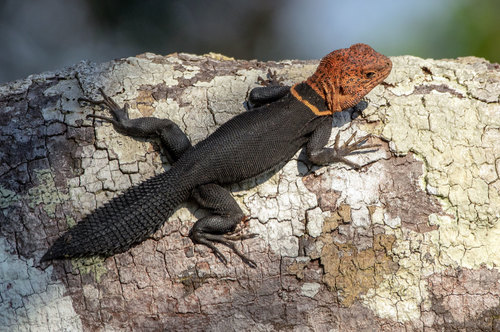
Males of Uracentron flaviceps can reach up to 13 cm (5.1 in) in snout–vent length, while smaller females only reach 9.5 cm (3.7 in). Individuals have a large, flat tail covered in scales that ends in a point; the function of these scales is currently unclear. Their bodies are brown, speckled with yellow or gold spots. Some specimens collected in Ecuador and Peru have been recorded to have a black collar around the neck, bordered by narrow, light-colored edges. This species has been recorded in the lowlands of eastern Ecuador, eastern Peru, northwestern Brazil, and extreme southern Colombia; it may also occur in Bolivia. Uracentron flaviceps, commonly called the tropical thornytail iguana, is found only in the Amazon Rainforest, and within that region it generally occurs in lowland tropical rainforest, usually in areas near lagoons, rivers, streams, and palm swamps. It is an arboreal species, spending most of its life in high treetops. It prefers trees with large horizontal branches that allow for morning sun basking, and it is almost exclusively found in trees that have hollow areas accessible through entrances in branches and trunks. No specific tree species has been found to be favored by these lizards; tree structure, rather than tree species, determines their habitat preference. The breeding season for this species appears to be extended, based on observations of juveniles of different sizes occupying a single tree. During the breeding season, males become more territorial and perform displays of head bobbing and body movements to warn other intruding males away. These displays are also used to attract potential mates. Like most reptiles, tropical thornytail iguanas are oviparous and lay clutches of eggs. For this species, most females lay clutches of two eggs, and clutches of one egg are very rare. Eggs are laid in nests deep within the tree holes occupied by a group of tropical thornytail iguanas.