About Upupa marginata Cabanis & Heine, 1860
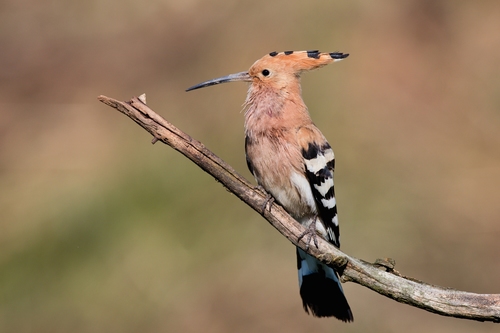
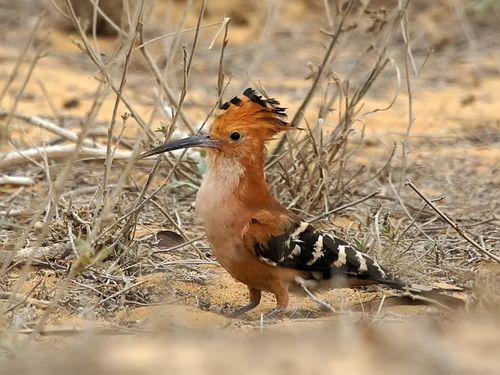
The adult Madagascar hoopoe (Upupa marginata) measures approximately 32 cm (12.6 in) in length, and weighs between 57 and 91 g (2.0 to 3.2 oz). It has a long, decurved bill and cinnamon-coloured plumage, with bold black and white barring on its wings. Its tail is black, and it bears a long cinnamon crest with black-tipped feathers that can be raised when the bird is alarmed. Its wings are broad and rounded; its characteristic flight pattern involves a few wing beats, after which it folds its wings momentarily to glide, before it begins flapping again. Females are slightly duller in colour than males, and have less white visible on their wings. Compared to the African hoopoe, the Madagascar hoopoe is larger, has a longer tail, and a pinker throat. Its song is very different from the African hoopoe's "hoop-hoop-hoop"; it is described as a low cooing trill rrrrrrooow that drops slightly in pitch, lasts 1.5–2.5 seconds, and is repeated every 3–10 seconds. The Madagascar hoopoe is endemic to Madagascar. Its range covers the north, west, central, and southern regions of the country, and it is largely absent from eastern Madagascar. It inhabits forest edges, clearings, glades, savannah, pasture, and brushland. The Madagascar hoopoe is usually found alone or in pairs, and forages on the ground. It walks a few steps, then pauses to look around, bobs its head, probes soil and leaf litter with its bill, picks food items from the ground surface, probes dung, and investigates crevices for food. Its diet consists mainly of insects, including beetles, flies and their larvae, grasshoppers, and caterpillars. When disturbed, it may fly to a horizontal branch to perch, where it will flash its wings and raise and lower its crest. This species is monogamous and territorial. Breeding occurs between August and December, with most breeding activity taking place in October and November. Nests are built inside deep tree cavities, most often within 3 m (10 ft) of the ground. Very little nesting material is used, and the cavity becomes messy and smelly before the young birds fledge. One recorded nest contained a clutch of six bluish-grey eggs. Incubation may possibly be done only by the female, and the male partner has been observed feeding the female while she incubates. In other hoopoe species, the incubation period lasts 15 to 16 days, and the fledging period lasts 26 to 32 days. Both parent birds take part in feeding the young.