About Upucerthia validirostris (Burmeister, 1861)
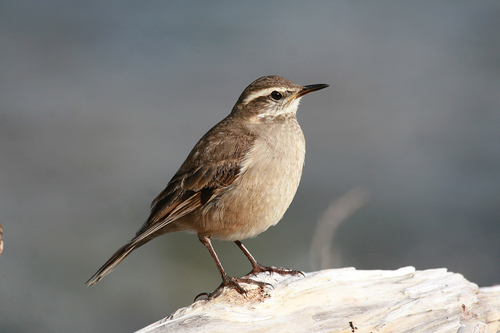
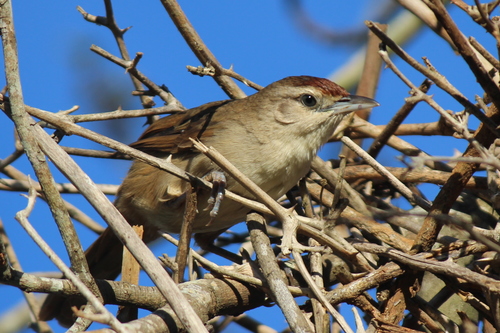
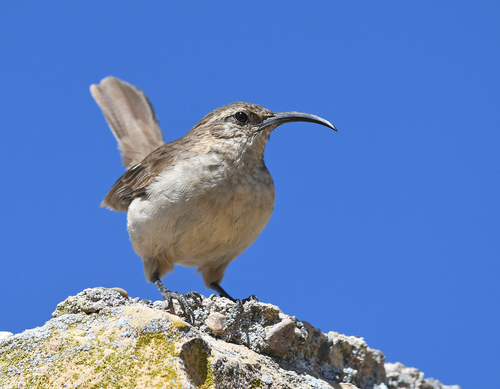
The buff-breasted earthcreeper (scientific name Upucerthia validirostris (Burmeister, 1861)) is 17 to 21 cm (6.7 to 8.3 in) long and weighs 30 to 45 g (1.1 to 1.6 oz). It is a medium-sized earthcreeper with a long, strongly decurved bill. The sexes have identical plumage. Adults of the nominate subspecies have a pale buffish white supercilium. Their crown, nape, back, rump, and uppertail coverts are dull brownish gray. Their tail is dark brown, with the amount of rufous increasing from the central to outer feathers. Their wings are mostly the same brownish gray as the back, but have extensive rufous coloring at the base of the primaries. Their throat is grayish white with brownish specks; their upper breast is grayish white with a brownish scaly pattern, and their lower breast, belly, and undertail coverts are plain light buffish. Their iris is dark brown, their bill is blackish with a paler base, and their legs and feet range from blackish to dark brown. Juveniles resemble adults but have more conspicuous markings on the breast. Subspecies U. v. jelskii has a smaller, shorter bill and less rufous in the wings than the nominate subspecies. U. v. saturata is very similar to jelskii, but has grayer underparts. Among the buff-breasted earthcreeper subspecies, U. v. jelskii has by far the widest distribution. It occurs in the Andes from Peru's Department of Lima south into Chile's Tarapacá Region, and through western Bolivia to far northwestern Argentina's Jujuy Province. U. v. saturata occurs in the western Andes of central Peru, between the departments of Ancash and Pasco. The nominate U. v. validirostris occurs in northwestern Argentina, from Salta Province south to Mendoza Province and east into western Córdoba Province. Buff-breasted earthcreeper inhabits puna grassland and arid montane scrublands. Within these landscapes, it prefers dry ravines with dense scrub, and rocky, shrubby slopes; it avoids level ground.