About Upucerthia certhioides (Orbigny & Lafresnaye, 1838)
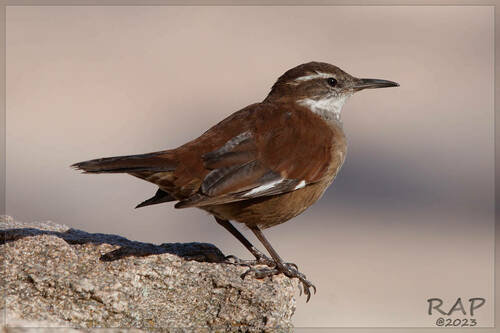
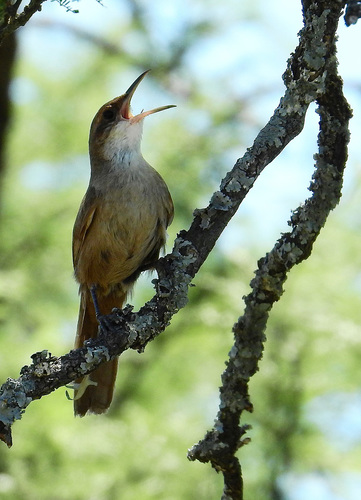
The Chaco earthcreeper, scientifically named Upucerthia certhioides (Orbigny & Lafresnaye, 1838), is approximately 16 cm (6.3 in) long and weighs 18 to 31 g (0.63 to 1.09 oz). It is a small earthcreeper with a long, very slightly decurved bill. Males and females have identical plumage. Adults of the nominate subspecies have a mostly dark brown face marked with an indistinct orange-rufous supercilium. Their forehead is dull orange-rufous, their crown and back are dull dark brown, and their rump and uppertail coverts are a somewhat rufescent brown. Their tail is generally dull brown, with progressively more rufous coloring from the central feathers to the outermost feathers. Their wings are slightly more rufous brown than the back, with rufous bases on the flight feathers. Their throat and cheeks are white. Their breast and belly are brown, and their flanks and undertail coverts are rufescent. Their iris is brown, their maxilla is blackish to dark gray, their mandible is slate gray to pinkish gray, and their legs and feet are blackish to dark gray. Juveniles have an overall rufous tinge, but their forehead is less rufous than that of adults. Subspecies U. c. luscinia has grayer (less rufescent) upperparts, more rufous on the wings, and paler underparts than the nominate subspecies. U. c. estebani has a paler back, a duller breast and belly, and no rufescent tinge on the flanks compared to the nominate. Three subspecies have separate known ranges: U. c. estebani is found in Santa Cruz Department in south central Bolivia, northern Argentina, and western Paraguay. U. c. luscinia occurs in the western Argentine provinces of San Juan, La Rioja, Córdoba, Mendoza, and San Luis. The nominate U. c. certhioides is found in northeastern Argentina, from Río Negro Province north to Formosa Province, and has been recorded once in Rio Grande do Sul, Brazil. U. c. estebani and U. c. certhioides live in dense scrublands and deciduous woodland in the Chaco Basin, especially in areas with terrestrial bromeliads. U. c. luscinia inhabits slopes with dense shrubs in the Andean foothills. Across the whole species, it occurs at elevations up to 1,800 m (5,900 ft).