About Uperodon taprobanicus (Parker, 1934)
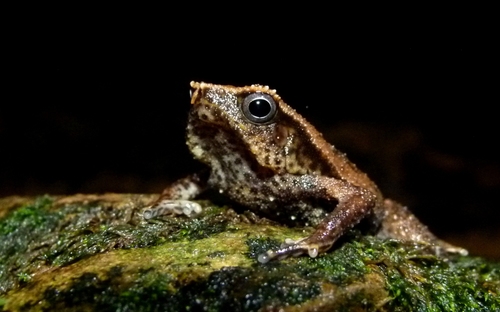
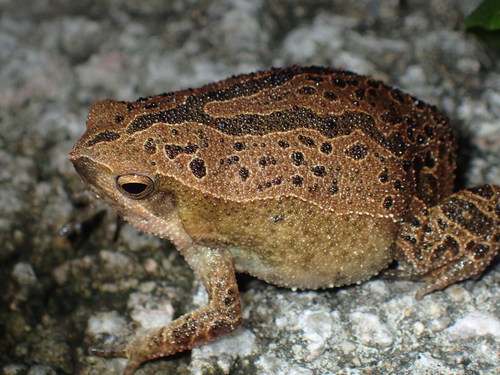
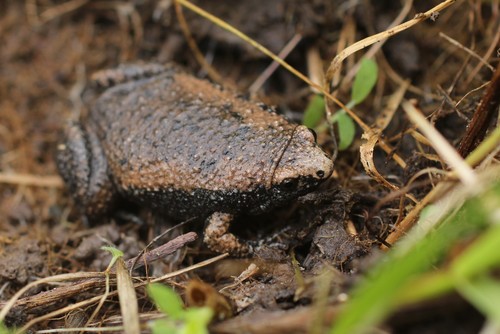
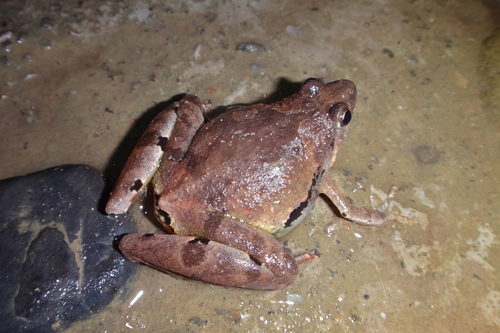
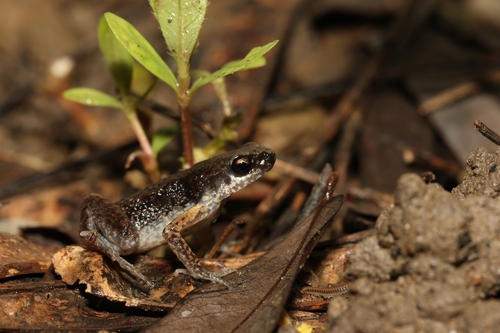
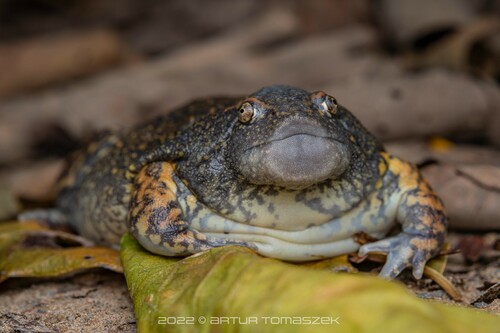
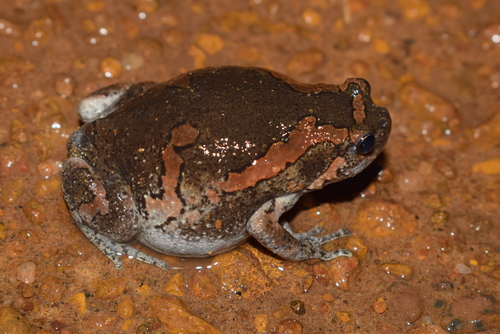
Uperodon taprobanicus (Parker, 1934) is a plump frog species. Adults reach a snout–vent length of about 75 millimetres (3.0 in), and females are slightly larger than males. Its dorsal surface is greyish-black, with a symmetrical pattern of reddish-brown patches on both sides. This pattern includes a colored band that stretches from the back of the eye to the base of the arm. The underparts are pale yellowish-grey, mottled with black or brown. During the breeding season, males develop a dark patch on the throat. This species is native to Sri Lanka, India, Bangladesh and Nepal, and it is most common in southern India and Sri Lanka. The Brahmaputra River acts as a dispersal barrier: Uperodon taprobanicus is distributed west and north of the river, while Kaloula assamensis is located north of it, and Kaloula pulchra is found to the east and south of the river. In India, it has an isolated population distribution in parts of Gujarat and Rajasthan, and also occurs in the states of West Bengal, Odisha, Assam, Karnataka, Kerala, Telangana, Tamil Nadu, and Andhra Pradesh. It is most common in the southern areas of the Western and Eastern Ghats. In Sri Lanka, where the species is most abundant, it is spread across the whole island at elevations ranging from sea level up to 1,300 metres. Uperodon taprobanicus is a fossorial species; it spends the day buried in leaf litter, loose soil, or under fallen logs, but it can also climb into tree branches. Its preferred habitats include dry forests, coconut and rubber plantations, wetlands, rice fields, and disturbed areas near human dwellings.