About Umimayanthus parasiticus (Duchassaing de Fonbressin & Michelotti, 1860)
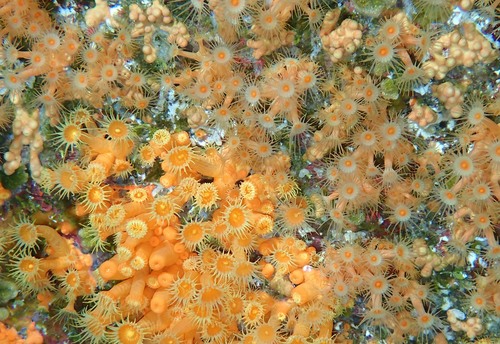
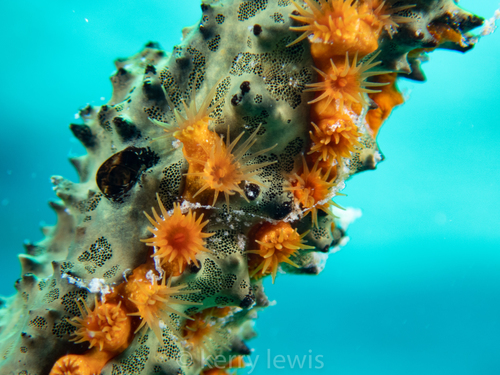
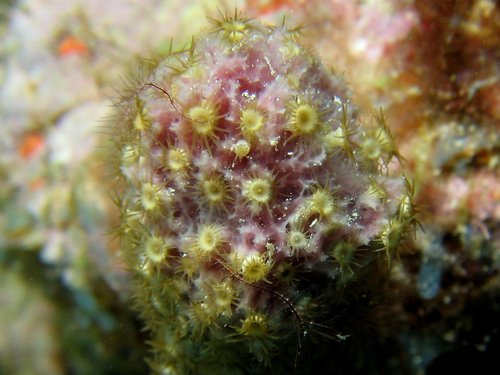
The polyps of Umimayanthus parasiticus bear a superficial resemblance to small sea anemones. These polyps grow either individually or in small groups of two or three, attached to the surface of certain sponge species. A thin tissue layer called coenenchyme connects all the polyps, and they occur at densities between 3 and 10 per square centimeter, which equals 20 to 60 per square inch. As the colony spreads across its host sponge via budding, the distance between individual polyps increases. The column of each polyp is encrusted with sand particles and calcareous material, and is white in color. The oral disc of a polyp can reach up to 6 millimeters (0.24 in) in diameter. Two rings of tentacles line the edge of the disc, with around 14 tentacles in each ring. These tentacles are brown, and contain symbiotic zooxanthellae: unicellular photosynthetic algae that provide the polyp with nutrients, while gaining access to the polyp's nitrogenous waste. Umimayanthus parasiticus is distributed across the Caribbean Sea, the Gulf of Mexico, Florida, Bermuda, and the Bahamas. It occurs at depths ranging from 7.5 to 30 meters (25 to 98 ft). It is common in areas where its host sponges grow. Known host species include Cliona deletrix, other Cliona species, Gelloides ramosa, Callyspongia vaginalis, and Spheciospongia species.