About Umbrina canariensis Valenciennes, 1843
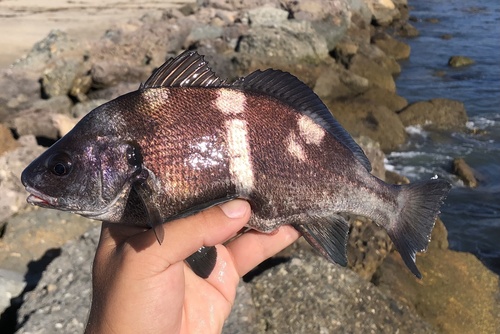
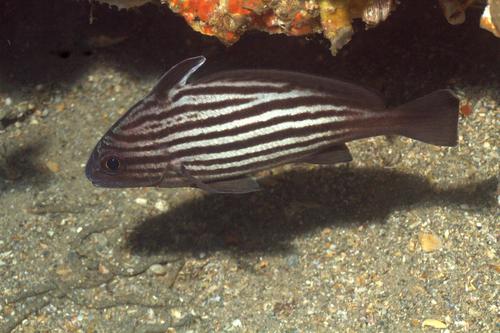
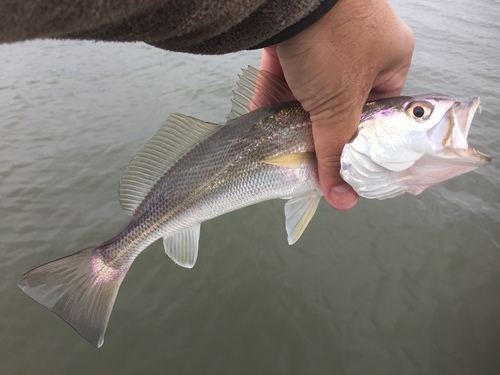
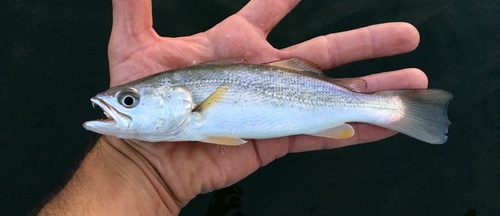
Umbrina canariensis, formally named Umbrina canariensis Valenciennes, 1843, has a short, deeply compressed body, a small downward-facing mouth, and a short rigid barbel on its chin. Its caudal fin has straight edges, and may sometimes show a slight S-shape. Most of its scales are ctenoid; only the scales on the snout and around the eye are cycloid. Its body color ranges from greyish-silver to dark, with dark longitudinal lines along the back and upper sides. These lines often extend onto the head, and become less distinct as the fish matures. The distal portions of its fins are dark grey to black, while the membranes along the rear edge of its gill covers are dark brown. This species normally reaches 40 cm in standard length, and can grow up to 63 cm in standard length; the maximum recorded total length is 80 cm. Umbrina canariensis is distributed in the western Mediterranean, ranging as far east as the Sicilian Channel, and in the northeastern Atlantic as far south as the Canary Islands. It is found along most of the western African coastline from Gibraltar to central Namibia. It is uncommon in northern Namibia, and absent off southern Namibia and the west coast of South Africa, a gap caused by the cold Benguela Upwelling System. In the Western Indian Ocean, it occurs from False Bay in Western Cape to Mozambique, and has also been reported from Pakistan. Umbrina canariensis inhabits continental shelf and upper slope waters at depths between 50 m and 300 m, over substrates of mud and sand. Juvenile individuals are found closer to shore. This species can occur near shore in the surf zone, as well as in waters more than 400 m from shore, and can also be found over rocky bottoms and in reefs below the low water mark.