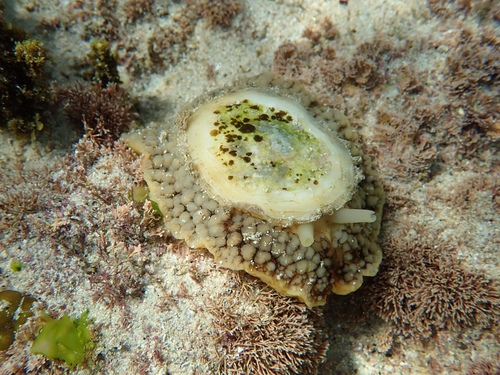
About Umbraculum umbraculum (Lightfoot), 1786
Umbraculum umbraculum is a large mollusc that reaches a maximum length of 20 cm (8 in). It has a relatively small external shell on its dorsal surface; this shell is shaped like a somewhat flattened cone, and is typically encrusted with both plant and animal epiphytic organisms. The mantle has a roughly circular outline, and is covered in pustules. The base colour of the mantle can vary, but is most commonly orange or brownish, while the pustules are usually white. This mollusc does not elongate when it crawls, and the position of its head becomes visible when the animal extends its rolled rhinophores out from beneath the shell. A pair of eyes sits at the base of the rhinophores, and a cleft holding the mouth is located below the eyes. The radula is broad, and lined with many small teeth. At any given time, this species has roughly 10,000 teeth in its mouth, and over its maximum lifespan of up to ten years, it will shed and replace approximately 750,000 teeth. The sole of the foot is smooth and flat, while the bipinnate gills are located on the right side of the body. Umbraculum umbraculum is found in tropical and warm temperate regions of the Pacific Ocean; its known range includes Indonesia, Australia, New Zealand, Hawaii, Mexico, and Panama. It is also present in the Red Sea, the Mediterranean Sea, and the warmer areas of the Atlantic Ocean. In 2016, researchers reported that the species had been observed for the first time in the Bay of Biscay during surveys carried out between 2011 and 2014. This observation appeared to reflect a northward shift in the species' range, a process of tropicalisation that was attributed to rising sea temperatures. It can be found in shallow water, and occurs at depths down to approximately 275 m (900 ft). Umbraculum umbraculum feeds on sponges, and its natural colouring often provides effective camouflage. It rasps the surface of host sponges with its radula, widening the basal cleft to allow it to press its mouth against the sponge surface. It has been recorded feeding on Tethya spp., Aaptos aaptos, Ancorina alata and Plakina trilopha. This species lays its eggs in a long, coiled ribbon, and its larvae are planktonic.

