About Umbonia crassicornis Amyot & Serville, 1843
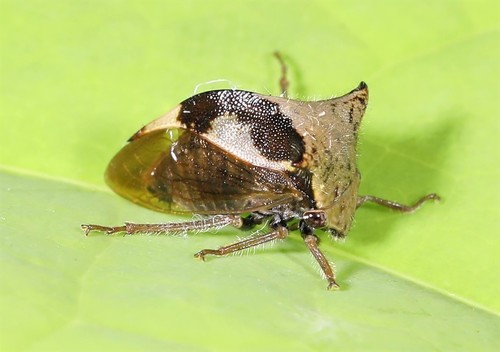
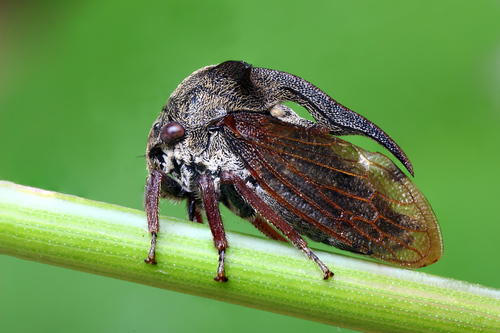
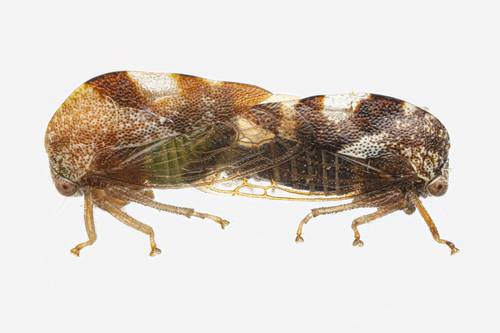
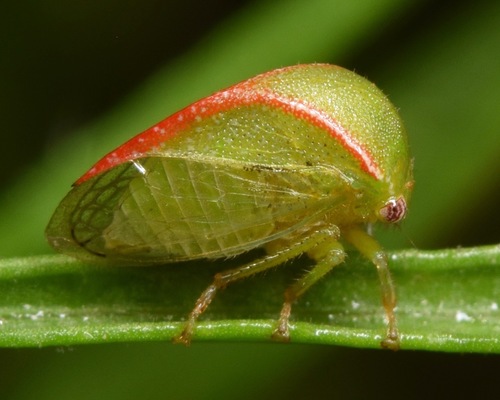
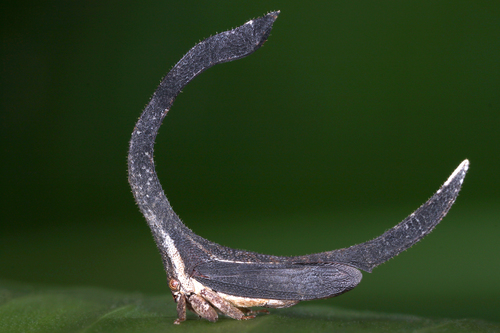
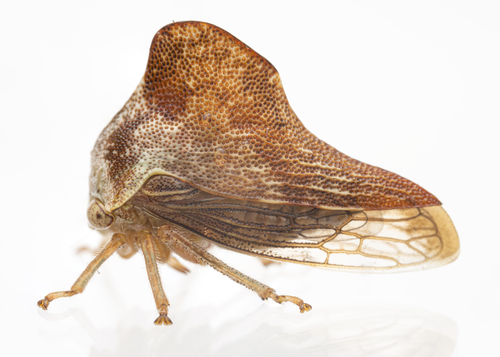
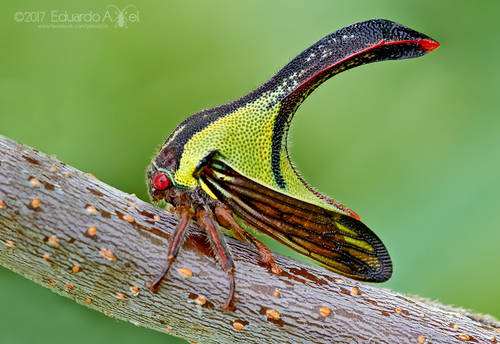
Umbonia crassicornis, commonly known as the thorn bug, is a widespread member of the insect family Membracidae, and an occasional pest of ornamental and fruit trees in southern Florida. Adult thorn bugs have an approximate body length of 10 millimetres (0.39 in). This species shows considerable variation in size, color, and physical structure, particularly in the pronotal horn of males. The male pronotal horn angles more posteriorly than the female's, and is often somewhat expanded at its tip. The tall, nearly perpendicular thorn-like pronotum discourages birds and other predators from eating it, largely by causing predators to mistakenly confuse it with an actual plant thorn. Adult thorn bugs are typically green or yellow, with reddish lines and brownish markings. This species is restricted to warmer climates where average temperatures stay above zero; this limits its range from the tropical regions of northern South America north to Mexico and Florida, USA. Any temperature below 0 degrees Celsius is fatal to this species, and population levels decrease by 10 to 90 percent as temperatures drop below freezing. Its preferred hosts are ornamental and fruit trees in subtropical regions, and it feeds on sap inside these plants. Female Umbonia crassicornis typically deposit around 100 eggs at a time into a plant stem, under the bark. Occasionally, females will lay their eggs in a leaf petiole, even though leaf petioles are sometimes shed. Females choose their brooding site based on whether they can wrap their legs around the branch, which is typically around 3.8 mm in diameter. The mother thorn bug stays with her clutch of eggs until the nymphs reach maturity. If no adult female is present during nymph development, the clutch survival rate drops from 53% to 27%. If the defending female of a clutch dies, the clutch may be adopted by a nearby female, and the two clutches merge into one, though the survival rate of the adopted clutch decreases significantly. A clutch normally consists entirely of full siblings, because females usually only mate once. Siblings are more likely to defend each other due to this close genetic relatedness. A downside of a large group of closely related young developing together is an increased risk of inbreeding once the individuals reach reproductive maturity. When inbreeding occurs, the survival rate of the resulting offspring drops significantly due to harmful mutations from mating with a close sibling.