About Umbilicaria torrefacta (Lightf.) Schrad.
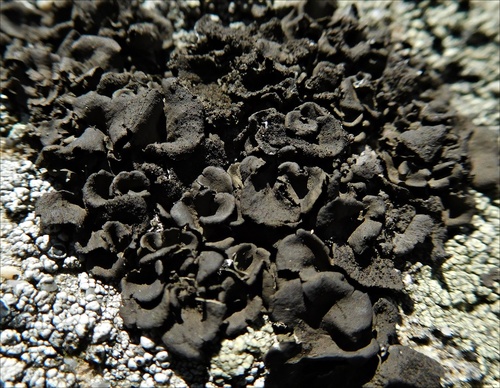
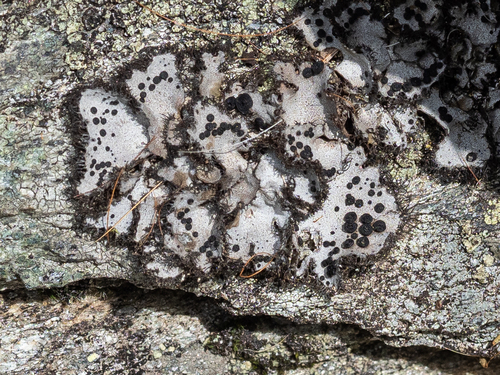
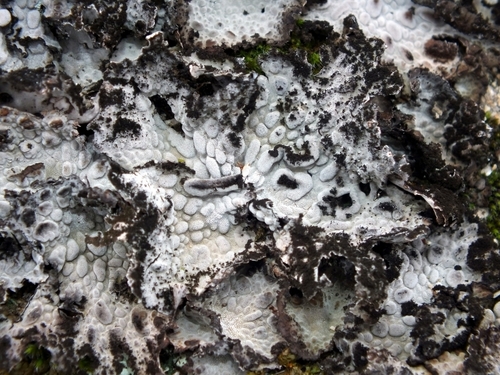
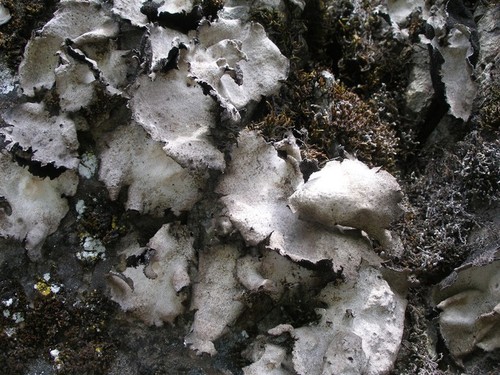
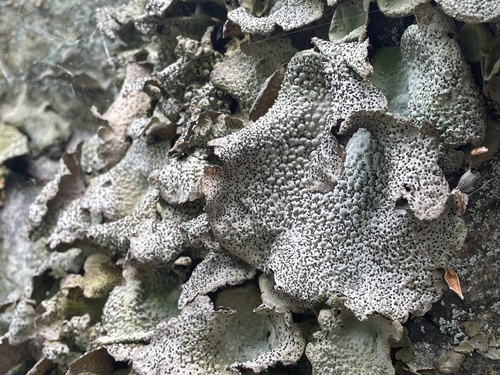
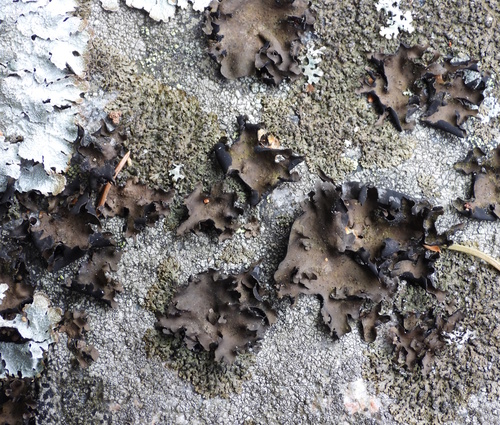
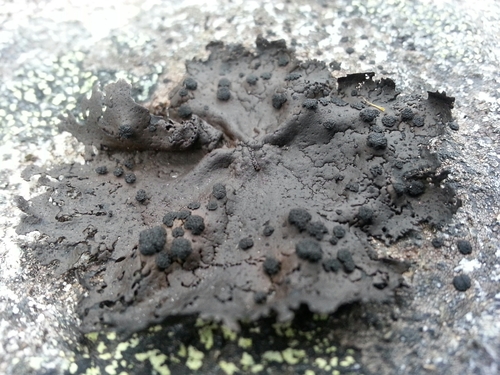
Umbilicaria torrefacta (Lightf.) Schrad. is a lichen with a single-lobed thallus that measures 2 to 6 cm (3⁄4 to 2+3⁄8 inches) in diameter. Its thalli are monophyllous, meaning they attach to their growing substrate at just one single attachment point called an umbilicus. The thallus is often crumpled, with finely dissected edges and small perforating holes that create a lace-like appearance; these holes may sometimes extend toward the center of the thallus. The upper surface of the thallus ranges in colour from brown to dark brown, and can be either smooth or have a cracked, wart-like texture. McCune and Geiser compare the surface cracks to "sutures in a skull" and note these cracks are a characteristic feature of the species. The lower surface ranges from pale brown to black, and has irregular, thin, somewhat flattened plate-like structures called trabeculae that are often torn or perforated. While this species does not have rhizines (root-like attachment structures), torn fringes of trabeculae can be misidentified as rhizines. Nineteenth-century authors recorded that the lichen gives off a tea-like odour when rewetted. Fruiting bodies called apothecia are common in this species, and measure 0.5 to 2 mm in diameter. They sit slightly immersed in depressions on the thallus, have a twisted, gyrose appearance, and bear black discs. The paraphyses, sterile filaments located among the spores, are unbranched with brown tips. The ascospores, spores produced inside the fruiting bodies, are colourless, hyaline (translucent), ellipsoid in shape, and lack internal dividing septa (partitions). Two different sets of spore measurements have been published in scientific literature: a European source reports spores 7 to 16.5 μm long by 5 to 10 μm wide, while a North American source reports spores 8 to 12 μm long by 4 to 6 μm wide. Asexual reproductive spores called thalloconidia are absent in this species. In anatomical studies, the thallus of U. torrefacta shows substantial variability in the thickness of its layers. For example, the algal layer ranges from 25 to 65 μm thick, and the medulla ranges between 40 and 105 μm thick. The upper cortex is typically 10 to 25 μm thick, while the lower cortex ranges from 15 to 27.5 μm thick. These structural variations help the lichen optimize photosynthesis and maintain hydration under different environmental conditions. The medulla of Umbilicaria torrefacta is classified as the "Ruebeliuna" type. This type is defined by scleroplectenchyma, meaning it is made up of tightly packed hyphae with no preferential growth orientation. Both transverse and radial cross-sections of this medulla look similar, forming an arachnoidal (spider web-like) network of hyphae. The cells in these medullae are even more densely packed than in the "Deusta" medulla type, which results in narrow protoplasts that are difficult to observe at standard light microscope magnifications. Chemical spot testing shows that the medulla, the inner layer of the thallus, has specific reactions: it tests C+ (red) and KC+ (red), which indicates the presence of gyrophoric acid and lecanoric acid. It shows no reaction with K and Pd spot tests. If stictic acid is present, however, the medulla tests K+ (yellow) and Pd+ (orange). Umbilicaria torrefacta occurs in rocky, alpine environments across the Holarctic region, spanning both the Palearctic and Nearctic biogeographical areas. It grows on both open and sheltered rock outcrops. According to Llano's 1950 monograph on the genus Umbilicaria, in North America the species has not been recorded south of the White Mountains of California, and has never been found in South America. It also grows in the splash zone of coastal ecosystems, particularly along the White Sea in Russia. This lichen species occupies a range of coastal habitats, growing on vertical rock faces and in boulder fields. It is occasionally exposed to sea spray, though it tends to prefer more sheltered, less frequently wetted environments than its relative Umbilicaria deusta. In the Nuuk region of southern Greenland, U. torrefacta is typically found on somewhat moist siliceous rocks, and often grows alongside a lichen community that includes Aspicilia berntii, Bellemerea subsorediza, Lecidea lapicida, Miriquidica atrofulva, Miriquidica leucophaea, Miriquidica nigroleprosa, Montanelia disjuncta, Orphniospora moriopsis, and Pseudephebe minuscula. Umbilicaria torrefacta has a growth pattern marked by rapid initial expansion that gradually slows as the thallus approaches its maximum size. A study conducted across a 240-year chronosequence in the foreland of the Hellstugubreen glacier in Jotunheimen National Park, Norway found that the initial growth rate of U. torrefacta is relatively slow compared to other Umbilicaria species, averaging 0.9 mm per year. The maximum thallus diameter observed in the study was 47 mm, with the total growth period extending to approximately 107 years. This growth pattern follows a common trend among alpine lichens, where rapid early growth is followed by a stabilization phase as the lichen reaches maturity. Reproduction in U. torrefacta is closely tied to thallus size. Apothecium production increases as thallus size increases, with the first fertile individuals appearing when the thallus reaches around 8 to 12 mm in diameter. However, U. torrefacta tends to begin reproducing later than some of its close relatives, such as U. hyperborea, which starts reproducing at smaller thallus sizes. Reproductive output continues to increase with thallus size, but this trend is more linear than the exponential reproductive increase seen in U. hyperborea. This indicates a more steady reproductive strategy, likely shaped by the harsh alpine conditions where U. torrefacta grows. Umbilicaria torrefacta has historical importance as a natural dye in the Scottish Highlands. It is commonly grouped as one of the "crotal" lichens, and was traditionally used to dye wool and fabric. Dye made from U. torrefacta produces a range of colours, including purplish-red and greyish-magenta hues, depending on the dyeing process and mordants used. The fermentation method involves soaking the lichen in an ammonia solution for several weeks to produce rich red and purple dyes. These colours were highly valued and often used in traditional Scottish tartans and textiles. The dyeing process using U. torrefacta and similar lichens was a core part of textile traditions in the Scottish Highlands. Lichen dyes were known for their vibrant, long-lasting colours, which were necessary to create the vivid hues seen in traditional Highland dress.