About Umbilicaria muhlenbergii (Ach.) Tuck.
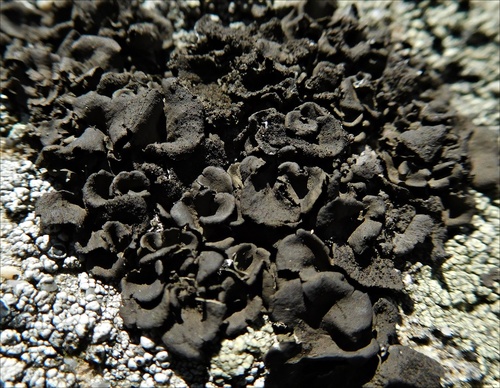
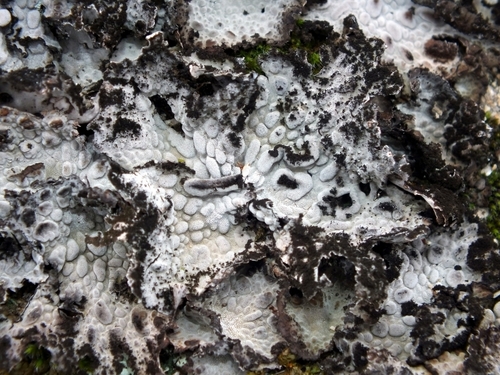
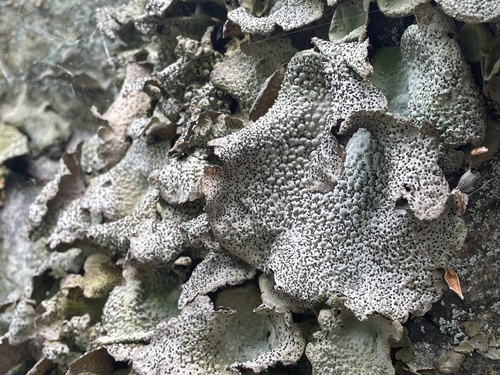
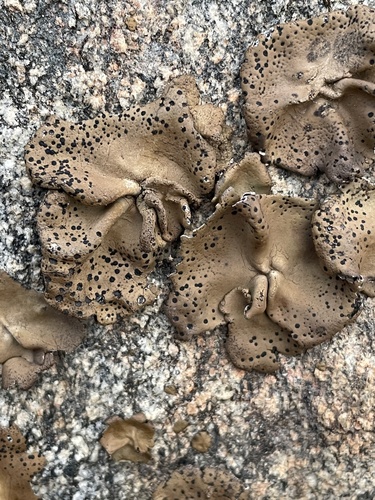
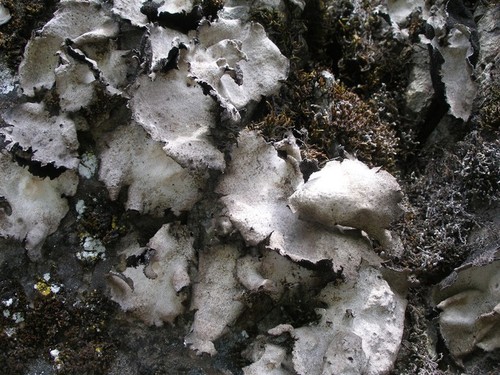
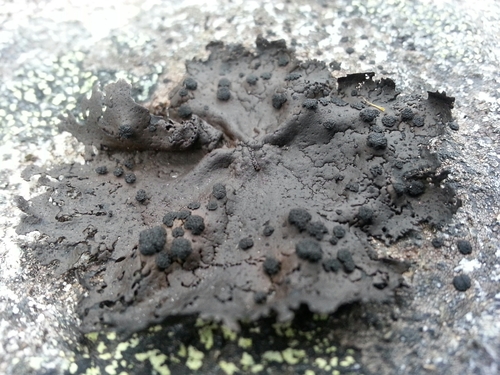
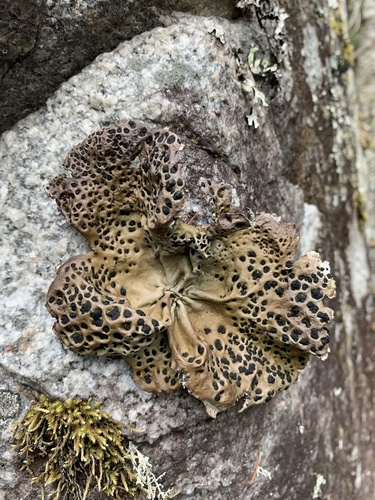
Umbilicaria muhlenbergii (Ach.) Tuck. is a lichen with an umbilicate thallus that ranges from dark brown to greyish-brown in color. It varies greatly in size, consisting of a single folded leaf with a torn margin. Its surface has a satin-like texture, and it is either smooth or covered in small wart-like bumps, a condition called verruculose. The underside of the thallus is dark and shaggy, with an open network that splits into stiff fibrils at the margin; this lichen does not have true rhizines. It produces numerous, relatively large apothecia that sit in pits, each with a black, convex, plicate disk that has finer folds than the apothecia of other Umbilicaria species. Apothecia are common in this species, typically measuring 1–4 mm in diameter. They have branched and radiating ridges, and are partially embedded in the thallus surface. Fine-structure research shows the medulla hyphae of Umbilicaria muhlenbergii have an extrahyphal, gel-like matrix, which differs from multiple other Umbilicaria species. Extensive, sheetlike lamellae are also present in this lichen's lower cortex. Gyrophoric acid is one of several lichen compounds found in this species, and this compound is studied for its potential antitumor and antioxidant activities. Umbilicaria muhlenbergii is widely distributed across eastern United States, and central and eastern Canada. It grows on steep rock walls and boulders. A study of rock-dwelling lichens in a coastal barren of Nova Scotia found that this lichen was most often found on the back faces of boulders, and its abundance increased gradually moving further away from the shoreline. This observation led to the inference that the ocean negatively impacts its growth, although the lichen is thought to have some salt tolerance. The Woodland Cree (Sakāwithiniwak) people of southeastern Saskatchewan historically added pieces of Umbilicaria muhlenbergii to fish broth to turn it into a thick soup. This soup was considered gentle on the stomach, and was used to feed people who were sick.