About Umbilicaria cylindrica (L.) Delise
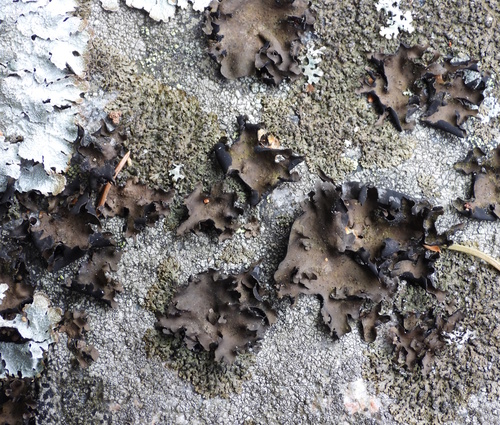
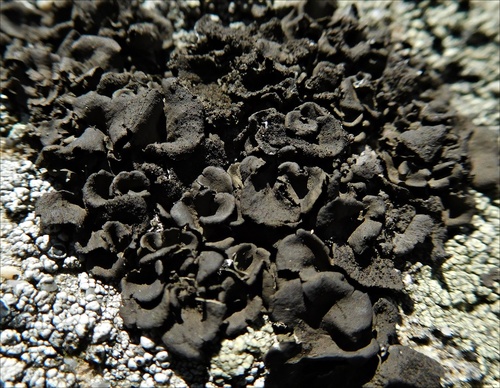
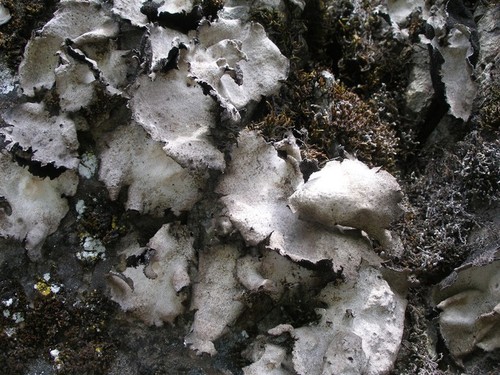
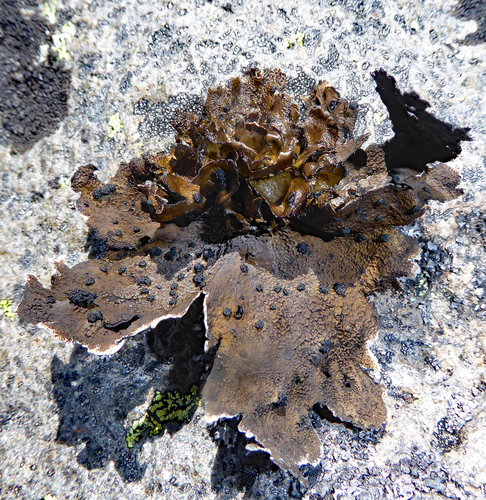
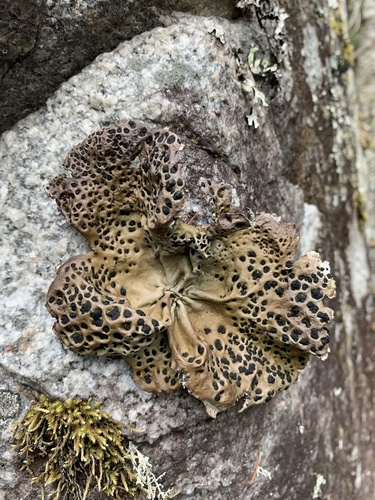
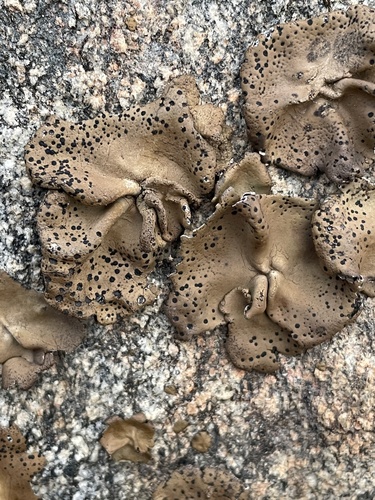
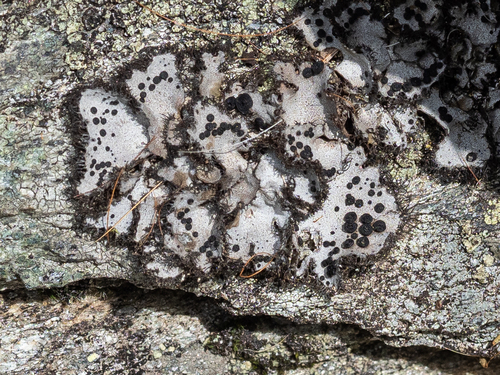
Umbilicaria cylindrica (L.) Delise has a leaf-like thallus that grows 2–10 cm in diameter, though most specimens are smaller than 4 cm across. One specimen originally documented as variety delisei was recorded at 26 cm in diameter. The thallus is made up of multiple lobes, which may be smoothly rounded or irregularly jagged, and sometimes have small holes. The upper surface ranges in color from dark brown to dark grey or black, and may be partly covered with a grey, powdery coating. Its texture can be smooth or slightly rough, with tiny, map-like cracks. Internally, the thallus has a distinctive three-layered medulla (inner tissue): a loosely arranged, web-like (arachnoidal) outer upper layer beneath the algal zone, a dense plectenchymatic central core where fungal threads are tightly packed in parallel, and another web-like lower layer connecting to the bottom surface. This decussata-type medullary structure is characteristic of the species. The structure lets the thallus store a moderate amount of water, with approximately 20% of its volume made up of pore spaces. The species' reproductive structures, called apothecia, are distinctive and numerous. They appear as black, slightly raised discs 0.5–2.0 mm in diameter, rarely reaching up to 4.0 mm. These structures have a gyrose (maze-like) pattern on their surface, are elevated above the thallus on short stalks, and have margins that are either smooth or slightly cracked. Gustav Lindau conducted early studies of this species' apothecia in the late 19th century, documenting that apothecia develop near the centre of the thallus, a few millimetres inward from the marginal pycnidia. He observed that apothecia start developing below the algal layer, where densely packed hyphae form a coiled structure that later grows upward through the thallus layers. Lindau interpreted the emerging hyphal bundles as mechanical boring structures, but other lichenologists of the era, such as Wilhelm Baur, considered them to be early paraphyses. This debate reflected the limited understanding of lichen reproduction at that time. The underside of the lichen is typically beige-brown or pinkish, and occasionally grey, with darker colour near its central attachment point, the umbilicus. The lower surface is smooth in texture, and hosts scattered to densely packed root-like structures called rhizines that match the lower surface's colour. These rhizines are cylindrical and either simple or slightly branched. While generally smooth, older specimens may develop slight cracking patterns near the central umbilicus. One of the most distinctive features of this species is its abundant simple to branched root-like structures called rhizinomorphs, which protrude from both the upper and lower surfaces, particularly along the edges. These dark, glossy projections are 1–4 mm long and usually branch into multiple segments. They start flat where they attach to the lichen body, before becoming cylindrical and tapering to a point, and sometimes develop small knob-like growths. When reproducing sexually, U. cylindrica produces simple elliptical spores that measure 12–18 by 5–9 micrometres (μm). It can also reproduce asexually through smaller, rod-shaped structures called conidia that measure 3–4 by 0.5–0.7 μm, though it rarely produces other types of vegetative reproductive structures. Umbilicaria cylindrica is an Arctic–alpine lichen that grows on exposed rocky surfaces in cold, mountainous regions. It prefers siliceous (acidic) rocks such as granite and basalt, and typically grows in the alpine vegetation zone above the treeline. Thalli usually grow on windswept boulders and outcrops that only have brief seasonal snow cover, often near mountaintops. In the Alps, it occurs from subalpine elevations around 1000 m up to the nival zone, with records from as high as 4270 m on the Finsteraarhorn. This lichen tolerates the extreme climatic conditions of high UV exposure, frequent freeze-thaw cycles, and desiccation that are typical of alpine and polar environments. In Greenland, the species has an unusual altitudinal distribution pattern: while it is typically found at high elevations elsewhere, it is scarce in continental highlands and lower coastal areas due to the desiccating effects of frequent Foehn winds. However, it persists at higher coastal altitudes up to 1600 m where these warm, dry winds have less impact. Rather than acting as a pioneer species in these Greenland locations, it functions more as a specialist coloniser of protected ecological niches. Umbilicaria cylindrica has a circumpolar distribution across the Northern Hemisphere and is widespread in arctic and boreal-alpine regions. It has been recorded in North America, Europe, and Asia, where it is very common in alpine areas of these continents. For example, it occurs from northern Scandinavia and Russia's Arctic tundra to the high mountain ranges of central Europe, such as the Alps and Carpathians, and Asia. It is also found at high elevations in the Himalayas. Beyond its primary Holarctic range, U. cylindrica has been reported in temperate parts of the Southern Hemisphere, specifically at high-altitude sites in Tasmania, southeastern Australia, and New Zealand in Australasia. In its alpine habitats, U. cylindrica often grows as part of lichen-dominated communities on bare rock. It acts as a pioneer species on newly exposed substrates such as glacier forefields, helping to initiate soil formation and ecosystem succession on barren rock. Its tolerance for harsh conditions allows it to colonize surfaces that few other organisms can, and mature thalli can persist for decades, slowly expanding and often dominating the microhabitat. On sun-exposed, wind-blasted ridges and plateaus, U. cylindrica frequently grows alongside other hardy lichens (for example, species of Cetraria, Stereocaulon, Rhizocarpon) and bryophytes, though total vegetation cover remains sparse. In Arctic sites, it can be among the most abundant foliose lichens on relatively flat rock surfaces, reaching about 5–8% cover in some lichen communities. Umbilicaria cylindrica is known to host specialized parasitic or commensal lichenicolous fungi that grow on or within its thallus. Several species have been documented growing on U. cylindrica. For example, the fungus Stigmidium gyrophorarum infects the thallus of U. cylindrica, forming tiny black perithecia on its surface. The species also hosts Lichenostigma epiumbilicariae, a lichenicolous fungus that forms distinctive dark superficial hyphal cords on the upper surface of the thallus. While this fungus specifically targets U. cylindrica and other Umbilicaria species, it appears to cause no appreciable damage to the host lichen's tissues, with fungal growth limited to the dead superficial epinecral layer of the upper cortex. Straminella printzenii is a lichenicolous lichen, a lichen that lives on other lichens, known from Europe; its type host is U. cylindrica. On rock surfaces, U. cylindrica competes with other lichens and algae for space and light. Its thick, leathery thallus and tolerance for extreme exposure give it an advantage on open, horizontal surfaces with intense sunlight and wind. In contrast, it is absent from shaded overhangs or vertical cliff faces, where other Umbilicaria species (for example, U. decussata) or orange crustose lichens may dominate. This indicates niche partitioning: U. cylindrica grows on top surfaces and gentle slopes, while certain relatives and competitors occupy steeper or shaded niches. When in direct contact, the slow growth of U. cylindrica means its edges can be overgrown by faster-spreading lichens or mosses, especially if environmental conditions become less extreme. Nonetheless, in its favoured alpine settings with high stress from freeze-thaw cycles and high light, it experiences relatively little competition and can form near-monospecific lichen patches on rock.