About Ulva lactuca L.
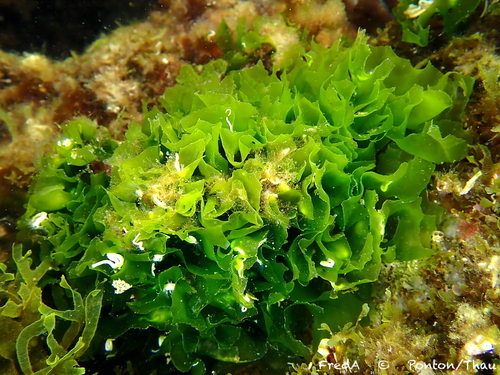
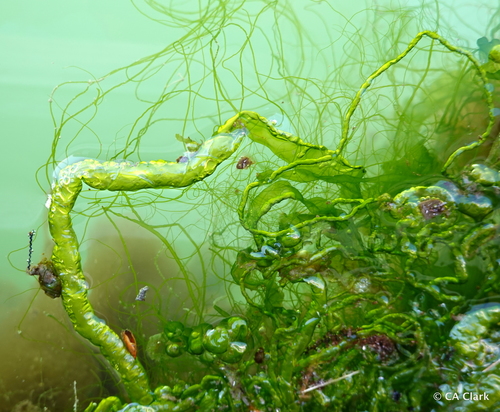
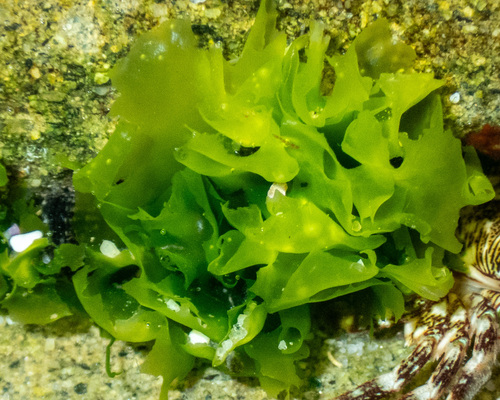
Ulva lactuca L. is a thin flat green alga that grows from a small discoid holdfast. It attaches directly to rocks or other algae without a stipe. Its margin is somewhat ruffled and often torn. It can reach 18 centimetres (7 inches) or more in length, though it is generally much smaller, and can grow up to 30 cm (12 in) across. Its membrane is two cells thick, soft and translucent. This Chlorophyta species is green to dark green in colour, and has two irregularly arranged layers of cells when viewed in cross-section. Sources differ on the shape of its chloroplast: some describe it as cup-shaped, while others describe it as a parietal plate, and it contains one to three pyrenoids. Other similar Ulva species exist, and they are not always easy to distinguish from Ulva lactuca. This alga has a worldwide distribution, including Europe, both the east and west coasts of North America, Central America, the Caribbean Islands, South America, Africa, Indian Ocean Islands, South-west Asia, China, Pacific Islands, Australia and New Zealand. It is very common in the littoral and sublittoral zones of shores around the British Isles, the coast of France, the Low Countries, and up to Denmark. The range of Ulva lactuca L. in the Pacific Northwest extends from Alaska to the Gulf of California. Ulva lactuca grows particularly prolific in areas with abundant nutrients. One example of this is off the coast of Brittany, where high levels of nitrates from local intensive farming wash out to sea. This causes large quantities of U. lactuca to wash up on beaches, and their decay produces methane, hydrogen sulfide, and other gases. Certain environmental conditions can lead the algae to spread over large areas. In August 2009, unprecedented amounts of this algae washed up on beaches in Brittany, France, causing a major public health scare as it decomposed. Rotting thalli produced large volumes of hydrogen sulfide, a toxic gas that, like hydrogen cyanide, inhibits cytochrome c oxidase, blocks cellular respiration and leads to critical cellular hypoxia. Near Saint-Michel-en-Grève, one incident left a horse rider unconscious and killed his horse after they breathed the seaweed fumes. Environmentalists blamed this event on excessive fertilizer use and nitrate excretion from pig and poultry farming. An earlier separate incident occurred at the same beach in July 2009, when a truck driver died near his vehicle after hauling three truckloads of sea lettuce during an annual cleanup without protective gear. His death was initially recorded as a heart attack, but this conclusion prompted French authorities to exhume his remains for an autopsy. It was later determined that he died from cardiac arrest caused by pulmonary edema, which indicates possible hydrogen sulfide poisoning. Environmentalists have claimed that dead animals found on these algae-clogged beaches, including 31 wild boars in July 2011, died from exposure to these toxic fumes. In its life cycle, sporangial and gametangial thalli are morphologically identical. Diploid adult plants produce haploid zoospores through meiosis. These zoospores settle and grow into haploid male and female plants that have a similar appearance to the diploid plants. When these haploid plants release gametes, the gametes unite to form a zygote. The zygote germinates and grows into a new diploid plant. This alga has a variety of documented uses. In Scotland, U. lactuca is used in soups and salads. In Cuba, this sea lettuce is boiled and consumed as a juice. In Hawaiʻi, U. lactuca is called limu pālahala and eaten in multiple preparations: mixed with other algae, salted and served with raw fish, boiled into a soup, or served with chili pepper, onions, soy sauce and sugar. It also has traditional Hawaiian uses as a fertilizer and as an adornment for hula; when used for hula, it is called limu pāpahapaha. As an alternative to vegetable oil crops, U. lactuca can be used as a source of biofuels, and is suitable for transesterification in biodiesel production. It does not require arable land or fertilizers, can grow in saline water and wastewater, and sequesters more atmospheric carbon dioxide than terrestrial energy crops.