About Ulmus rubra Muhl.
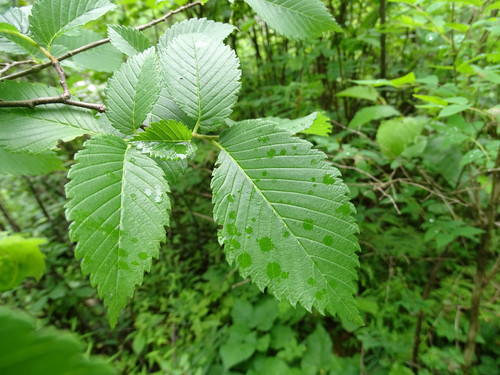
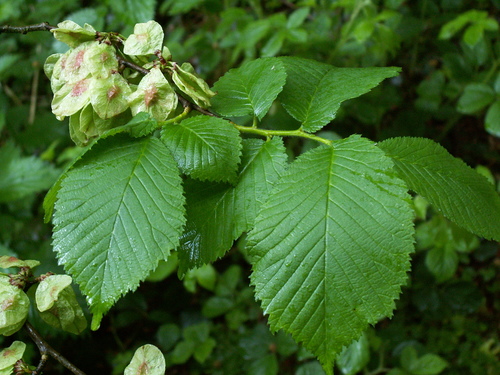
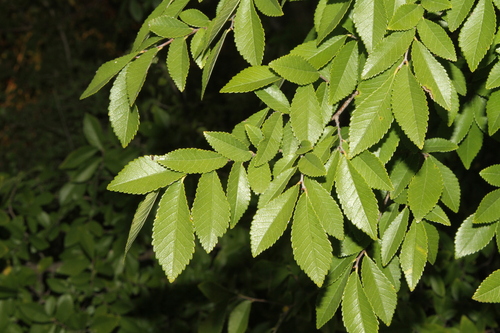
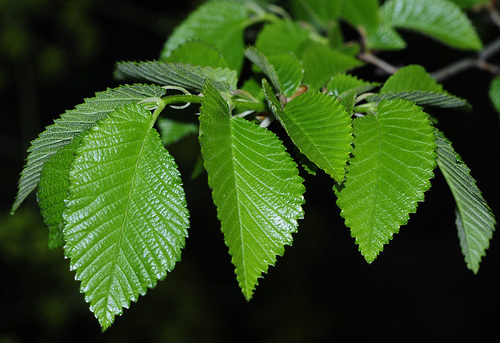
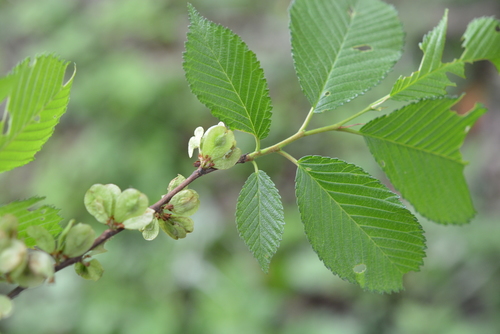
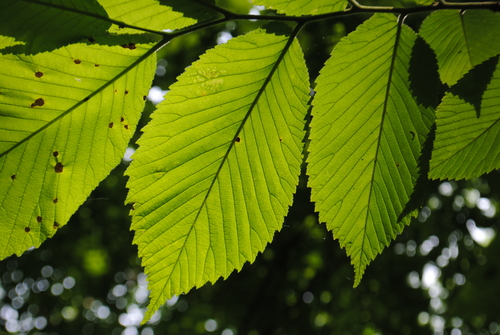
Ulmus rubra is a medium-sized deciduous tree with a spreading branch crown, commonly reaching 12–19 metres (39–62 feet) in height, and very occasionally growing to over 30 m (98 ft). Its heartwood is reddish-brown. Its broad leaves range from oblong to obovate, measuring 10–20 centimetres (4–8 inches) long. Leaves have a rough upper surface and velvety lower surface, with coarse double-serrate margins, acuminate tips, and oblique bases. Leaf petioles are 6–12 millimetres (1⁄4–15⁄32 in) long. Newly emerged leaves are often tinged red, turning dark green by summer and dull yellow in autumn.
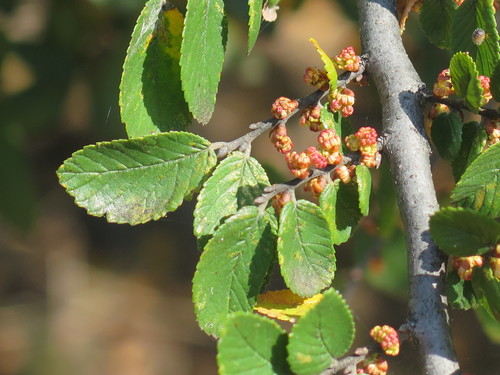
This species produces perfect, apetalous, wind-pollinated flowers in early spring before leaves emerge. Flowers typically grow in tight, short-stalked clusters of 10 to 20. The fruit is a reddish-brown oval winged samara, ranging from orbicular to obovate in shape with a slight notch at the top. Samaras measure 12–18 mm (15⁄32–23⁄32 in) long; the single central seed is coated with red-brown hairs, while the rest of the samara surface is naked.
Ulmus rubra looks superficially similar to American elm (Ulmus americana), but can be clearly distinguished from that species by its downy twigs, chestnut brown or reddish hairy buds, and slimy red inner bark.
This species is native to eastern North America, with a range extending from southeast North Dakota east to Maine and southern Quebec, south to the northernmost part of Florida, and west to eastern Texas. It grows best in moist uplands, but can also grow in dry, intermediate soils.
Ulmus rubra has rarely been planted as an ornamental in its native country, though it occasionally appeared in early 20th-century United States nursery catalogues. It was introduced to Europe in 1830, and later to Australasia. It has never grown well in the United Kingdom; Elwes & Henry did not record any good specimens there, and the last tree planted at Kew only reached 12 m (39 ft) tall over 60 years. In 1902, the Späth nursery of Berlin supplied specimens to the Royal Botanic Garden Edinburgh labeled as U. fulva, and some may still survive in Edinburgh, as the Garden had a practice of distributing trees throughout the city (as with the Wentworth Elm). One specimen held at RBGE was felled around 1990, and the plant does not appear on the Garden’s current list of living accessions. Hillier & Sons nursery of Winchester, Hampshire propagated and sold this tree in the UK from 1945 until production stopped in 1976; 20 trees were sold between 1970 and 1976. Several mature trees still survive in Brighton.
The mucilaginous inner bark of Ulmus rubra is edible raw or boiled, and was eaten by Native Americans. The bark can also be used to make tea. In folk medicine, the inner bark is used orally to treat sore throat and gastrointestinal upset, and applied topically to treat skin rash and irritation. It has long been used as a demulcent, and is still sold commercially as an over-the-counter demulcent in the United States for this purpose. The leaves can be dried and ground into powder, then brewed into tea.