About Ulmus americana L.
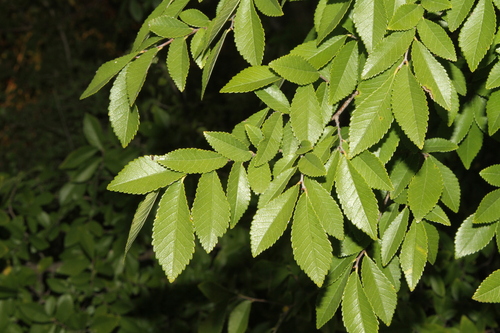
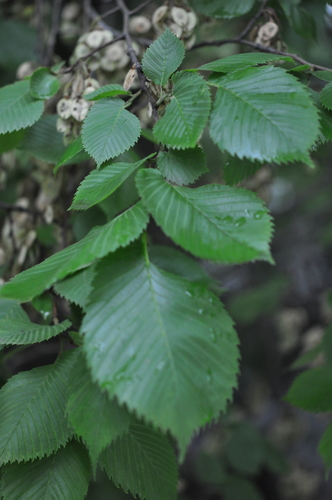
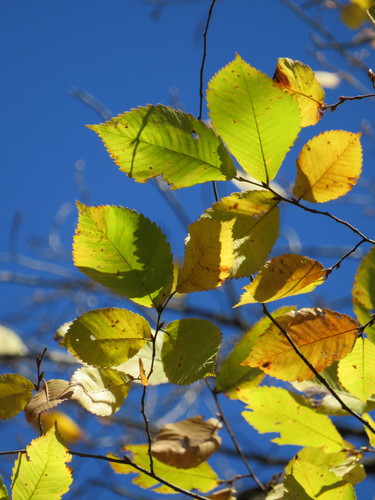
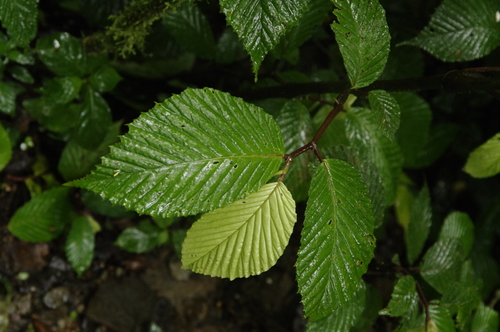
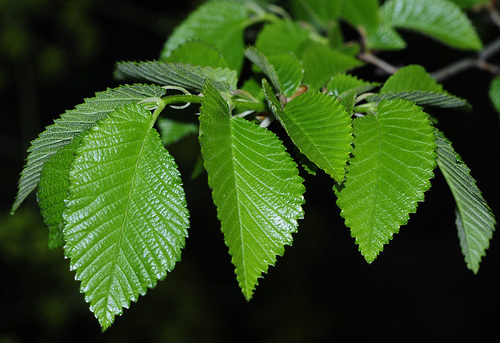
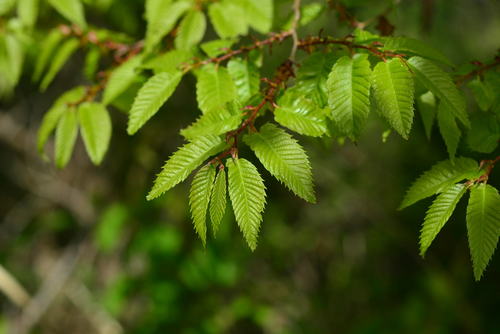
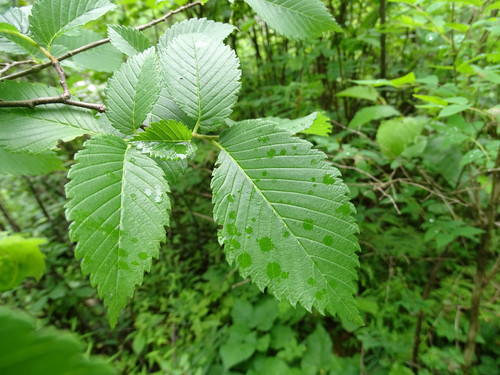
Ulmus americana L., commonly known as American elm, is a deciduous tree. Under ideal growing conditions, it reaches heights of 21 to 35 meters (69 to 115 feet), with a trunk diameter at breast height that can exceed 1.2 m (4 ft). This trunk supports a tall, wide-spreading, umbrella-like canopy. Its leaves are alternate, 7–20 centimeters (3–8 inches) long, with double-serrate margins and an oblique base, and turn yellow in autumn. The tree produces small, purple-brown perfect flowers that are wind-pollinated and apetalous (lacking petals). The flowers are protogynous, meaning female parts mature before male parts; this reduces but does not eliminate self-fertilization. Flowers emerge in early spring before leaves appear. The fruit is a flat samara 2 cm (3⁄4 in) long by 1.5 cm (1⁄2 in) wide, with a circular papery wing surrounding a single 4.5 millimeters (1⁄8 inch) seed. Like its close relative Ulmus laevis (European white elm), American elm bears its flowers and seeds on 1–3 cm (0.39–1.18 in) long stems. American elm is completely insensitive to photoperiod (daylight length), and continues growing well into autumn until frost damages new growth. The typical ploidy for the species is 2n = 56; 2n = 28 occurs much more rarely. For over 80 years, U. americana was classified as a tetraploid (carrying double the usual number of chromosomes), which made it unique within its genus. However, a 2011 study from the United States Department of Agriculture Agricultural Research Service found that around 20% of wild American elms are diploid, and these diploid individuals may even represent a separate species. Additionally, several triploid trees known only in cultivation, such as the cultivar 'Jefferson', have a high level of resistance to Dutch elm disease (DED), which devastated wild American elm populations during the 20th century. This suggests that diploid parent trees, which have noticeably smaller cells than tetraploid American elms, may also be highly resistant to DED. American elm is native to eastern North America, with a natural range extending from Nova Scotia west to Alberta and Montana, and south to Florida and central Texas. It is an extremely hardy tree, able to tolerate winter temperatures as low as −40 °C (−40 °F). The species grows naturally in a wide variety of habitats, most commonly rich bottomlands, floodplains, stream banks, and swampy ground, though it also often grows well on hillsides, uplands, and other well-drained soils. In higher elevation areas such as the Appalachian Mountains, it is most often found growing along rivers. The species produces wind-dispersed seeds, which allow it to spread quickly into newly available suitable habitat. American elm fruits in late spring; fruiting time can range from as early as February to as late as June depending on local climate. Seeds usually germinate immediately with no need for cold stratification, though occasionally some seeds will remain dormant until the following year. The species reaches its maximum growth potential in the Northeastern United States. In the Deep South and Texas, American elms grow much smaller and have shorter lifespans, but their survival rate is higher in these regions because the local climate is less favorable for the spread of DED. In the United States, American elm is a principal species in four major forest cover types: black ash-American elm-red maple; silver maple-American elm; sugarberry-American elm-green ash; and sycamore-sweetgum-American elm. The first two of these cover types also occur in Canada. A sugar maple-ironwood-American elm cover type is found on some hilltops near Témiscaming, Quebec. American elm leaves are a food source for the larvae of many Lepidoptera species. Known feeders include the butterflies Eastern Comma (Polygonia comma), Question Mark (Polygonia interrogationis), Mourning Cloak (Nymphalis antiopa), Painted Lady (Vanessa cardui) and Red-spotted Purple (Limenitis arthemis astyanax), as well as the moths Columbian Silkmoth (Hyalophora columbia) and Banded Tussock Moth (also called Pale Tiger Moth, Halysidota tessellaris). In the 19th and early 20th centuries, American elm was a very common street and park tree, valued for its tolerance of urban conditions, rapid growth, and graceful form. This popularity led to extreme overplanting, especially to create living archways over streets. This overplanting ultimately created an unhealthy monoculture of elms with no resistance to disease and pests. American elms do not naturally form pure stands, and landscaped trees were grown from just a handful of cultivars, resulting in extremely low genetic diversity. Before DED became widespread, the species was popular because its rapid growth and longevity let it reach a large size within decades. Ohio botanist William B. Werthner described the difference between open-grown and forest-grown American elms, noting: "In the open, with an abundance of air and light, the main trunk divides into several leading branches which leave the trunk at a sharp angle and continue to grow upward, gradually diverging, dividing and subdividing into long, flexible branchlets whose ends, at last, float lightly in the air, giving the tree a round, somewhat flattened top of beautifully regular proportions and characteristically fine twiggery." This distinctive growth form is the trait most valued in open-grown American elms used for street plantings, lawns, and parks. When planted on opposite sides of most narrower streets, elms arch outward and blend together to form a leafy canopy over the pavement. Even so, elms can grow to many different sizes and take on different forms depending on their location and climate zone. In 1926, Klehm Nurseries of Arlington Heights, Illinois, observed: "American Elms grown in the regular way from seedlings show extreme variability, growing up into trees of all shapes, some of them being very slow in growth while others are moderately rapid in development. The shapes run all the way from the true open excurrent growth to globular, or flat-topped, or pendant. As regards foliage, the leaves are from small to medium large, some shedding early and others late. This condition makes it difficult for the landscape architect to choose just the right trees to obtain the effect desired." The classic vase-shaped form typical of cultivated American elm was mostly produced by selective breeding of a small number of cultivars, and is much less common in wild individuals. American elms have been planted in North America beyond their natural range as far north as central Alberta, and can survive the low desert heat of Phoenix, Arizona. Introductions of the species to Europe rarely succeeded even before the spread of DED. It was introduced to the United Kingdom by James Gordon in 1752, and was noted to be far more susceptible to insect damage to its foliage than native UK elms. Hillier & Sons nursery of Winchester, Hampshire propagated and sold American elm in the UK from 1945. Between 1962 and 1977, 450 specimens were sold, before production stopped when a more virulent form of Dutch elm disease emerged. As of 2023, some well-grown specimens survive in Finland, including one planted in the 1880s. The species was introduced to Australasia, and was listed for sale by Australian nurseries in the early 20th century. It is known to have been planted along the Avenue of Honour in Ballarat, Victoria, the Avenue of Honour in Bacchus Marsh, Victoria, and a heritage-listed planting can be found along Grant Crescent in Griffith, Australian Capital Territory. American elms are only rarely found in New Zealand. Young American elm twigs and branchlets have tough, fibrous bark that has been used as tying and binding material. It has also been used to make rope swings for children, and to make whips.