About Udotea flabellum (J.Ellis & Sol.) M.A.Howe
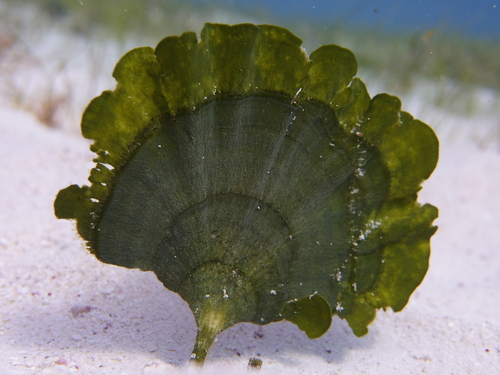
Udotea flabellum, commonly nicknamed mermaid's fan algae, is a species of green macroalgae. It anchors to the seabed through rhizoids, which are root-like structures that form a holdfast, and can attach to substrates of sand or mud. Its main body, the thallus, grows in a characteristic fan shape, and is most often lobed. The lobes are thick, leathery, and moderately calcified. While this alga lacks true stems, leaves, roots, and a vascular system, it does have a stem-like structure called a stipe, which is also frequently calcified. Members of the Udotea genus occur in tropical to subtropical regions. Udotea flabellum has been recorded in waters off North America, Atlantic islands, Mexico, the Caribbean, South America, Africa, the Indian Ocean, Australia, New Zealand, and Asia. It commonly grows in coral reefs, sandy coastlines, and seagrass beds, and can be found at depths of up to 23 meters. Because both its thallus and stipe are calcified, dead Udotea flabellum enriches sediment nutrients and contributes to sediment formation, which supports the continued growth of local reefs. This species forms a base of reef food webs. As a photosynthetic organism, it carries out primary production, the process of synthesizing organic compounds, mostly carbohydrates, from carbon dioxide, and acts as a food source for marine herbivores.