About Tyto tenebricosa (Gould, 1845)
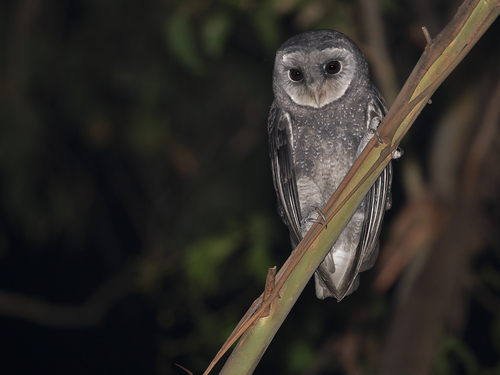
Tyto tenebricosa, commonly known as the greater sooty owl, has a finely white-spotted head, with scattered white spots also present on its wings. Females of this species are lighter in color than males. Greater sooty owls appear to be the heaviest living species in the barn owl family, though the Tasmanian subspecies of the Australian masked owl is larger. Females measure 41 to 50 cm (16 to 20 in) in length and weigh 750 to 1,200 g (1.65 to 2.65 lb). The smaller males measure 37 to 43 cm (15 to 17 in) in length and weigh 500 to 700 g (1.1 to 1.5 lb). Wing length ranges from 30 to 40 cm. Large dark eyes are set in a large round facial disk. The facial disk is dark gray-silver or sooty black, and its color changes with age; it also has a heavy black edge. The upper body of the greater sooty owl is black to dark gray, while the underbody is lighter. It has a short tail, feathered legs, and large feet and talons. Its call is a piercing shriek that can last up to two seconds. Greater sooty owls are nocturnal. During daylight hours, they roost in large tree hollows, caves, and dense foliage. They are rarely seen or heard, and occupy areas with deep gullies in moist forests, where smooth-barked gum trees, tree ferns, and wet forest understorey are present. They may hunt in drier areas, but usually roost and breed in moister areas. Greater sooty owls nest in large hollow trees or caves. The female roosts in the nest for several weeks before laying one or two dull white eggs. Nesting usually begins between January and June, but can occur at almost any time of year depending on location and climatic conditions. Incubation lasts 42 days. The male brings food to the female, who rarely leaves the nest. Hatchlings are born covered in dull grey down, and are able to fly three months after hatching. Young greater sooty owls remain dependent on their parents for an extended period after fledging. The lifespan of the greater sooty owl is unknown. This species is territorial and sedentary year-round.