About Tyto novaehollandiae (Stephens, 1826)
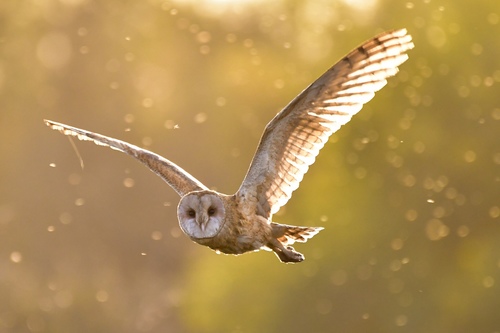
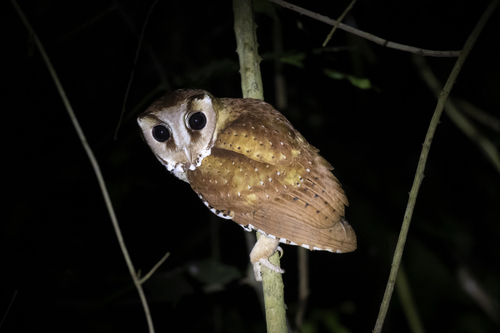
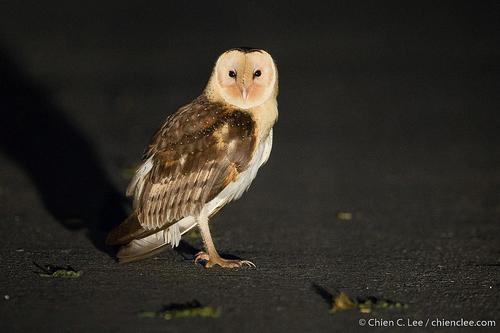
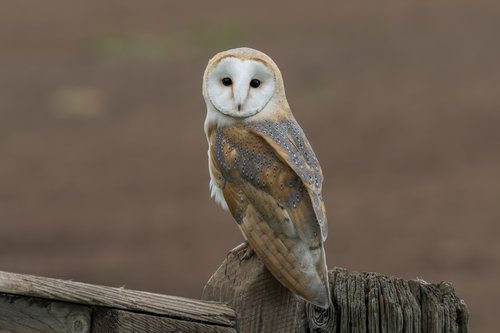
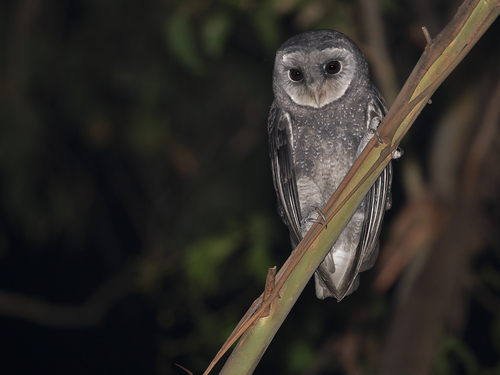
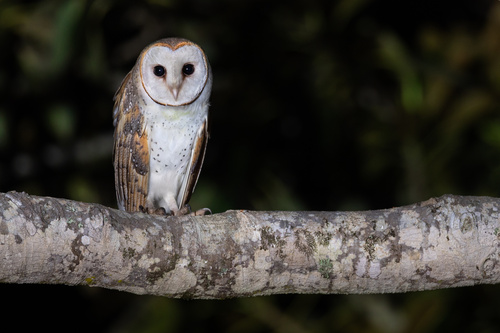
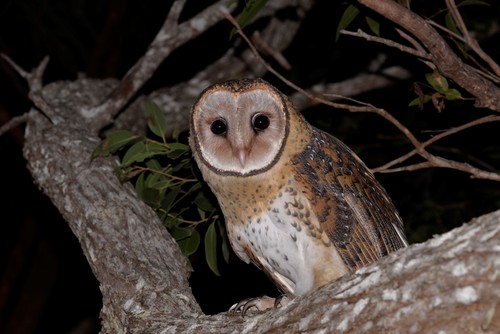
This species, Tyto novaehollandiae, has brown feathers surrounding a white, heart-shaped facial mask. Its dorsal plumage is brown, with light gray spots on the upper back. The underparts are white with brown spots, and eye color ranges from black to dark brown. The species displays sexual dimorphism: females are larger and darker than males. Male body mass ranges from 420 to 800 g (0.93 to 1.76 lb), while females typically weigh 545 to 1,260 g (1.202 to 2.778 lb). Body length is 330 to 410 mm (13 to 16 in) for males, and 390 to 500 mm (15 to 20 in) for females. Southern female masked owls can have a wingspan up to 1,280 mm (50 in). Masked owls follow the typical trend for birds: tropical individuals are much smaller than those from temperate regions. Tasmanian masked owls are the largest in the entire barn-owl family. Among species in the family, only the greater sooty owl is on average heavier than the Australian masked owl, but the Tasmanian subspecies is larger and heavier even than the greater sooty owl. The mean body mass of the nominate subspecies is 476 g (1.049 lb) for males and 630 g (1.39 lb) for females; in Tasmania, mean body mass is 632 g (1.393 lb) for males and 845 g (1.863 lb) for females. The Australian masked owl inhabits timbered areas, often with a shrub understorey. In Australia, they are seldom found more than 300 km inland. They roost and nest in large tree hollows located near foraging areas. This species is nocturnal. Its prey includes rodents, small dasyurids, possums, bandicoots, rabbits, bats, birds, reptiles, and insects. Most foraging targets terrestrial prey, though some prey is captured from trees or while in flight. The mainland Australian population of the Australian masked owl is declining, and the species is included on the Species Conservation Status list in several Australian states. Australian masked owls are territorial, and individuals may remain in the same area once they have established a breeding territory. A 2020 case study using radio telemetry suggested that the home range of these owls could be as large as 19–23 km², but this data remains ambiguous due to a small sample size. The breeding population in Tasmania's Takayna rainforest is threatened by a proposal from MMG Mining Company, 68% owned by China's Minmetals conglomerate, to flood the forest with a tailings dam to dump acidic mineral waste. As of February 2024, the plan is awaiting ministerial approval from Australia's Environmental Minister Tanya Plibersek. Australian masked owls breed when conditions are favorable, which can occur at any time of year. Nests are usually built in hollow trees, lined with soil, mulch, or sand. Some populations are known to use caves or rock crevices for nesting and roosting. The female lays two or three eggs and incubates them, while the male hunts for food. When young owls first develop feathers, they are white or off-white. They can leave the nest at two to three months of age, but return to be fed by their parents for an additional month before becoming independent.