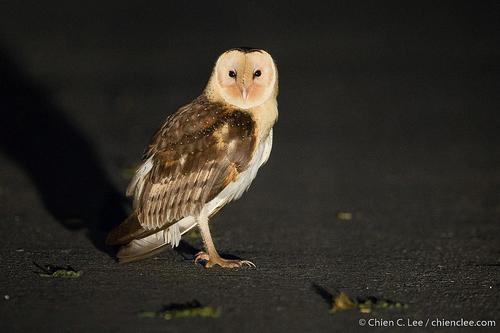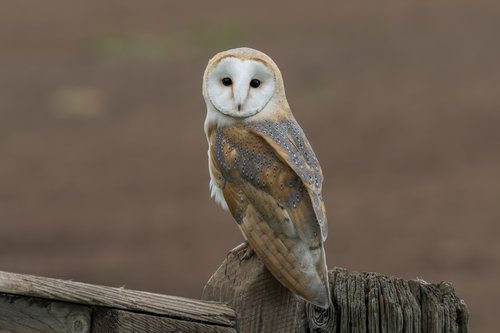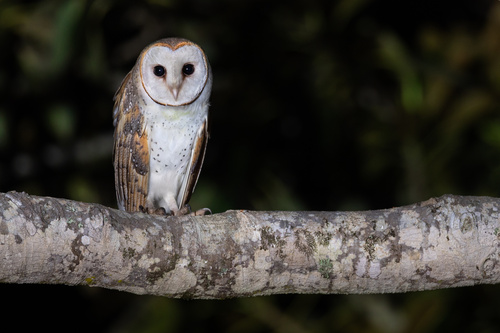
About Tyto javanica (J.F.Gmelin, 1788)
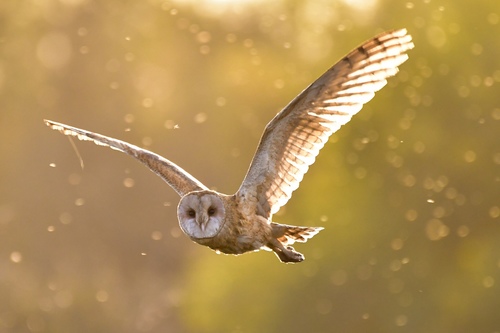
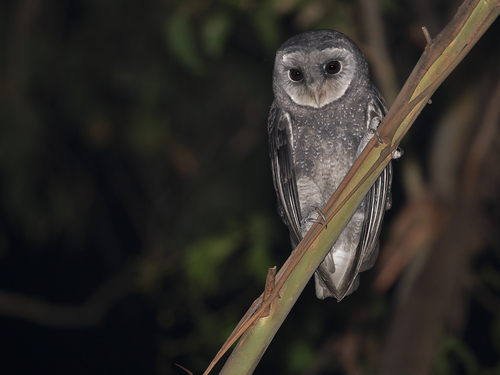
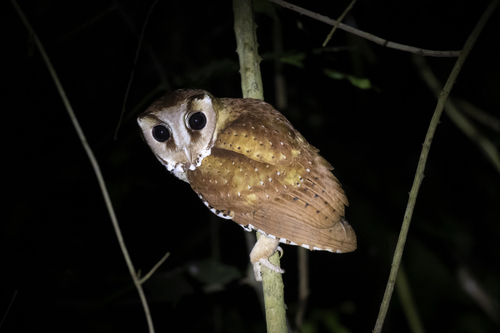
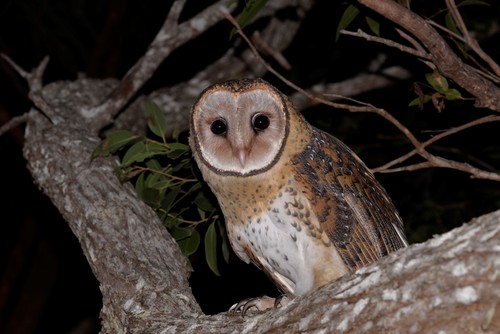
The eastern barn owl, with the scientific name Tyto javanica, is most often treated as a subspecies group. Together with the American barn owl group, the western barn owl group, and sometimes the Andaman masked owl, it forms the genus Tyto. Most taxonomic authorities recognize a single cosmopolitan barn owl species, but a small number of authorities including the International Ornithologists' Union separate these groups into distinct species, which is the treatment followed here. The eastern barn owl is native to southeastern Asia, Australasia, and New Zealand. Across most of its range, the eastern barn owl is nocturnal, but on some Pacific islands, it also hunts during the day. These owls specialize in hunting animals that are on the ground, and nearly all of their diet consists of small mammals. They locate prey using their very acute sense of hearing. Eastern barn owls mate for life unless one member of a pair is killed, at which point a new pair bond may form. Breeding occurs at different times of the year depending on the location. A clutch averages about four eggs, which are laid in a nest built in a tree hollow, an old building, or a fissure in a cliff. The female performs all incubation, and both the female and the young chicks depend on the male to provide food. When large numbers of small prey are easily available, eastern barn owl populations can expand rapidly. König proposed that Tyto alba delicatula should be split off as a separate species called the eastern barn owl, and that this species would include the subspecies T. d. sumbaensis, T. d. meeki, T. d. crassirostris, and T. d. interposita. The eastern barn owl is distributed across the Indian subcontinent, Southeast Asia, Australia, and many Pacific Islands. It is generally considered sedentary; many individuals that have settled in a location stay there even if better foraging areas become available nearby. In Australia, the species undertakes some migration: birds move toward the northern coast in the dry season and southward in the wet season, and also make nomadic movements linked to rodent plagues. Occasionally, eastern barn owls have been recorded on Norfolk Island, Lord Howe Island, or New Zealand, which shows they are capable of crossing oceans. In 2008, eastern barn owls were recorded breeding in New Zealand for the first time. Like most owls, the eastern barn owl is nocturnal, relying on its acute sense of hearing to hunt in complete darkness. It often becomes active shortly before dusk, and can sometimes be seen during the day when moving between roosting sites. On various Pacific Islands, and possibly in other locations, it sometimes hunts during the day. This daytime hunting may depend on whether the owl is mobbed by other birds when it emerges in daylight. The eastern barn owl lives in open country such as farmland or grassland with scattered patches of woodland. It usually occurs at altitudes below 2,000 metres (6,600 ft), but may occasionally be found as high as 3,000 metres (9,800 ft) in the tropics. This owl prefers to hunt along the edges of woods or in rough grass strips adjacent to pasture. It flies with an effortless, wavering pattern as it systematically searches the ground, staying alert for sounds made by potential prey. Like most owls, the eastern barn owl flies silently. Tiny serrations on the leading edges of its flight feathers and a hairlike fringe on the trailing edges break up airflow over the wings, which reduces turbulence and the noise it produces. Hairlike extensions on the feather barbules, which give the plumage a soft texture, also minimize noise created during wingbeats. Researchers can determine the types of prey the eastern barn owl consumes by identifying prey fragments in the indigestible pellets the bird regurgitates. Diet studies have been conducted across most of the species' range. In moist temperate areas, over 90% of prey tends to be small mammals, while in hot, dry, unproductive areas this proportion is lower, and the owl eats a wider variety of other creatures based on local abundance. Most prey is terrestrial, but the eastern barn owl also catches bats, birds, lizards, amphibians, and insects. Even when earthworms are abundant and other prey is scarce, eastern barn owls do not appear to eat them. In the tropics, subtropics, and Australia, mice and rats are the main food source. Eastern barn owls are usually more specialized feeders in productive areas, and generalist feeders in drier areas. Locally superabundant rodent species that weigh several grams per individual usually make up the single largest portion of prey. The eastern barn owl hunts by flying slowly, systematically searching the ground, and hovering over spots that may hide prey. It may also use branches, fence posts, or other elevated lookouts to scan its surroundings; this is the main method of locating prey in the oil palm plantations of Malaysia. The bird has long, broad wings that allow it to manoeuvre and turn abruptly. Its long, slender legs and toes improve its ability to forage among dense foliage or under snow, and give it a wide spread of talons when attacking prey. Studies show that an individual eastern barn owl may eat one or more voles (or the equivalent in other prey) per night, which is equal to about twenty-three percent of the bird's bodyweight. Excess food is often stored at roosting sites to be used when food is scarce. On islands with large numbers of birds, birds may make up fifteen to twenty percent of a barn owl's diet. The eastern barn owl has acute hearing, with asymmetrically placed ears. This arrangement improves detection of the position and distance of sound sources, and the bird does not need sight to hunt. The facial disc plays a role in this process; experiments show that when the ruff feathers are removed, the bird can still locate sound sources in azimuth but cannot do so in elevation. Hunting at night or during twilight, the eastern barn owl can target its prey and dive to the ground, driving its talons through snow, grass, or brush to seize small prey with deadly accuracy. Compared to other owls of similar size, the eastern barn owl has a much higher metabolic rate, so it requires relatively more food. Weight for weight, eastern barn owls consume more rodents—animals often considered pests by humans—than possibly any other creature. This makes the eastern barn owl one of the most economically valuable wild animals for agriculture.