About Tyto furcata (Temminck, 1827)
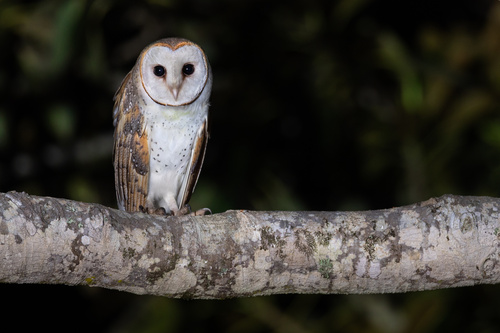
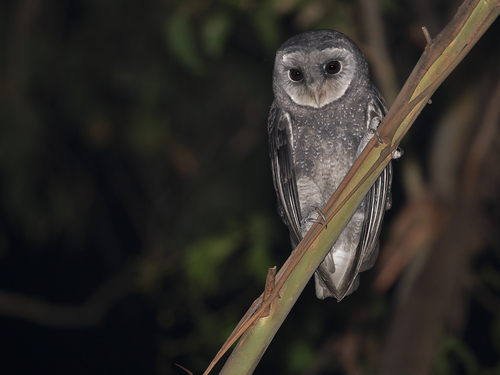
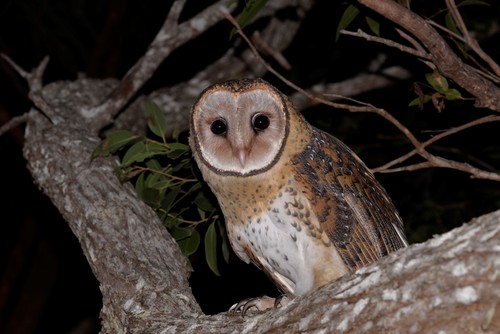
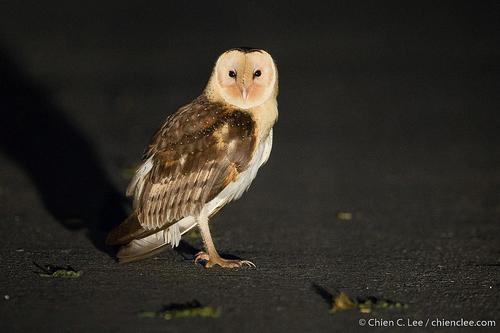
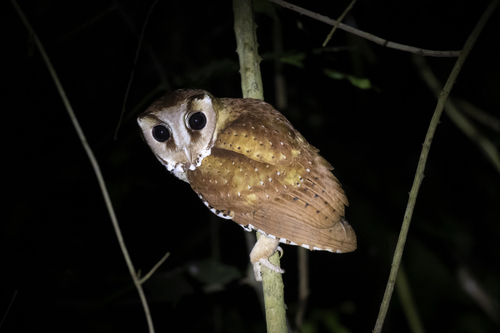
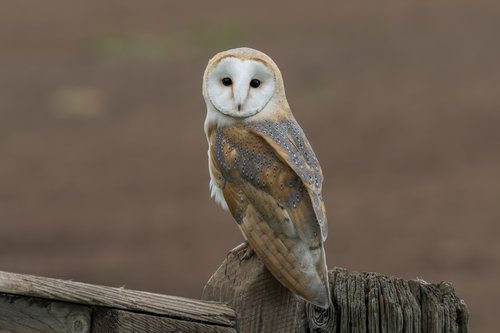
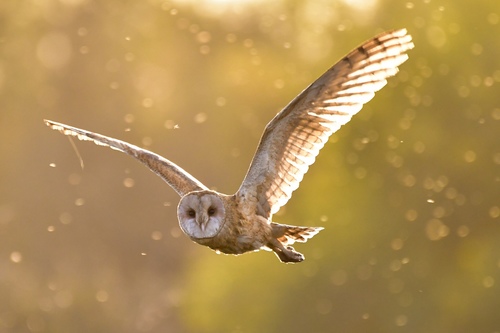
Tyto furcata, the American barn owl, is a medium-sized, pale-colored owl with long wings and a short, squarish tail. The tail shape, undulating flight pattern, and dangling feathered legs distinguish this species from typical owls when seen in flight. It has a distinctive pale, heart-shaped face with black eyes, which looks like a flat mask with large, oblique black eye-slits; the ridge of feathers above its beak somewhat resembles a nose. For most subspecies, the head and upper body typically range between pale brown and a shade of grey, especially on the forehead and back. Some subspecies have a purer, richer brown upper body. All parts of the bird except the main wing and tail feathers (remiges and rectrices) have fine black-and-white speckles; the main wing and tail feathers are light brown with darker bands. The heart-shaped face is usually bright white, but it is brown in some subspecies. The underparts, including the lower leg (tarsometatarsal) feathers, range from white to reddish buff across subspecies. Underparts are either mostly unpatterned, or have a variable number of tiny blackish-brown speckles. Among continental European populations, females with more spotting are healthier than plainer females; this correlation does not hold for European males, where spotting varies by subspecies. The beak color ranges from pale horn to dark buff, matching the general hue of the owl's plumage. The iris is blackish brown. The talon skin ranges in color from pink to dark pinkish-grey, and the talons themselves are black. On average within any single population, males have fewer underside spots and are paler than females. Females are also larger than males; a large female of a large subspecies can weigh over 550 g (19 oz), while males are typically about 10% lighter. Newly hatched nestlings are covered in white down, but the heart-shaped facial disk becomes visible soon after hatching. In the United States, dispersal of this species typically covers distances between 80 and 320 km (50 and 199 mi); the farthest travelling individuals have been recorded 1,760 km (1,094 mi) from their origin point. This species was successfully introduced to the Hawaiian island of Kauai to control rodent populations, but introduced individuals have also been found feeding on native birds. Like most owls, the American barn owl is nocturnal, and relies on its acute sense of hearing to hunt in complete darkness. It often becomes active shortly before dusk, and can sometimes be seen during the day when moving between roosting sites. American barn owls are not particularly territorial, but each individual has a home range where it forages. Female home ranges largely overlap with the home ranges of their mates. Outside of the breeding season, males and females usually roost separately. Each individual has about three favored sites to conceal itself during the day, which are also visited for short periods at night. Roosting sites include tree holes, cliff fissures, disused buildings, chimneys, and haysheds, and are usually smaller than nesting sites. As the breeding season approaches, the birds move back to roost near the chosen nesting site. The American barn owl lives in open country such as farmland or grassland with some scattered woodland. It usually occurs at altitudes below 2,000 metres (6,600 ft), but can occasionally be found as high as 3,000 metres (9,800 ft) in the tropics. This owl prefers to hunt along the edges of woods, or in rough grass strips next to pasture. It has an effortless wavering flight as it quarters the ground, staying alert for sounds made by potential prey. Like most owls, the American barn owl flies silently. Tiny serrations on the leading edges of its flight feathers, and a hairlike fringe on the trailing edges, break up air flow over the wings to reduce turbulence and associated noise. Hairlike extensions on the feather barbules, which give the plumage a soft texture, also minimize noise produced during wingbeats. The largest-bodied subspecies of this barn owl, T. f. furcata, is an island race native to Cuba and Jamaica, two larger islands that support larger prey and have few larger owls competing for food resources.