About Tyto alba (Scopoli, 1769)
The barn owl, with the scientific name Tyto alba (Scopoli, 1769), is a medium-sized pale-coloured owl with long wings and a short, squarish tail. Subspecies vary in size: a typical adult measures 33 to 35 cm (13 to 14 in) in total length, with a wingspan of 80 to 95 cm (31 to 37 in). Adult weight also differs across subspecies: nominate T. a. alba from Italy weighs 240–310 g (8.5–10.9 oz), T. a. guttata in Germany weighs 290–480 g (10–17 oz), and T. a. poensis from South Africa weighs 295–380 g (10.4–13.4 oz). Sexes are broadly similar in weight, with females averaging about 10% heavier than males, though there is considerable overlap. Generally, barn owls living on small islands are smaller and lighter, which may be due to their higher reliance on insect prey and a greater need for maneuverability. Starving or recently dead barn owls weigh 190–240 g (6.7–8.5 oz).
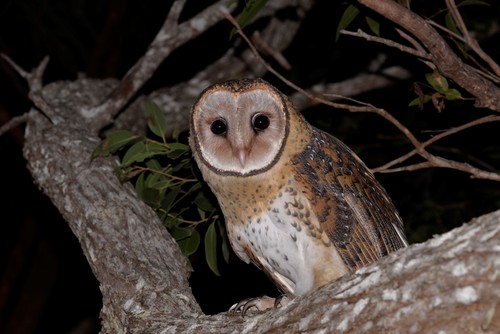
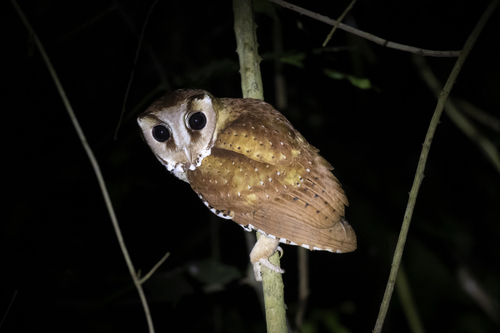
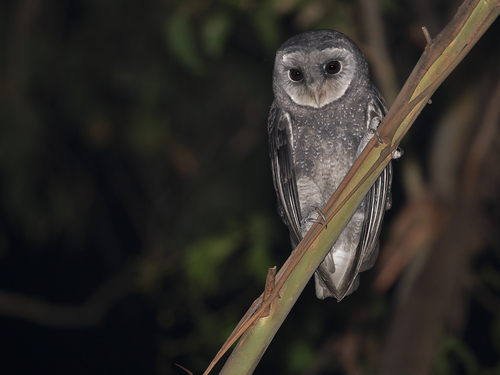
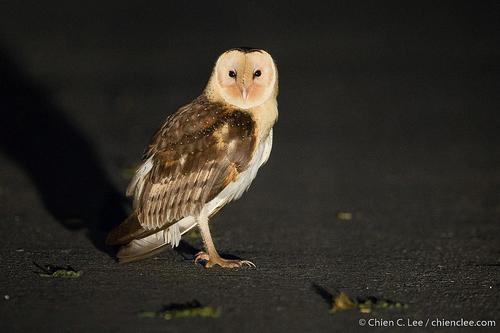
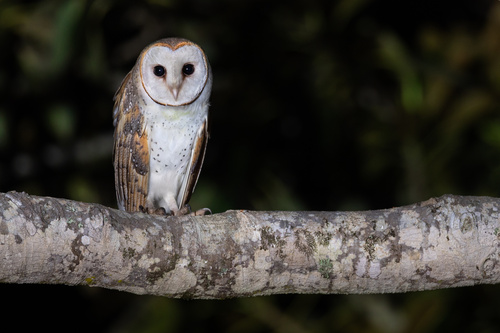
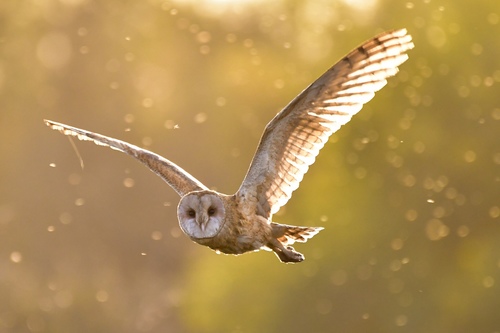
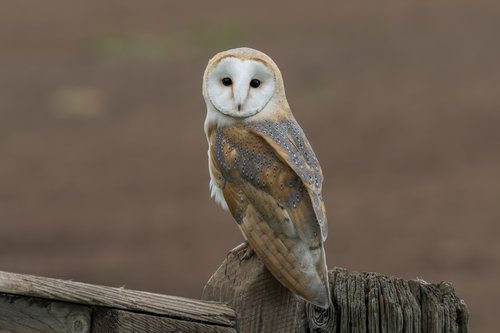
Tail shape distinguishes barn owls from typical owls when seen in flight. Other identifying traits include an undulating flight pattern and dangling, feathered legs. The pale heart-shaped face with black eyes gives the flying bird a distinctive look, like a flat mask with oversized, oblique black eye slits; the ridge of feathers above the bill somewhat resembles a nose. For most subspecies, the head and upper body typically range between pale brown and a shade of grey, especially on the forehead and back; some subspecies are a purer, richer brown. All subspecies have fine black-and-white speckles, except for the main wing feathers (remiges and rectrices), which are light brown with darker bands. The heart-shaped face is usually bright white, but is brown in some subspecies. The underparts, including lower leg (tarsometatarsal) feathers, range from white to reddish buff across subspecies, and are either mostly unpatterned or have a variable number of tiny blackish-brown speckles. In continental European populations, females with more spotting are healthier than plainer females. This does not hold true for European males, where spotting varies by subspecies. The bill ranges from pale horn to dark buff, matching the overall plumage hue, and the iris is blackish brown. Toe colour matches bill variation, ranging from pink to dark pinkish-grey, and talons are black.
Both leucistic and melanistic barn owls have been recorded in the wild and captivity; melanistic individuals occur at an estimated rate of 1 in 100,000 birds. Within any single population, males average fewer underpart spots and are paler in colour than females. Nestlings are covered in white down, but the heart-shaped facial disk becomes visible soon after hatching.
Contrary to popular belief, the barn owl does not hoot (hooting is the call of typical owls like the tawny owl and other Strix genus members). Instead, it produces a characteristic piercing shree scream, an eerie, long-drawn-out shriek. Males give a shrill twitter during courtship. Both young and adult barn owls can hiss like a snake to scare away intruders. Other sounds include a purring chirrup that signals pleasure, and a "kee-yak" that resembles a tawny owl vocalisation. When captured or cornered, the barn owl defends itself by throwing itself on its back and flailing with sharp-taloned feet. It may also produce rasping sounds or clicking snaps in this situation, likely from the bill but possibly from the tongue.
The barn owl's range covers all of Europe except Fennoscandia and Malta, most of Africa outside the Sahara, and southwest Asia east to western Iran. Recorded movement distances are greater in continental Europe, commonly between 50 and 100 kilometres (31 and 62 mi), and exceptionally up to 1,500 km (932 mi), with ringed birds from the Netherlands reaching Spain and Ukraine. Recorded movements in Africa include 1,000 km (621 mi) from Senegambia to Sierra Leone, and up to 579 km (360 mi) within South Africa. Ten geographical subspecies are currently accepted.
Like most owls, the barn owl is crepuscular to nocturnal, and relies on its acute sense of hearing to hunt in complete darkness. It often becomes active shortly before dusk, and may be seen during the day when relocating between roosting sites. In Britain, it sometimes hunts during the day; this practice may depend on whether the owl is mobbed by other birds when it emerges in daylight. Some British barn owls continue to hunt by day even when mobbed by magpies, rooks, and black-headed gulls; this diurnal activity may happen when the previous night was wet or windy, making hunting difficult. By contrast, barn owls in southern Europe and the tropics are almost exclusively nocturnal, and any individuals that hunt by day are severely mobbed.
Barn owls are not particularly territorial, but have a home range where they forage. For male barn owls in Scotland, the home range has a radius of about 1 km (0.6 mi) from the nest site, with an average size of around 300 hectares. Female home ranges largely overlap with those of their mates. Outside the breeding season, males and females usually roost separately, and each individual has around three favoured sites to hide during the day, which are also visited for short periods at night. Roosting sites include tree holes, cliff fissures, disused buildings, chimneys, and haysheds, and are often smaller than nesting sites. As the breeding season approaches, the birds return to roost near the chosen nest site.
The barn owl inhabits open country such as farmland or grassland with some scattered woodland, usually at altitudes below 2,000 metres (6,600 ft), and occasionally as high as 3,000 metres (9,800 ft) in the tropics. It prefers to hunt along the edges of woods or in rough grass strips next to pasture. It flies with an effortless wavering pattern as it crosses the ground, staying alert for sounds made by potential prey. Like most owls, the barn owl flies silently; tiny serrations on the leading edges of its flight feathers and a hairlike fringe on the trailing edges break up air flow over the wings, reducing turbulence and associated noise. Hairlike extensions on the barbules of its feathers, which give the plumage a soft texture, also minimize noise produced during wingbeats. Slight differences in behaviour and ecological preference can occur even between neighbouring subspecies, as seen in European T. a. guttata and T. a. alba, which probably evolved allopatrically in glacial refugia in southeastern Europe, and in Iberia or southern France respectively.