About Tyromyces chioneus (Fr.) P.Karst.
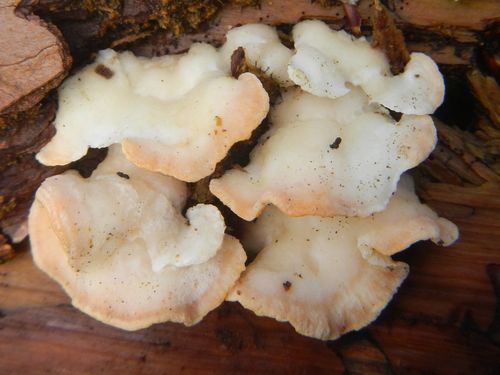
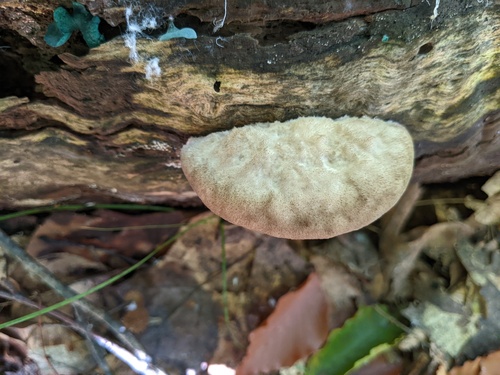
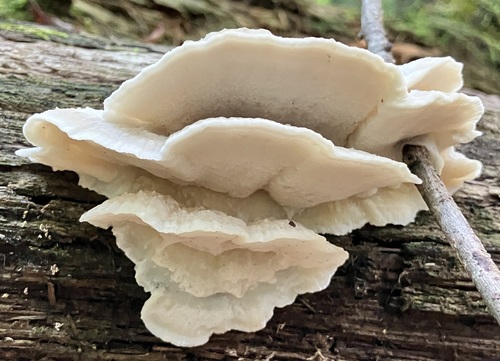
The scientific name of this fungus is Tyromyces chioneus (Fr.) P.Karst. Its fruit bodies are semicircular to fan-shaped brackets, growing up to 8 cm (3 in) deep by 12 cm (5 in) wide, and 0.5–2 cm (1⁄4–3⁄4 in) thick. The upper surface starts white, and yellows or grays as it ages, with a texture that varies from smooth to tomentose. The undersurface has white to cream-colored round to angular pores, with 3–4 pores per millimeter. Young flesh is soft and fleshy, but becomes hard and brittle when aged or dried. It has a mild or indistinct taste and a pleasant odor. This fungus produces a white spore print; its spores are smooth, cylindrical, hyaline (translucent), and measure 4–5 by 1.5–2 μm. The four-spored club-shaped basidia measure 10–15 by 4–5 μm, and have a clamp at their base. The hyphal system is dimitic, made up of both generative and skeletal hyphae. Generative hyphae have clamps and are intricately branched, while skeletal hyphae are thick-walled, rarely branched, and measure 2–4.5 μm in diameter. Cystidia are not present in the hymenium, but fused immature cystidia called cystidioles are found here, measuring 15–20 by 4–5 μm. Tyromyces chioneus causes white rot in dead hardwood trees, and its most common host is birch. It has a circumpolar distribution in temperate boreal pine forests across Asia, Europe, and North America. In Greenland, it is commonly found growing on Betula pubescens. This species is inedible. Laboratory experiments have found that cultures of the fungus contain a sesquiterpene with anti-HIV activity.