About Tyrannus savana Vieillot, 1808
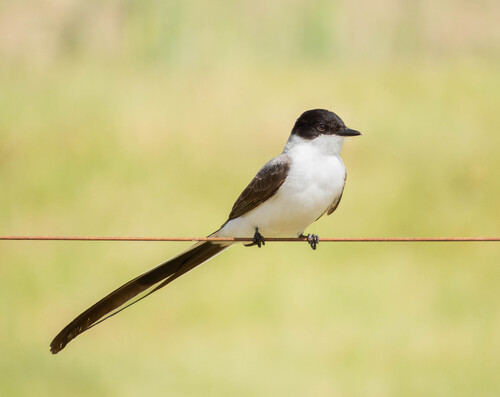
The fork-tailed flycatcher, Tyrannus savana Vieillot, 1808, has white underparts, gray upperparts, and a black cap. Males sometimes show a yellow crown stripe, and also have an extremely long, forked tail that is longer than the tail of the related scissor-tailed flycatcher. Females have a somewhat shorter tail, and juvenile tails are significantly shorter than adult male tails. Including their tails, males measure 37–41 cm (15–16 in) in length, while females measure 28–30 cm (11–12 in). Individuals of this species weigh only 28–32 g (0.99–1.13 oz), which is much less than the weight of closely related kingbirds—even though kingbirds are half the total length of this species. In adult males, the tail is two to three times longer than the length of the bird from its bill to the base of its tail. Overall, males and females of the species look quite similar, but can be told apart by the male’s longer tail. The nominate subspecies T. s. savana has a darker grey back than T. s. monachus and T. s. sanctaemartae, which have pale, light-colored backs that create a strong contrast with their black heads. Distinct notches on the primary feathers are also useful for identifying the species’ different subspecies. Most fork-tailed flycatchers are migratory, but some individuals remain in their range year-round, particularly in southern Mexico. Migratory fork-tailed flycatchers typically have more pointed wings than nonmigratory individuals. Fork-tailed flycatchers are usually found at elevations below 1000 m, occurring in a wide variety of habitats that include pastures, riparian forests, forest edges, mangroves, and open residential areas with scattered trees. During migration, however, T. savana can be found in an even broader range of habitats. The species’ breeding range extends from central Mexico to central Argentina. Across most of this range, the species is present year-round, but it retreats northward to overwinter in the southern parts of its range. During migration, fork-tailed flycatchers are quite gregarious, and nest in flocks that can number up to 10,000 individuals. This species is known to wander widely, and is spotted almost annually along the eastern United States seaboard and in Canada, usually in fall between September and November. During migration, fork-tailed flycatchers have been observed flying alongside related species such as eastern kingbirds, and aggressively chasing away predators. The nominate subspecies T. s. savana occurs in central and southern Brazil, Bolivia, Paraguay, Uruguay, and Argentina, ranging south to the Río Negro. It overwinters in Amazonia, across a large portion of northern South America including the Orinoco River Basin, and in Trinidad and Tobago, and occasionally appears in the West Indies.