About Tyrannopsis sulphurea (Spix, 1825)
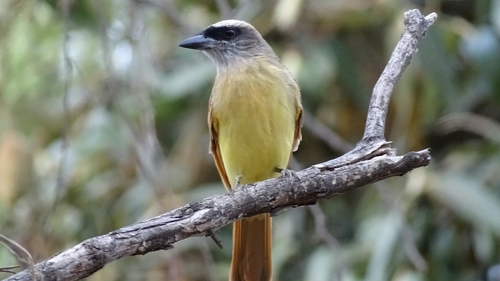
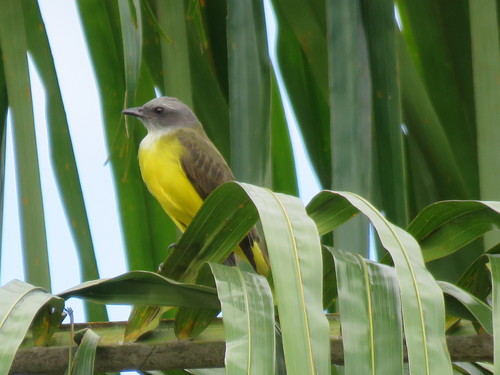
The sulphury flycatcher, Tyrannopsis sulphurea (Spix, 1825), is 19 to 20 cm (7.5 to 7.9 in) long and weighs 48 to 61 g (1.7 to 2.2 oz). Males and females have identical plumage. Adult individuals have a mostly dusky head, with a largely hidden orange-yellow patch at the center of the crown, an unclear whitish supercilium, and a blackish band running from the lores to the ear coverts. Their upperparts and tail are dull olive brown, and their wings are dark brownish dusky. Their throat is whitish, with blurry dark gray streaks along its sides. Their upper breast is white, while the rest of their underparts are bright yellow. The breast has an olive gray wash and olive gray streaks along its sides, and their flanks carry an olivaceous tinge. They have a brown iris, a black bill, and black legs and feet. This species is primarily native to the Amazon Basin, with a range that extends north across the Guiana Shield and includes the offshore island of Trinidad. On the South American mainland, it occurs in eastern Colombia, northeastern Ecuador, eastern Peru, far northern Bolivia, eastern Venezuela, the Guianas, and most of northern Brazil. In Brazil, the southern edge of its range crosses north-central and eastern Rondônia, the northern half of Mato Grosso, western Tocantins, and the northwestern half of Maranhão. The sulphury flycatcher is almost always associated with moriche palms. It inhabits clusters of these palms in swampy forest, particularly areas around oxbow lakes, as well as more scattered moriche palms growing in savanna. It is sometimes also found around isolated moriche palms in cultivated areas and near human habitations. Its maximum elevation range differs across its distribution: from sea level up to 400 m (1,300 ft) in Brazil and 400 m (1,300 ft) in Ecuador, up to 500 m (1,600 ft) in Venezuela, up to 600 m (2,000 ft) in Peru, and up to 1,200 m (3,900 ft) in Colombia.