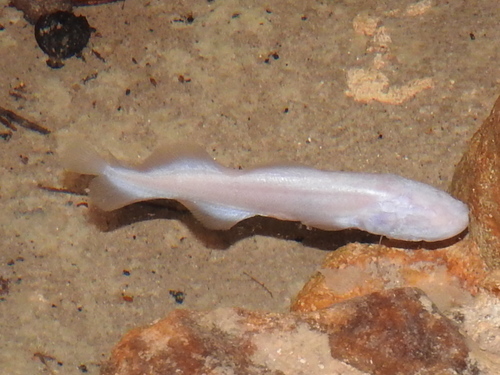
About Typhliasina pearsei (Hubbs, 1938)
The scientific name of this species is Typhliasina pearsei (Hubbs, 1938), commonly known as the Mexican blind brotula. This fish has a large, laterally compressed, scaleless head that lacks eyes. Instead, the head holds several papillae and cavities that contain sensory organs. Its nostrils sit on the upper lip, and the mouth has a longitudinal split at the back. The fish's body is covered in scales, and it has long dorsal and anal fins that end close to the caudal fin but remain separate from it. The dorsal fin has no spines, and between 75 and 87 soft rays. The anal fin also has no spines, with between 59 and 68 soft rays. Males have two pairs of pseudoclaspers, with the inner pair positioned in front of the outer pair. This species reaches a standard length of around 9.7 cm (3.8 in). Its skin has no pigment, giving the fish a pinkish-white appearance. The Mexican blind brotula lives in cenotes (water-filled sinkholes) and aquifers on Mexico's Yucatán Peninsula. Water temperatures in this habitat stay between 23 and 27 °C (73 and 81 °F) year-round. These habitats are typically anchialine, meaning they are connected to the sea, but the Mexican blind brotula has only been recorded from the fresh or brackish water sections of these systems. The Mexican blind brotula is the top predator in the Yucatán aquifer system, and it is likely not abundant. It feeds on crustaceans that live in the aquifers, including shrimps and mysids. In some locations, it lives alongside another blind fish, the blind swamp eel Ophisternon infernale; in one cave system, it associates with the catfish Rhamdia guatemalensis. This species does not react to light, but it is very sensitive to vibrations. It is a viviparous fish, and gives birth to up to twelve young between December and February. Newborn Mexican blind brotulas are yellowish, and measure between 2.4 to 3.7 cm (0.9 to 1.5 in) in length.

