About Typha latifolia L.
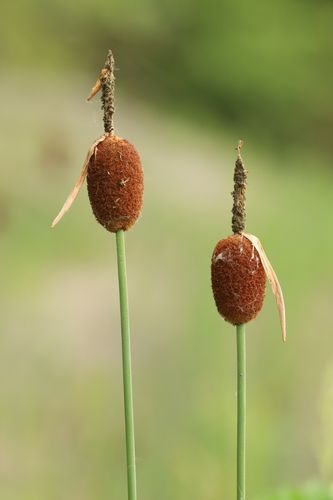
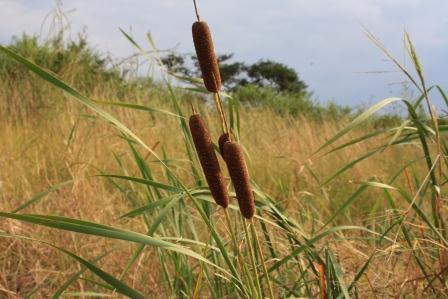
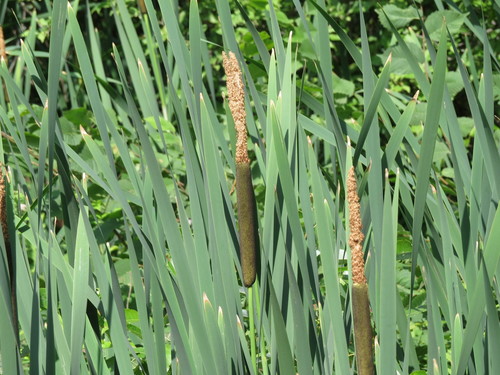
Typha latifolia L. grows between 1.5 and 3 metres (5 to 10 feet) tall, with leaves that are 2–4 centimetres (3⁄4–1+1⁄2 inches) broad. It typically grows in water between 0.75 and 1 metre (2 to 3 feet) deep. Its leaves are deciduous: they emerge in spring and die back in autumn. Flowers form a dense cluster at the top of the main stem, separated into a female section below and a male tassel above. Unlike Typha angustifolia, which has a 3–8 cm gap of bare stem between its male and female flower sections, T. latifolia’s male and female parts are directly connected, making the species easy to distinguish. Flowering occurs from June to July. After flowering, the male portion falls off, and the female portion develops into a fruit head that matures into the well-known brown, sausage-shaped spike. Seed heads remain through the winter, and gradually break apart in spring to release tiny seeds embedded in hairs that aid wind dispersal. T. latifolia is native to a wide range across Eurasia and North America, and occurs more locally in Africa and South America. In Canada, it grows in all provinces, as well as the Yukon and Northwest Territories; in the United States, it is native to every state except Hawaii. It is an introduced, invasive species and classified as a noxious weed in Australia and Hawaii. It has also been recorded in Indonesia, Malaysia, New Zealand, Papua New Guinea, and the Philippines, where it is called Soli-soli. The species grows in a variety of climates, including tropical, subtropical, southern and northern temperate, humid coastal, and dry continental climates, at elevations from sea level up to 2,300 metres (7,500 ft). T. latifolia is an obligate wetland species, meaning it always grows in or near water. It generally grows in flooded areas where water depth does not exceed 0.8 m (2+1⁄2 ft), but has also been recorded growing in floating mats in slightly deeper water. It grows mostly in fresh water, but also occurs in slightly brackish marshes. When salinity drops, T. latifolia can displace species native to salt marshes; it can be considered aggressive under these conditions because it disrupts conservation of salt marsh habitat. T. latifolia shares its range with other related species, and hybridizes with Typha angustifolia (narrow-leaf cattail or lesser bulrush) to form Typha × glauca. It usually grows in shallower water than T. angustifolia. Traditionally, T. latifolia has been used by certain indigenous cultures of British Columbia for food, medicine, and other purposes. Rhizomes are edible after cooking and skin removal, while peeled stems and leaf bases can be eaten raw or cooked. Young flower spikes, young shoots, and sprouts at the end of rootstocks are also edible. Pollen from mature cones can be used as a flavouring, and Native Americans ground starchy rootstalks into meal. It is not recommended to eat plants harvested from polluted water, as T. latifolia absorbs pollutants and is actually used for bioremediation. Plants with a very bitter or spicy taste should not be eaten. In Greece, dried T. latifolia is used for traditional chair making, specifically for the woven seat of chairs. To prepare the material, the plant is collected in summer and left to dry for 40–50 days. In San Francisco, a town on Pacijan Island in the Camotes Islands of Cebu, Philippines, the plant (called Soli-soli locally) is used as a weaving fiber or material to make mats, bags, hats, and other organic accessories and ornaments. Soli-soli weaving is one of the main livelihoods for the townspeople, showcases San Franciscohanon local crafts, and provides an outlet for cultural expression and eco-tourism. The town holds the Soli-soli Festival to celebrate the plant’s abundance and the local weaving industry. This festival is a thanksgiving celebration dedicated to Saint Joseph, the town’s patron saint, held around March 19 (the solemnity of Saint Joseph, Spouse of Mary). Townspeople incorporate the plant into their festival costumes, often wearing outfits made entirely from woven Soli-soli.