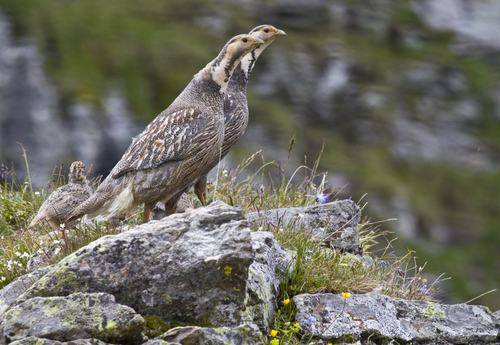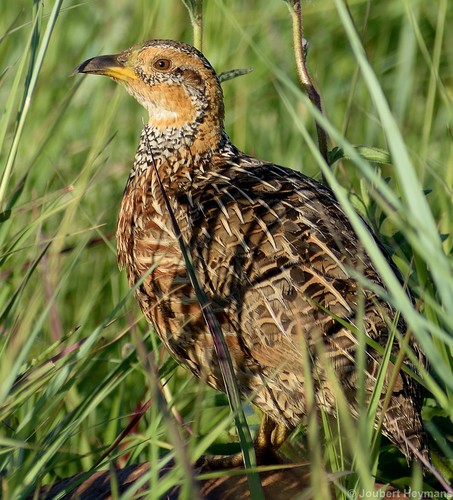
About Tympanuchus phasianellus (Linnaeus, 1758)
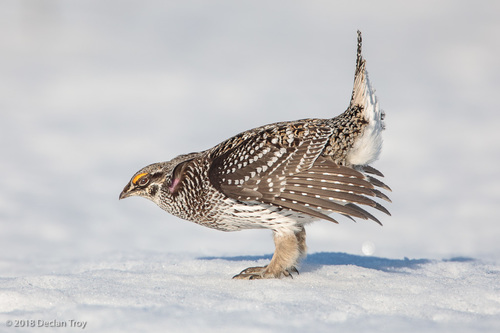
This species has the scientific name Tympanuchus phasianellus (Linnaeus, 1758), and is commonly called the sharp-tailed grouse. Adult sharp-tailed grouse have a relatively short tail; the two central deck feathers are square-tipped and somewhat longer than the lighter outer tail feathers, which gives the species its common name. Their plumage is mottled dark and light brown over a white base color. They are paler on their underparts, with a white belly uniformly covered in faint V-shaped markings. These V-shaped markings separate sharp-tailed grouse from lesser and greater prairie chickens, which have heavy barring on their underparts. Adult males have a yellow comb over each eye and a violet display patch on their neck. This violet neck patch is another feature that distinguishes them from prairie chickens, whose male members have yellow or orange air sacs instead. Females are smaller than males. They can also be told apart by the pattern of their central deck feathers: females have regular horizontal markings across these feathers, while males have irregular markings that run parallel to the feather shaft. Females also typically have less obvious combs. Measured size ranges for the species are: 15.0–19.0 in (38.1–48.3 cm) in length, 21.0–31.0 oz (596–880 g) in weight, and 24.4–25.6 in (62–65 cm) in wingspan. Before European settlement, sharp-tailed grange occupied eight Canadian provinces and 21 U.S. states, ranging north to Alaska, south to California and New Mexico, and east to Quebec, Canada. After European settlement, the species was extirpated from California, Kansas, Illinois, Iowa, Nevada, and New Mexico. Sharp-tailed grouse live in a variety of prairie ecosystems across North America, from the pine savannahs of the eastern upper Midwest to the shortgrass, midgrass, and shrub steppe prairies of the Great Plains and Rocky Mountain West. Specific habitat and vegetation community selection varies between the different subspecies of sharp-tailed grouse, and depends on the quality of available habitat. The main habitats documented for sharp-tailed grouse in scientific literature are savannah-style prairie with dominant grasses, mixed shrub patches, and very few tree patches. Hammerstrom (1963) noted that taller woody vegetation needs to make up a smaller portion of the habitat. This savannah-style habitat is most often preferred from summer through brood rearing and into autumn, but the general habitat type is used year-round for different purposes. Habitat selection and use differs by season, with separate habitats chosen and used for lekking, nesting, brood rearing, and winter. A lek, or dancing ground, is usually made of short, relatively flat native vegetation. Other habitat types used for leks include cultivated lands, recent burns, mowed sites, grazed hill tops, and wet meadows. Manske and Barker (1987) recorded sun sedge (Carex inops), needle and thread grass (Hesperostipa comata), and blue grama (Bouteloua gracilis) growing on lekking grounds in Sheyenne National Grassland, North Dakota. Males also select upland or midland habitat on the tops of ridges or hills for leks. Kirsch et al. (1973) observed leks surrounded by high residual vegetation, and noted that lek distribution was influenced by the amount of tall residual vegetation adjacent to the lek. Lek sites are eventually abandoned if vegetation structure grows too tall. The invasion of woody vegetation and trees into lekking arenas also causes displaying males to abandon leks. Moyles (1981) observed an inverse relationship between male lek attendance and increasing quaking aspen (Populus tremuloides) coverage within 0.8 km of lekking arenas in Alberta parklands. Berger and Baydack (1992) observed a similar pattern with aspen encroachment: 50% (7 out of 14) of leks were abandoned when aspen coverage increased to over 56 percent of the total area within 1 km of the lek. Males choose hilltops, ridges, or any location with a wide field of view for leks, so they can see surrounding displaying males, approaching females, and predators. Nesting cover is one of the most important habitat types needed by sharp-tailed grouse hens. Nesting habitat varies widely between the different subspecies. Hamerstrom Jr. (1939) found that most nests of prairie sharp-tailed grouse (T. p. campestris) were located in dense brush and woods at marsh edges. Gieson and Connelly (1993) reported that Columbian sharp-tailed grouse (T. p. columbianus) select dense shrub stands, with taller, denser shrubs at the nest site. Plains sharp-tailed grouse (T. p. jamesii) select nest sites with dense residual vegetation and a shrubby component. Regardless of subspecies, most nest sites are characterized by dense tall residual vegetation (the previous year’s growth), with woody vegetation present either at or near the nest site. Goddard et al. (2009) note that the use of shrub-dominated habitats has not been documented by many other researchers. They found that sharp-tailed grouse hens in Alberta, Canada prefer shrub steppe habitats for their first nest attempts, because shrubs provide more concealment than residual grass earlier in the breeding season. Roersma (2001) also found that grouse in southern Alberta selected taller, woody vegetation more often than any other assessed habitat, and used this area in greater proportion than its availability. These findings contradict Prose et al. (2002), who states that residual vegetation is critical to sharp-tailed grouse nest success due to the species’ early seasonal nesting behavior. Sharp-tailed grouse are a precocial species, meaning chicks hatch with their eyes open, are self-reliant, and do not need to be fed by their mother. Shortly after hatching, chicks and their mother leave the nest site to search for cover and food. Brood rearing habitats for sharp-tailed grouse have consistent characteristics: shrubby vegetation for concealment, short vegetation nearby for feeding, and a high abundance of forbs. This pattern explains why sharp-tailed grouse nest in or close to shrub communities. The shrub component of brooding habitat provides good canopy protection from direct sunlight and avian predators. Hamerstrom (1963) and Goddard et al. (2009) both observed that the largest number of sharp-tailed grouse broods occur in open rather than wooded landscapes. Both researchers hypothesized that this preference for open landscapes comes from an abundance of insects for chicks and green herbaceous cover for the hen to eat. How broods use habitat depends on time of day, available habitat, and weather. Brood habitats are made up of many complex habitat types. Broods may use shrubby areas or oak grassland savannah-type habitats, which provide cover while keeping the brood close to prime foraging habitats in short vegetation with a mix of native species. In winter, sharp-tailed grouse shift toward denser cover for thermal insulation. Hammerstrom and Hammerstrom (1951) noticed that in Michigan and Wisconsin, grouse use thicker edge habitat more than open ground during winter. They also noted that when birds were found in open habitat, they were no more than a few hundred meters from thicker cover, and were usually using grain fields. Swenson (1985) observed the same trend in Montana. Hammerstrom and Hammerstrom (1951) stated that use of forested habitat by sharp-tailed grouse varies by location: sharp-tailed grouse in more semi-arid and arid areas use brush less frequently in winter. However, they also reported that sharp-tailed grouse in Washington and California were observed using edge-type habitats more frequently during winter. Manske and Barker (1987) noted a similar winter habitat use trend in North Dakota: sharp-tailed grouse join small flocks into larger packs during severe weather, and these packs move from open prairie to shelterbelts, and adjacent croplands with standing corn and sunflowers. Winter habitat use varies greatly with snow depth (Swenson 1985). As snow depth increases, habitat selection shifts from cropland and prairie to shelterbelts and woody vegetation. Hamerstrom and Hamerstrom (1951) observed that grouse will select large snow banks to burrow into to stay warm during cold nights; the use of snow burrows was also reported by Gratson (1988). Habitat fragmentation has been one of the factors driving population decline for all subspecies of sharp-tailed grouse across their entire range in North America. The causes of habitat fragmentation include ecological succession, where shrub and grassland areas transition into forested areas, as well as fire suppression, tree plantings, limited logging practices, and increasing invasive woody species. The largest contributor to habitat fragmentation for this species is agriculture. The 1862 Homestead Act opened large expanses of unoccupied western prairie to early settlers. By 1905, around 41 million hectares of western land had been homesteaded, much of which was semi-arid rangeland with too little precipitation to support crop production. Plowing this land permanently altered the landscape. Another contributor to habitat fragmentation is unmonitored, excessive cattle grazing. When properly managed, cattle can be a useful tool to maintain appropriate habitat structure for sharp-tailed grouse (Evens 1968), but before cattle grazers understood the environmental impacts of overgrazing, early settlement overgrazing severely damaged sharp-tailed grouse habitat. A secondary effect of early agriculture came during the Dust Bowl and Great Depression of the late 1920s and early 1930s, when homesteaders abandoned unproductive land. The United States government purchased much of this land through the Land Utilization Program, and management eventually passed to the United States Forest Service and the Bureau of Land Management. During the 1930s drought, these agencies re-vegetated some of this land with non-native, highly competitive vegetation such as smooth brome (Bromus inermis) and crested wheatgrass (Agropyron cristatum). These plants successfully re-vegetated and protected soil, but became strong competitors that displaced native vegetation. In some cases, crested wheatgrass and smooth brome completely outcompete native vegetation to form monoculture habitats. Sharp-tailed grouse do not favor monoculture habitats, as they prefer sites with high heterogeneity. Hamerstrom (1939) wrote that "More important than the individual cover plants is the fact that most of the nests of all species were in cover mixtures rather than pure stands." Before 1950, research on sharp-tailed grouse habitat assessment was done visually. Hamerstrom (1939) reported that sparse vegetation was seldom selected for nesting due to lack of adequate cover. Early habitat generalizations were formed based on how many individuals were found at a given location, with the assumption that if more birds were present at one location than another, the first location was better habitat. Hamerstrom (1963) observed 119 out of 207 (57%) grouse broods using savannah-style habitat, and concluded that this habitat type was the best for management. As research on grouse habitat improved, assessment techniques also advanced. Cover boards and Robel poles were developed to measure visual obstruction (VO) and create habitat indices. Cover boards were first developed as early as 1938 by Wight (1938) to study white-tailed deer habitat. Wight’s cover board was 6 feet tall, marked and numbered every foot; visible marks were counted to measure plant obstruction. Kobriger (1965) developed a 4×4-foot board marked at 3-inch intervals with alternating white and black squares. He placed a camera 3 feet high in the center of the breeding ground, placed the cover board 30 feet away, and took photographs of the board. After collecting all photographs, he analyzed them with a hand lens to count the number of visible squares, which gave him a vegetation index for cover classes. This method was modified by Limb et al. (2007). Instead of taking photographs 30 feet away as Kobriger (1965) did, Limb et al. (2007) took photographs of vegetation against a 1×1-meter cover board, with the camera 1 meter high and 4 meters away. These digital photographs were uploaded to Adobe Acrobat and digitized against the 1×1-meter backdrop. Robel et al. (1970) developed a pole, named the Robel pole, to measure vegetation height based on a correlation with vegetation weight. Robel et al. (1970) found that VO measurements taken at 1 m height and 4 m distance from the pole gave a reliable index of vegetation production at a location. Robel et al. (1970) reported that Hamerstrom et al. (1957) stated "Height and density of grass were clearly more important to the prairie chickens than species composition", and this was also believed to hold true for sharp-tailed grouse. These key habitat characteristics can now be assessed effectively and efficiently using the Robel pole, Nudds cover board, and Limb et al. digital photography method.