About Tympanocryptis tetraporophora Lucas & Frost, 1895
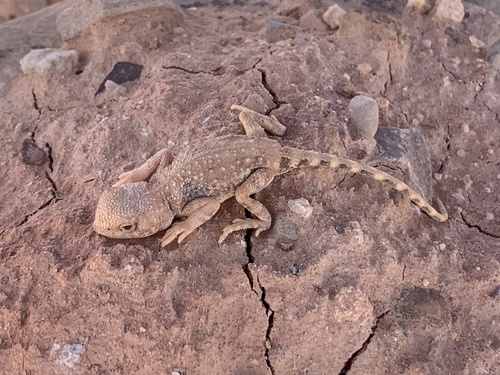
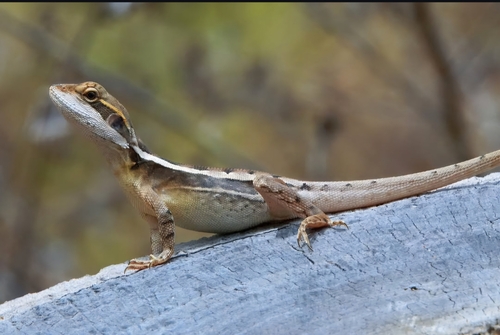
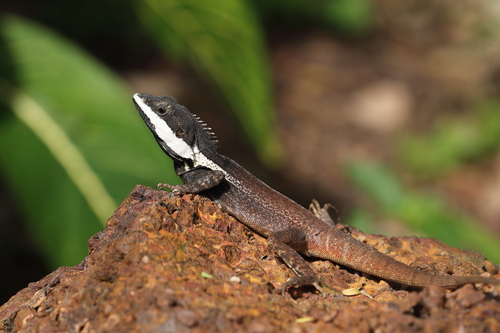
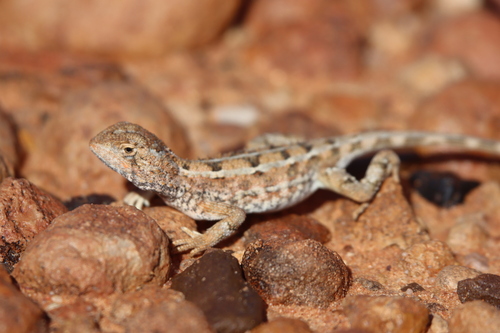
Tympanocryptis tetraporophora is a slender, medium-sized species of Tympanocryptis with a distinct neck and a blunt, rounded snout. Its nostril is positioned closer to the eyes than to the tip of the snout. The limbs are slender and moderately long, and the tail tapers to a rounded tip. This species is defined by the presence of four pores: two preanal pores, and one femoral pore on each side.
Its base colour ranges from red-brown to brown, and its overall body patterning is variable. Most individuals have four to six broken dark cross bands on the body, a faint or indistinct pale ventral stripe, and dark brown bands across the legs and tail. Mature females may have almost no body patterning at all.
The distribution of Tympanocryptis tetraporophora covers a large area, with both continuous and disjunct populations across four Australian states: South Australia, the Northern Territory, New South Wales, and Queensland. Its range overlaps with that of other Tympanocryptis species, including T. cephalus, T. lineata, T. intima, and T. pentalineata. It can be distinguished from T. cephalus, T. lineata, and T. intima by its characteristic four pores, and from T. pentalineata by the absence of five longitudinal body stripes.
Its habitat matches its wide, varied distribution: it occurs across semi-arid to arid regions, including gibber plains, grasslands, and shrublands associated with stony plains and hills. It also hides in cracks on dried river floodplains and overflows. Its extensive range also extends to tropical savannah grasslands in the Gulf region of northern Queensland.
Tympanocryptis tetraporophora is oviparous, meaning it reproduces by laying eggs. Breeding takes place between early spring and mid autumn. Females reach sexual maturity at a mean snout-vent length (SVL) of around 46 mm, while males become sexually active at approximately 42 mm SVL. Mature females range from 46 to 72 mm SVL, with an average of around 58 mm. Clutch size varies between 1 and 14 eggs, and there is a positive association between female body size and the number of eggs laid. As females mature, they gradually lose their stripes and dark blotches, and typically become completely patternless once they reach around 55 mm SVL. Mature males, by contrast, do not lose their stripes or blotches.