About Tympanocryptis intima Mitchell, 1948
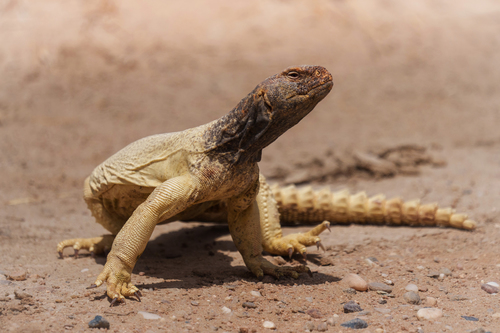
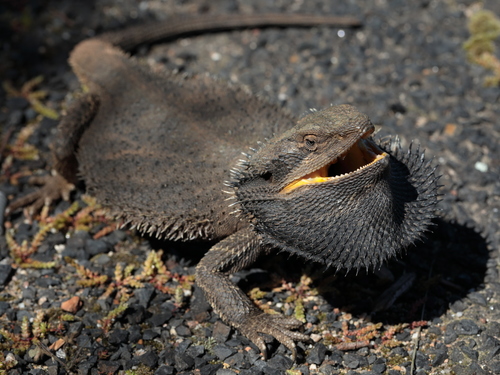
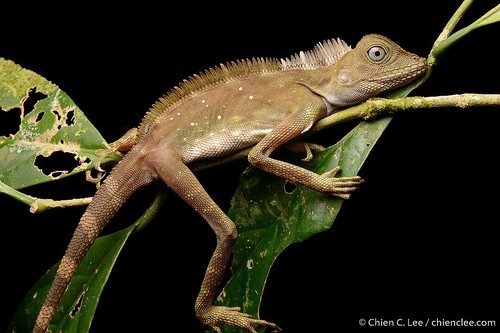
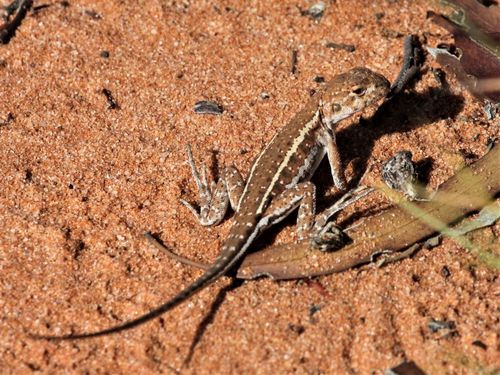
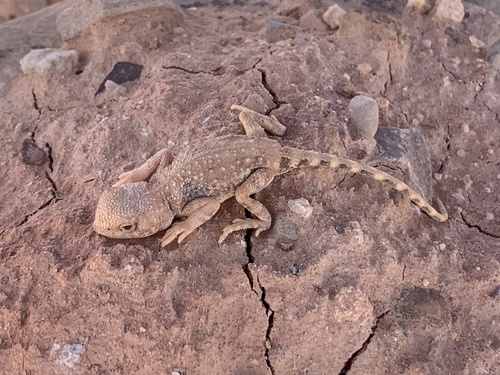
Adults of Tympanocryptis intima (common name Gibber Earless Dragon) have an average snout-vent length of 50mm and an average total body length of 110mm, with one recorded specimen measuring 123mm in total length, 41mm in body length, 16mm in head length, 13mm in head width, and 66mm in tail length. Fore limbs of this specimen measured 25mm, while hind limbs measured 38mm. Individuals of this species range in colour from pale yellowish brown to brick red, and colouration varies by locality. They often have pale banding across the body, darker banding along the length of the tail, and pale grey-brown to bright pale back lateral stripes on either side of the midline, with four darker brown blotches on each side of the midline. There are typically twelve darker bands along the tail, with pale colouration between these darker areas, and a greyish bar on the back of the nape. The head is rounded and longer than it is wide, with mostly smooth or slightly rugose scales. Body scales are less smooth, and are interspersed with larger spinose scales; enlarged spiky tubercles are generally aligned in four longitudinal rows, and are wider than they are long with rounded front edges. The ventral surface ranges from pale-cream to white, and is speckled with dark brown or black spots; males may also have fine brown spots on the throat and chest. This pale ventral colouration allows for greater thermal regulation in extreme temperatures. The species evolved cryptic colouration to avoid detection by predators in its natural habitat. The nostril is oval with an enlarged nasal scale, directed forward and downward between the eye and the tip of the snout, and separated from the labials by 4-6 scales. There are 12-16 smooth or slightly rugose superlabial (head) scales. The neck is narrower than the head, and the body is depressed. The body is covered with small, smooth, slightly overlapping scales, while gular (throat) and ventral scales are smooth. Limbs and tail are short. When the hind limb is adpressed to the shoulder, it has lateral scales and enlarged, sharply pointed tubercles. There are 18 spiny, two-pointed lamellae under the fourth toe, and 10 under the third toe. Preanal pores are present, and usually only occur in males, with one preanal pore on each side. Tympanocryptis intima is endemic to Australia, found within the arid interior of the Eyrean Basin, an inland drainage basin covering 1,200,000 square kilometres. Its distribution covers central north-western South Australia, south-eastern Northern Territory, western Queensland, and a small area of north-western New South Wales. Within this range, it inhabits open gibber deserts, spinifex flats, and shrublands with stony gibber substrate and sparse vegetation. It is restricted to rocky subhabitats, and strongly prefers gibber stone substrates that match its cryptic camouflage. To avoid predators, it presses its body into the gibber substrate, curls its tail to mimic a stone and reduce its shadow, relying on this camouflage instead of fleeing to cover or burrows. While some related lizards are burrowers, T. intima's depressed body form makes it more likely to be a crevice-dweller. Individuals generally stay close to their burrow system, perching on nearby rocks or other structures, and can retreat quickly when they sense danger. It is an active diurnal terrestrial ectotherm, and has an unusually high heat tolerance compared to other species in the Tympanocryptis genus: it can be active and bask in direct sunlight when temperatures reach as high as 43°C, a temperature where most other Tympanocryptis species retreat to burrows or shade. During the warmest summer months, it engages in a specific basking behavior where it props its hind legs up and lifts its body into a vertical position to expose its pale underside to the sun. The pale underside deflects some heat, allowing it to keep its core body temperature lower than the surrounding ambient temperature, helping it adapt to high temperature and arid conditions. This species is oviparous, with internal fertilization: the male uses one of its two hemipenes to penetrate the female's reproductive tract, fertilizing eggs inside the female's oviduct. Females lay a mean clutch size of approximately eight eggs, and clutch size can range from 1 to 14, with clutch size generally dependent on female size. The timing of reproduction can be affected by environmental factors including temperature, rainfall, humidity, and food availability. T. intima is a predator that feeds primarily on insects and other small terrestrial invertebrates. Its diet changes with maturity, seasonal changes, and changes in food availability.